
TII, UAE
Falcon
the Gulf's open flagship
Key facts
- Open weightself-host
- Licence
- Abu DhabiUAE
- Origin
- State-backednational institute
- Backing
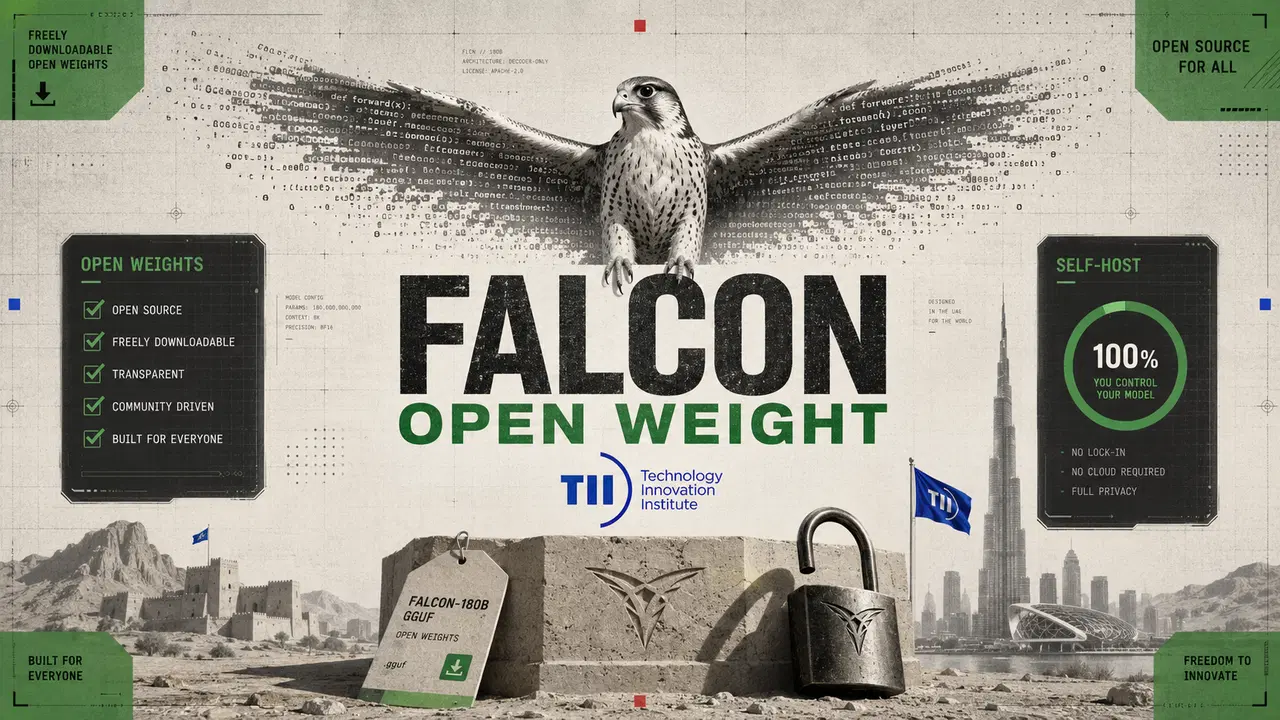
An openly released flagship from Abu Dhabi's Technology Innovation Institute, downloadable and self-hostable.
What it is
Falcon LLM is the family of open language models built by the Technology Innovation Institute, a research institute based in Abu Dhabi. Its significance rests on two things at once: the models are released openly, so anyone can download and run them, and they come from the Gulf rather than from the usual clusters of American and Chinese laboratories. Together those facts make the Falcon LLM series one of the clearest signs that frontier-scale model building is no longer confined to a handful of familiar names.
What open means here
The word “open” is doing a lot of work here, so it is worth being precise about it. An open model is one whose trained weights, the numbers that encode what the model has learned, are published for others to use. That lets developers run the model on their own hardware, inspect how it behaves, fine-tune it for a specific task and build products on top of it without asking a provider for permission or paying for every request. For researchers and companies wary of depending on a closed service they cannot see inside, an open flagship like Falcon is an attractive foundation.
Why the source is a statement
That the Technology Innovation Institute is the source gives the Falcon LLM project a particular weight. A national research institute publishing capable models openly is a statement about who gets to shape the technology. Rather than treating advanced AI as something to import and license, the institute has chosen to build and give away, which spreads capability to any developer willing to use it. For a Gulf state investing heavily in research, an open flagship is also a way to establish credibility in the field quickly, since released models can be examined and tested by anyone, and reputations in open-source AI are earned in public.
Openness cuts both ways, and that is part of why it earns respect. When a lab publishes its weights, it invites the wider community to probe the model’s strengths and expose its weaknesses. There is nowhere to hide a disappointing result behind a polished demo. A UAE AI model that holds up under that scrutiny does more for the institute’s standing than any amount of marketing, and it lets outside developers verify for themselves whether Falcon suits their needs before they commit to it.
Where Falcon sits among open models
The Falcon LLM family belongs to a growing group of open-weight models that give developers an alternative to the closed systems offered by the largest commercial labs. That group is no longer dominated by a single country or company, and Falcon is a prominent reason why. Its presence widens the pool of serious open models and gives builders more than one credible option when they want to run a capable system on their own terms.
What to watch from here is whether Falcon and its peers keep pace with the closed frontier. Open models have repeatedly narrowed the gap to the best proprietary systems, but the leading closed labs continue to push ahead, and staying competitive demands sustained investment in data, compute and talent. A research institute with state backing is well placed to supply that investment, which is one reason the Falcon LLM project is worth following rather than dismissing as a regional curiosity. For readers tracking the balance between open and closed systems across the field, our large language models hub follows how the families compare, and the broader AI section covers the labs and the strategy behind them.
For the current line-up, including the latest models and the exact terms under which they are released, the Technology Innovation Institute’s own Falcon site is the authoritative source, and it is the place to check before relying on any particular detail.
More in Large Language Models
All LLMs →- Google DeepMindGemini 4 Argonlonger reasoning, coding and cyber defence
- OpenAIGPT-5.6the flagship from 9 July to 3 September 2026
- OpenAIGPT-6 Astrathe new generation, rolling out from 3 September 2026
- OpenAIGPT-6.1 Solthe upgraded mid-price GPT-6 model, released 29 September 2026
- OpenAIGPT-6 Sol and Lunathe mid-price and budget GPT-6 models, released 22 September 2026
- AnthropicClaude Opus 5.5the first Claude 5.5 model, cheaper and faster than Opus 5