Gemma 4
the laptop model
Key facts
- 12Blaptop pick
- Parameters
- Open weightrun it yourself
- Licence
- GoogleGemini's open cousins
- Lab
- Jul 2026open-model rankings
- Noted
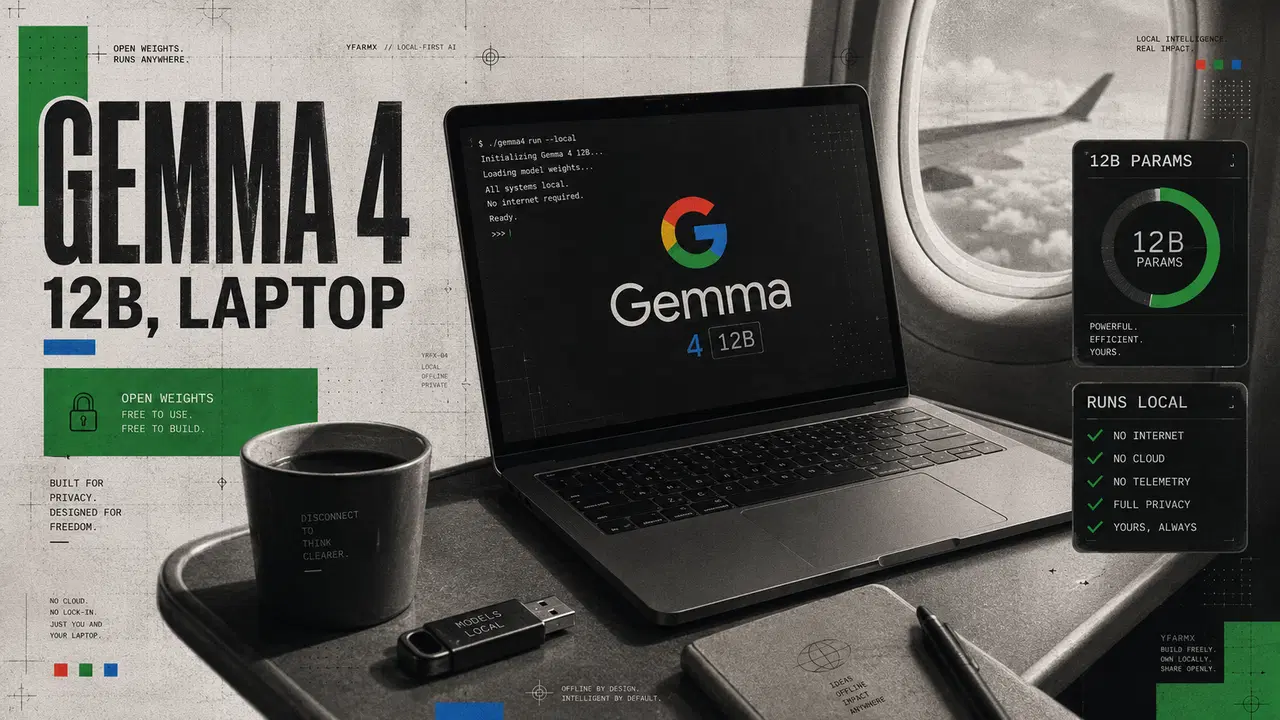
The laptop model. Google's open family; the 12B is called out as the practical laptop pick in July 2026 open-model rankings.
What it is
Gemma 4 is Google’s family of open large language models, the openly released cousins of its proprietary Gemini systems. Its calling card is that it runs on ordinary hardware: in July 2026 open-model rankings, the 12B version of Gemma 4 was singled out as the practical pick for a laptop, the model to reach for when you want capable local AI without a data centre behind it. That laptop-friendliness is the reason Gemma 4 has a following well beyond Google’s own cloud.
Why run a model locally
Running a model locally changes what it is good for. A model such as the 12B Gemma 4, meaning a version with roughly twelve billion parameters, is small enough to load on a well-specified laptop yet large enough to handle real tasks, which opens up uses that a cloud-only model cannot serve as easily. Text never leaves the device, so sensitive documents stay private; there is no per-token bill, so high-volume or experimental use is effectively free once the hardware is bought; and the model keeps working offline, on a train or a plane or behind a corporate firewall. For developers, a dependable local model is also the fastest way to prototype before committing to a larger hosted system. It also puts a genuine tool in the hands of people who cannot, or would rather not, send their data to a third party, from clinicians and lawyers to researchers working with confidential material.
What 12B means
The “12B” in the recommendation is doing real work. Parameter count is a rough proxy for both capability and appetite for memory, and twelve billion has become a sweet spot for consumer machines: big enough to be genuinely useful, small enough to fit within the memory of a modern laptop once compressed. Compression here refers to quantisation, the standard technique of storing a model’s numbers at lower precision so that it occupies less memory and runs on cheaper hardware, usually with only a modest loss of quality. A 12B model quantised in this way can sit comfortably on a laptop with enough spare memory, which is what makes the recommendation practical rather than theoretical. That Gemma 4 at this size was the one called out in mid-2026 rankings suggests Google has tuned the family well for the constraints of local hardware, which is exactly where an open model earns its keep.
A note on the specifics
A note of caution is in order on the specifics. Beyond the 12B version and its standing in July 2026 rankings, the precise release date and the full set of sizes in the Gemma 4 line should be confirmed against Google’s own documentation rather than assumed, since these details move and this page favours accuracy over guesswork. What can be said with confidence is the positioning: Gemma 4 is Google’s open, run-it-yourself family, and the 12B is its recommended laptop-class option as of the middle of 2026.
Where it fits and what to watch
That positioning places Gemma 4 in a fast-growing part of the field. As open models improve, the ability to run a capable one on a laptop rather than renting time on someone else’s servers has become a serious option for developers, hobbyists, privacy-conscious organisations and anyone in a low-connectivity setting. The trend has been reinforced by tooling that turns downloading and running these models into a few commands, so that a capable local model is now within reach of non-specialists as well as machine-learning engineers. Google offers Gemma alongside its much larger hosted Gemini models, so buyers can prototype locally on Gemma 4 and scale up to the cloud when a job demands it, all within one broadly compatible ecosystem, with the full details published at ai.google.dev/gemma.
What to watch next is how the rest of the Gemma 4 range fills out and whether smaller variants push capable local AI onto even more modest hardware. For the wider picture of how open and hosted models compare, see our large language models hub and the broader AI section.
More AI
All AI →
Gemma 4 gives Google a cleaner answer to the open-model race
Gemma 4 is Google’s latest push into the open-model market, and the company is pitching it as its most intelligent open family to date.
More in Large Language Models
All LLMs →- Google DeepMindGemini 4 Argonlonger reasoning, coding and cyber defence
- OpenAIGPT-5.6the flagship from 9 July to 3 September 2026
- OpenAIGPT-6 Astrathe new generation, rolling out from 3 September 2026
- OpenAIGPT-6.1 Solthe upgraded mid-price GPT-6 model, released 29 September 2026
- OpenAIGPT-6 Sol and Lunathe mid-price and budget GPT-6 models, released 22 September 2026
- AnthropicClaude Opus 5.5the first Claude 5.5 model, cheaper and faster than Opus 5