
OpenAI
GPT-5.5 "Spud"
recent predecessor, still widely deployed
Key facts
- 23 Apr 2026API 24 Apr
- Released
- 1.05Mtokens
- Context
- $5 / $30in / out per M
- Price
- 82.7%v2.0
- Terminal-Bench
- 51.7%Tiers 1-3
- FrontierMath
- 3Instant/Thinking/Pro
- Variants
Recent predecessor, still widely deployed. Released 23 April 2026 (API 24 April).
What it is
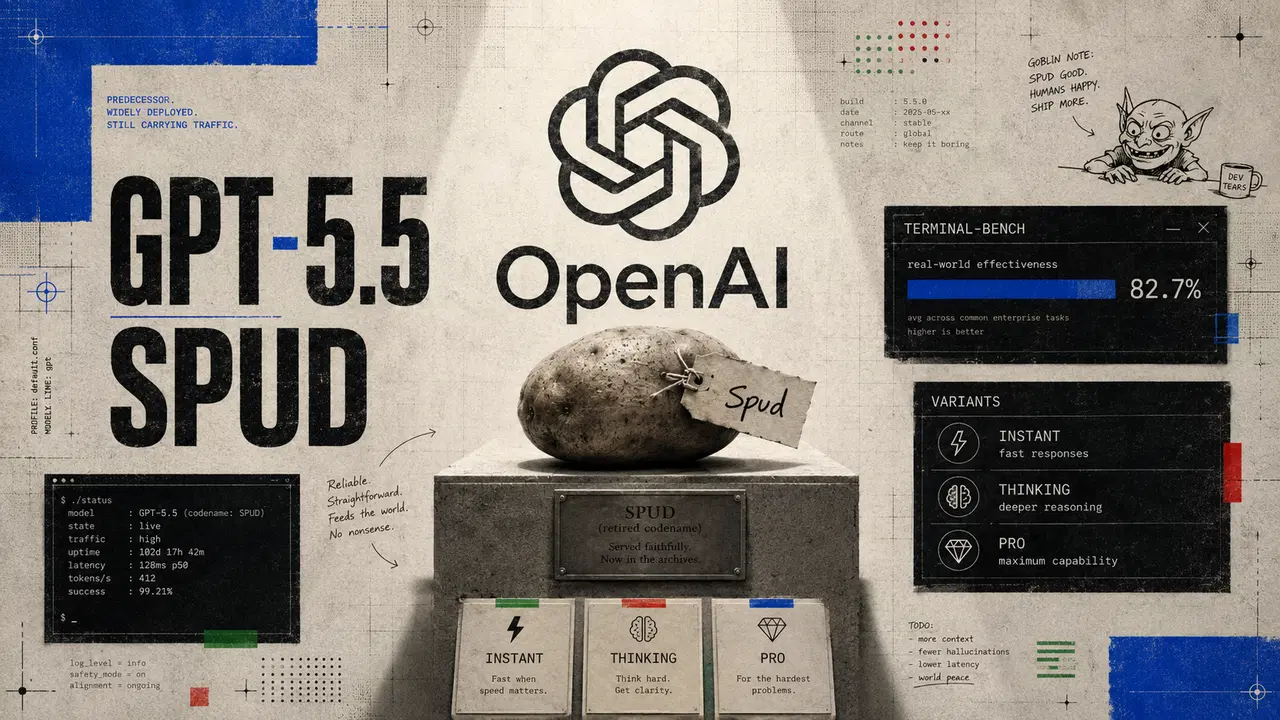
GPT-5.5, known inside OpenAI by the codename “Spud”, was released on 23 April 2026, with the API following a day later on 24 April. By the standards of this line it was a substantial step, and although newer models have since arrived, GPT-5.5 remains available through the API. OpenAI has announced that it will retire from ChatGPT, ChatGPT Work and Codex on 14 October 2026. It shipped in three variants, Instant, Thinking and Pro, covering the usual split between a fast default, a slower model that reasons before answering, and a higher-effort tier for the hardest problems. In practice that ladder lets a developer trade latency for depth: Instant for quick, cheap turns, Thinking when a problem needs the model to work through intermediate steps before replying, and Pro when accuracy on a genuinely hard task is worth the extra time and cost.
It became ChatGPT’s default in May 2026
The clearest sign of how central GPT-5.5 became is that in May 2026 GPT-5.5 Instant replaced GPT-5.3 Instant as the default model in ChatGPT. That is the position that decides what most people actually use, since the overwhelming majority of ChatGPT sessions run on whatever the default happens to be rather than on a model the user has deliberately chosen. Promoting GPT-5.5 to that slot put it in front of an enormous audience almost overnight.
Specifications and benchmarks
On paper the specifications were ambitious. OpenAI listed GPT-5.5 with a context window of 1,050,000 tokens, large enough to hold a substantial book or a sizeable code base in a single prompt, and set API pricing at $5 per million input tokens and $30 per million output tokens. The gap between the two, with output priced six times higher than input, is typical of the frontier and reflects the greater compute cost of generating text than of reading it; for anyone budgeting a deployment it means the length of the model’s answers, and not only the size of the prompt, drives the bill. Reported benchmark figures placed it at 82.7% on Terminal-Bench 2.0, a test of an agent working in a command-line environment, and at 51.7% on Tiers 1 to 3 of FrontierMath with 35.4% on the harder Tier 4, a research-level mathematics benchmark. As ever, these are the numbers reported at launch, and how a model performs on real work can differ from any single scoreboard.
The goblins and gremlins footnote
The most-quoted footnote to GPT-5.5 has nothing to do with benchmarks. OpenAI disclosed that the model had a recurring habit of mentioning goblins and gremlins, seemingly at random, and traced the tic to reward signals left over from a retired internal personality nicknamed “Nerdy”. The company filtered the offending data and added a developer-prompt fix in Codex to suppress the behaviour. It is a small episode, but a revealing one, because it shows how choices made during training, including personalities a lab experiments with and later drops, can leave odd residues in a shipped model that only surface once millions of people are using it.
ChatGPT access ends on 14 October
OpenAI’s current model documentation says GPT-5.5 will retire from ChatGPT, ChatGPT Work and Codex on 14 October 2026, across all plans. API access continues. These are separate product lifecycles, so developers using the API should follow its own model and deprecation notices.
For the newer general-purpose model, see GPT-6.1 Sol. The OpenAI release timeline places both in the wider family.
More in Large Language Models
All LLMs →- Google DeepMindGemini 4 Argonlonger reasoning, coding and cyber defence
- OpenAIGPT-5.6the flagship from 9 July to 3 September 2026
- OpenAIGPT-6 Astrathe new generation, rolling out from 3 September 2026
- OpenAIGPT-6.1 Solthe upgraded mid-price GPT-6 model, released 29 September 2026
- OpenAIGPT-6 Sol and Lunathe mid-price and budget GPT-6 models, released 22 September 2026
- AnthropicClaude Opus 5.5the first Claude 5.5 model, cheaper and faster than Opus 5