
Tencent
Hunyuan
the ecosystem model
Key facts
- Tencentin-house family
- Maker
- 4text, image, video, 3D
- Modalities
- Foundation familymultimodal
- Type
- 3D generationrare in the field
- Standout
- Tencent cloudfor developers
- Access
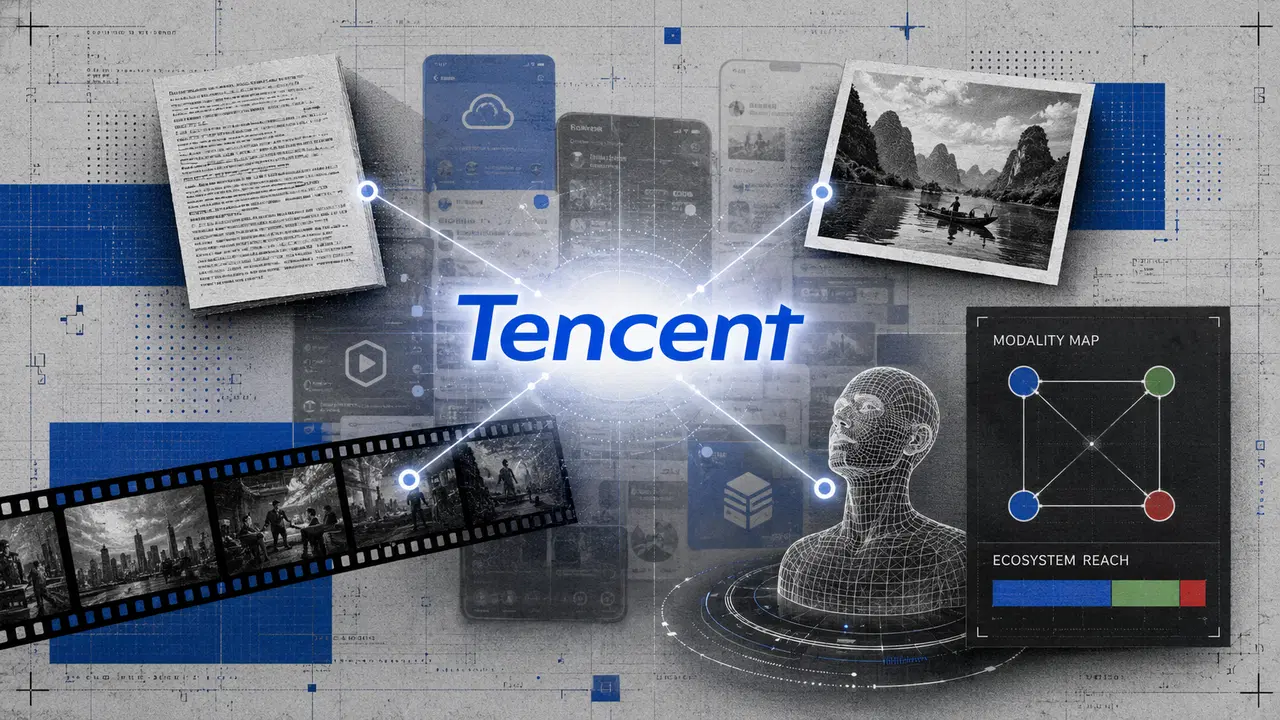
The ecosystem model. Tencent's foundation family across text, image, video and 3D.
What Hunyuan is
Tencent Hunyuan is the in-house foundation model family built by Tencent, one of China’s largest technology companies, and it is best understood as an ecosystem model: a set of systems designed first to power Tencent’s own vast collection of products and services. What sets Tencent Hunyuan apart from many rivals is breadth. It spans text, image, video and 3D generation under a single brand, making it one of the more complete multimodal efforts to come out of China.
A foundation model is a large system trained on broad data that can be adapted to many tasks, and Tencent has built the Hunyuan family across several of them. There is a text model in the mould of a conventional large language model, image and video generators for visual content, and, more unusually, a 3D generation capability aimed at producing three-dimensional assets. Grouping all of this under one name lets Tencent present a coherent toolkit rather than a scatter of separate products.
The ecosystem model
The ecosystem framing is the key to why this approach suits Tencent. The company reaches an enormous audience through its social, messaging, gaming and payment services, and a house model family gives it a way to add generative features across that estate without licensing technology from a competitor. Tencent Hunyuan is therefore both a product in its own right, offered to developers through Tencent’s cloud, and the engine behind features inside apps that hundreds of millions of people already use.
That dual role is the heart of the ecosystem model idea. Every product Tencent owns becomes a potential home for a Hunyuan feature, from a chat assistant to image tools inside a social app, while outside developers can license the same systems for their own use. Keeping the models in-house also means Tencent controls the cost, the data and the direction of its AI rather than depending on an outside supplier for capabilities it considers strategic.
The bet on 3D
The investment in 3D is worth dwelling on, because it reflects where Tencent’s interests lie. As a major force in gaming and interactive media, the company has obvious uses for tools that can generate three-dimensional models quickly, and building that capability alongside image and video keeps the whole pipeline in one place. Readers interested in the visual side can see our AI image and AI video hubs, which cover the wider categories these models belong to.
Bringing 3D, image and video together under one family is unusual and deliberate. Most laboratories concentrate on text, or on a single visual medium, whereas Tencent has chosen to cover the full range of generation a modern media and gaming company might want. That makes the family harder to summarise in a single benchmark, but more useful as a practical toolkit for building products.
What to check
As with the other large Chinese families, the specific text-model version moves quickly, and anyone building on Tencent Hunyuan should confirm the current release rather than rely on a fixed description. The branding covers a moving set of systems that Tencent updates across all its modalities. What stays constant is the strategy: a broad, multimodal family built to serve one of the world’s largest software ecosystems from the inside.
Where it sits
In the wider field, Tencent Hunyuan is the multimodal, ecosystem-first entry among China’s foundation models, built to cover every kind of generation a giant product portfolio might need rather than to win a single benchmark. That breadth makes it a distinctive case study in how a dominant platform company approaches AI, and a reminder that model strategy is as much about distribution as about raw capability. It is an approach only a company of Tencent’s reach could sustain across so many modalities at once.
More in Large Language Models
All LLMs →- Google DeepMindGemini 4 Argonlonger reasoning, coding and cyber defence
- OpenAIGPT-5.6the flagship from 9 July to 3 September 2026
- OpenAIGPT-6 Astrathe new generation, rolling out from 3 September 2026
- OpenAIGPT-6.1 Solthe upgraded mid-price GPT-6 model, released 29 September 2026
- OpenAIGPT-6 Sol and Lunathe mid-price and budget GPT-6 models, released 22 September 2026
- AnthropicClaude Opus 5.5the first Claude 5.5 model, cheaper and faster than Opus 5