
Thinking Machines Lab
Inkling
the newest lab's first big swing
Key facts
- 15 Jul 2026first flagship
- Released
- Thinking MachinesMira Murati
- Lab
- Kimi K2.5Moonshot open model
- Post-training
- Debutspecs unconfirmed at 21 Aug 2026
- Status
The newest lab's first big swing. Released 15 July 2026 by Mira Murati's Thinking Machines.
What it is
Inkling is the first major model from Thinking Machines Lab, the company founded by Mira Murati, and it was released on 15 July 2026. As the newest of the well-funded frontier labs, Thinking Machines had been watched closely for what its debut would look like, and the Inkling model is that first big swing. Five weeks on, at this page’s last check on 21 August 2026, the detail around it is still thin, but the headline facts are clear enough: a new lab of considerable pedigree has now shipped a flagship model of its own. The significance is partly about who is behind it. A new lab does not reach the frontier cheaply, so the arrival of a serious model from Thinking Machines is a signal that the group has assembled the funding, the talent and the compute to compete, and that the field’s leading edge is not settling into a fixed set of names.
How it was trained
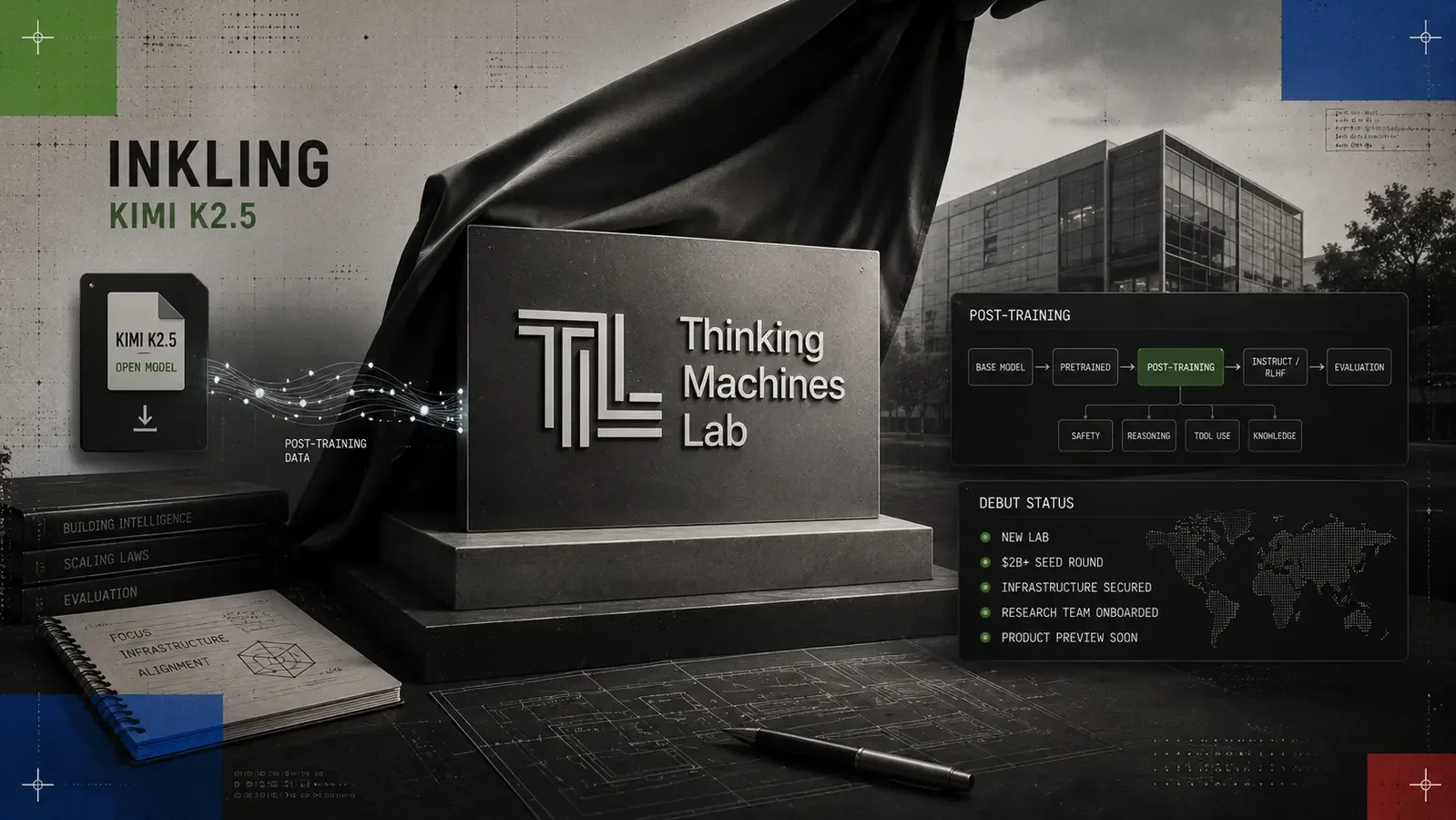
The most-discussed technical detail about the Inkling model concerns how it was trained rather than what it scores. Thinking Machines disclosed that Kimi K2.5, an openly released model from Moonshot, was used to generate early post-training data for Inkling. Post-training is the stage that comes after the initial, expensive pre-training on raw text: it is where a base model is shaped into something useful and well behaved, through instruction tuning and similar techniques, and it depends heavily on large volumes of example data. Using a strong existing model to generate some of that data is an increasingly common practice, because it is far cheaper and faster than commissioning every example by hand, and it lets a new lab reach a capable starting point without a vast in-house data operation.
What the training choice reveals
That single detail says a good deal about how a modern lab bootstraps a model. It shows Thinking Machines being pragmatic, drawing on the best available open model to accelerate its own first release, and it is a neat illustration of how open weights ripple through the field: a model that one lab publishes becomes a building block others use. It also underlines why the openness of models like Moonshot’s Kimi line has consequences well beyond their direct users, since they feed the training of the next generation of systems. There is a dependency worth naming in that: a newcomer’s first model can inherit some of the character, and some of the limitations, of the model whose output helped train it, which is one reason independent testing of Inkling will be so informative.
A note on the specifics
Caution is the right posture on the specifics. As of 21 August 2026 the Inkling model’s precise specifications, its exact positioning against rival systems and the terms of its licence should still be confirmed against Thinking Machines’ own announcement rather than assumed. What can be stated with confidence is the shape of the story: a high-profile new lab, led by Mira Murati, has entered the frontier with a first model, and it did so using post-training data generated in part by an existing open model.
Where it sits and what to watch
In the wider field, the Inkling model counts for as much because of the lab behind it as because of the software. Thinking Machines is one of a small number of new entrants trying to establish themselves alongside the incumbents, and a credible first release is the price of admission to that conversation. Whether Inkling can compete on capability and cost with the more established families will become clearer as independent testing accumulates and as the lab publishes more detail. For now the honest summary is that a highly credible team has made its opening move, and the interesting questions are empirical ones that only use and scrutiny can settle.
What to watch next is straightforward: firmer specifications, real-world results and the licence terms for the Inkling model, all of which will decide whether this first swing connects. For the wider picture of how new and established models compare, see our large language models hub and the broader AI section.
More in Large Language Models
All LLMs →- Google DeepMindGemini 4 Argonlonger reasoning, coding and cyber defence
- OpenAIGPT-5.6the flagship from 9 July to 3 September 2026
- OpenAIGPT-6 Astrathe new generation, rolling out from 3 September 2026
- OpenAIGPT-6.1 Solthe upgraded mid-price GPT-6 model, released 29 September 2026
- OpenAIGPT-6 Sol and Lunathe mid-price and budget GPT-6 models, released 22 September 2026
- AnthropicClaude Opus 5.5the first Claude 5.5 model, cheaper and faster than Opus 5