
AI21
Jamba
the SSM-transformer hybrid
Key facts
- HybridSSM-transformer
- Architecture
- Mambastate space model
- Design basis
- Long contextsingle pass
- Focus
AI21's hybrid family interleaves transformer and state space layers to hold long inputs at lower cost.
What it is
AI21 Jamba is the family of hybrid language models built by the research company AI21, and it earns attention for how it is constructed rather than for topping any single leaderboard. Almost every modern large language model rests on one architecture, the transformer. AI21 Jamba departs from that consensus by combining the transformer with a state space model, the kind of design popularised under the name Mamba. The outcome is an SSM-transformer hybrid: a single model that splices two different ways of reading text in the hope of keeping the strengths of each.
The cost of attention
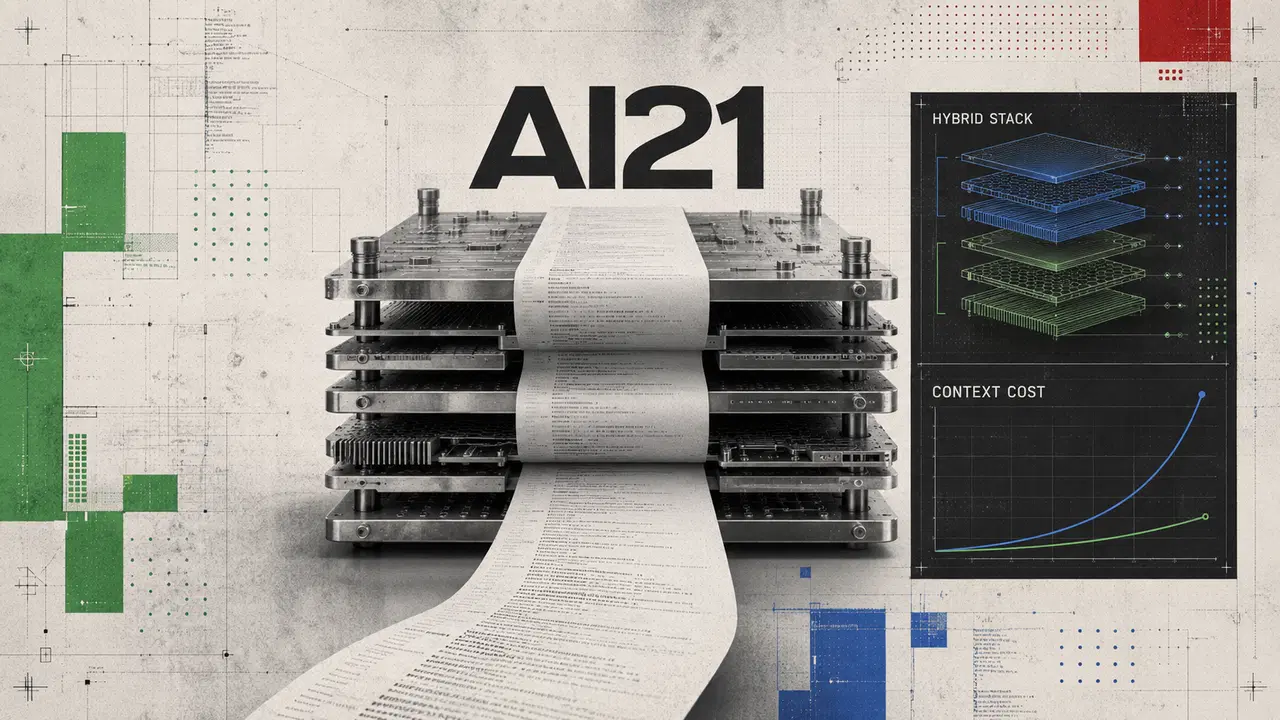
Understanding why AI21 chose this route means understanding the cost of attention. A transformer compares every token in its input with every other token, which gives it a rich view of context but carries a steep price: as the text grows longer, the work of attention rises roughly with the square of the length. Feed a transformer twice as much text and it does close to four times the work. That is manageable for a paragraph and punishing for a book.
A state space model handles a sequence differently. Rather than compare everything with everything, it moves through the text in order and carries a compact running summary forward, so its cost rises much more gently as the input lengthens. The weakness is that a pure state space model can lose the fine-grained recall that attention provides. The Jamba answer is to interleave the two, letting transformer layers supply precise recall where it counts and state space layers carry the long-range load cheaply. This is the reasoning behind the AI21 Jamba design, and it is why the model is described first of all as a hybrid.
Why long context is the payoff
The payoff AI21 has emphasised is long context: the ability to take in a large body of text at once and reason across the whole of it. A model that can hold a lengthy contract, a sprawling codebase or a stack of research in a single pass can answer questions that depend on connecting distant parts of the material, something a short context window cannot do. Long inputs are exactly where the quadratic cost of pure attention bites hardest, so a design that softens that cost is well suited to the task. In Jamba, the architecture and the headline feature are two sides of one decision.
Why the hybrid approach is worth watching
The wider significance of AI21 Jamba is that it treats the transformer as one component rather than the whole story. For most of the field’s recent history the debate has been about how to train and scale transformers, not whether to use them. Efforts like Jamba reopen that question by shipping an alternative at production scale rather than confining it to a research paper. State space models and other non-attention designs have shown promise in the laboratory, and hybrids are the most pragmatic way to bring them into working systems without discarding what attention does well.
None of this settles the argument. Whether hybrids become the default or stay a specialist choice will depend on how they perform as context windows keep expanding and as the cost of processing long inputs becomes the deciding factor in which model a business can afford to run at scale. If the price of long context is what limits deployment, designs that lower that price hold a natural advantage. If transformer efficiency improves by other means, the pressure eases. For anyone following the large language models space, AI21 Jamba is a clear marker of this contest between architectures being fought out in a shipped product rather than a slide deck.
Readers who want the current specification, including the latest versions and the details AI21 chooses to publish, should consult AI21’s own site, since a fast-moving family like this changes faster than any summary can. For broader context on how the model fits alongside its rivals, our AI hub tracks the labs and systems shaping the field.
More in Large Language Models
All LLMs →- Google DeepMindGemini 4 Argonlonger reasoning, coding and cyber defence
- OpenAIGPT-5.6the flagship from 9 July to 3 September 2026
- OpenAIGPT-6 Astrathe new generation, rolling out from 3 September 2026
- OpenAIGPT-6.1 Solthe upgraded mid-price GPT-6 model, released 29 September 2026
- OpenAIGPT-6 Sol and Lunathe mid-price and budget GPT-6 models, released 22 September 2026
- AnthropicClaude Opus 5.5the first Claude 5.5 model, cheaper and faster than Opus 5