
Moonshot
Kimi K2.6 and K2.7 Code
the run-up to K3
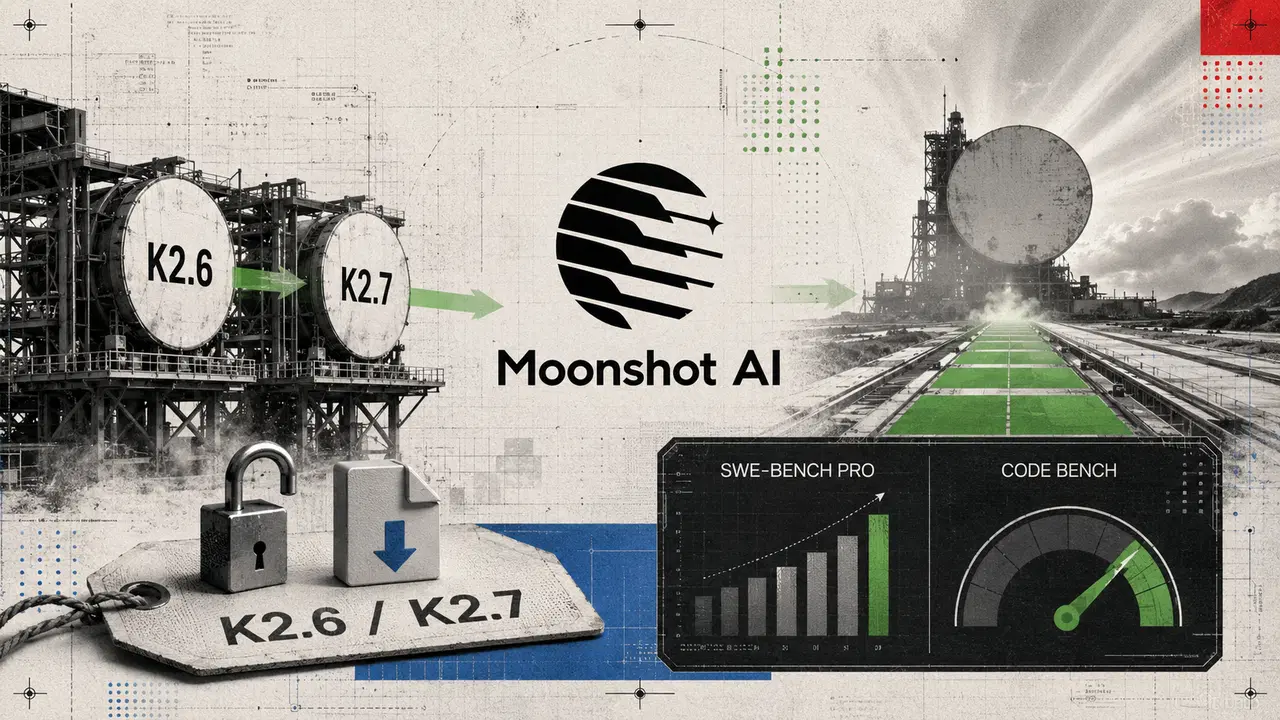
Key facts
- 20 Apr 2026SWE-bench Pro lead
- K2.6 released
- 12 Jun 2026coding-focused
- K2.7 Code
- +21.8%vs K2.6, Code Bench v2
- Coding gain
- 6xfaster inference
- HighSpeed
- Open weightHugging Face
- Licence
- 1st openled every premium model
- SWE-bench Pro
The run-up to K3. K2.6 (20 April 2026): first open model to lead every premium frontier model on SWE-bench Pro.
What they are
Kimi K2.6 and K2.7 Code are two closely spaced releases from Moonshot, the lab whose Kimi models have become a fixture of the open-weight frontier. Positioned at the time as the run-up to a larger K3, which duly arrived on 17 July 2026, the pair show a lab iterating quickly on coding ability, and Kimi K2.7 in particular sharpened Moonshot’s claim to lead the open field on software tasks. Read together, K2.6 and Kimi K2.7 Code mark the point at which an openly released model started matching, and on some measures beating, the closed systems from the best-funded labs.
K2.6 and SWE-bench Pro
K2.6 arrived on 20 April 2026 and made a striking claim: it was reported to be the first open model to lead every premium frontier model on SWE-bench Pro, a benchmark that asks a model to resolve real software-engineering problems drawn from actual code repositories rather than toy puzzles. SWE-bench Pro is one of the more credible tests in this area precisely because it rewards a model that can navigate a real project, make a correct change and have it pass the project’s own checks. Topping it with an open model, if the result holds up in independent use, is the kind of milestone that shifts where developers look for a coding model. It also carries commercial weight, because an open model that can genuinely close pull requests is one a company can run on its own infrastructure instead of paying per call to a closed provider.
K2.7 Code and the HighSpeed variant
Kimi K2.7 Code followed on 12 June 2026 and pushed the same line further. Moonshot reported a gain of 21.8% over K2.6 on its own Kimi Code Bench v2, an internal coding benchmark, which is a large jump for a point release and suggests the lab concentrated its effort squarely on programming. Alongside the headline model, Moonshot shipped a HighSpeed variant of Kimi K2.7 said to run around six times faster at inference. That speed variant addresses one of the practical drawbacks of large capable models, namely that they can be slow and expensive to run, and it points to Moonshot trying to make Kimi K2.7 usable in interactive settings and high-volume pipelines, not only impressive on a leaderboard.
Reading the benchmark claims
The internal-benchmark caveat is worth keeping in mind. A 21.8% improvement measured on a lab’s own Kimi Code Bench v2 is a claim from the model maker rather than an outside verdict, and self-reported gains do not always survive independent testing. The SWE-bench Pro result is more useful because it is a shared, external benchmark, but even there the honest reading is that Kimi K2.7 and its predecessor were leading contenders in the open field as of mid-2026, with the usual proviso that leaderboards move quickly.
Open weights and the run-up to K3
What makes this pair interesting beyond the numbers is the naming. Calling them the run-up to K3 tells you Moonshot treated K2.6 and Kimi K2.7 Code as staging posts rather than a destination, releases that let the lab bank progress and gather real-world feedback while a larger model was prepared. The decision to distribute the weights, published through Moonshot’s account on Hugging Face, is central to their influence: an open model that leads on a serious coding benchmark can be downloaded, inspected, fine-tuned and self-hosted, which is why capable open releases from Moonshot and its peers have become such a significant part of the field. For a lab outside the largest incumbents, leading a respected external benchmark with an open release is also the surest way to win attention, since the result can be checked by anyone rather than taken on trust.
That next step is now on the record. Kimi K3 was released on 17 July 2026 at 2.8 trillion parameters, with the weights published on 27 July, so the coding gains of Kimi K2.7 did carry into a broader, more general model and the weights did come with it. The terms changed, though: K3 is governed by a bespoke Kimi K3 licence rather than a standard open-source one. For the wider picture of how open and closed models compare, see our large language models hub and the broader AI section.
Kimi Code since K2.7
The code line has moved on again. On 11 September 2026 Moonshot completed the rollout of Kimi K2.8 Preview to all users of Kimi Code, its coding product, keeping the model ID unchanged as kimi-for-coding, so existing set-ups picked up the new model on their next call. Moonshot’s own What’s new documentation describes its performance as close to Kimi K3.
More in Large Language Models
All LLMs →- Google DeepMindGemini 4 Argonlonger reasoning, coding and cyber defence
- OpenAIGPT-5.6the flagship from 9 July to 3 September 2026
- OpenAIGPT-6 Astrathe new generation, rolling out from 3 September 2026
- OpenAIGPT-6.1 Solthe upgraded mid-price GPT-6 model, released 29 September 2026
- OpenAIGPT-6 Sol and Lunathe mid-price and budget GPT-6 models, released 22 September 2026
- AnthropicClaude Opus 5.5the first Claude 5.5 model, cheaper and faster than Opus 5