
NVIDIA
Nemotron 3
the transparency play
Key facts
- NVIDIAopen model family
- Lab
- Open weight+ data & recipes
- Licence
- Full recipedata, recipes, evals
- Disclosure
- SuperJul 2026 rankings
- Noted variant
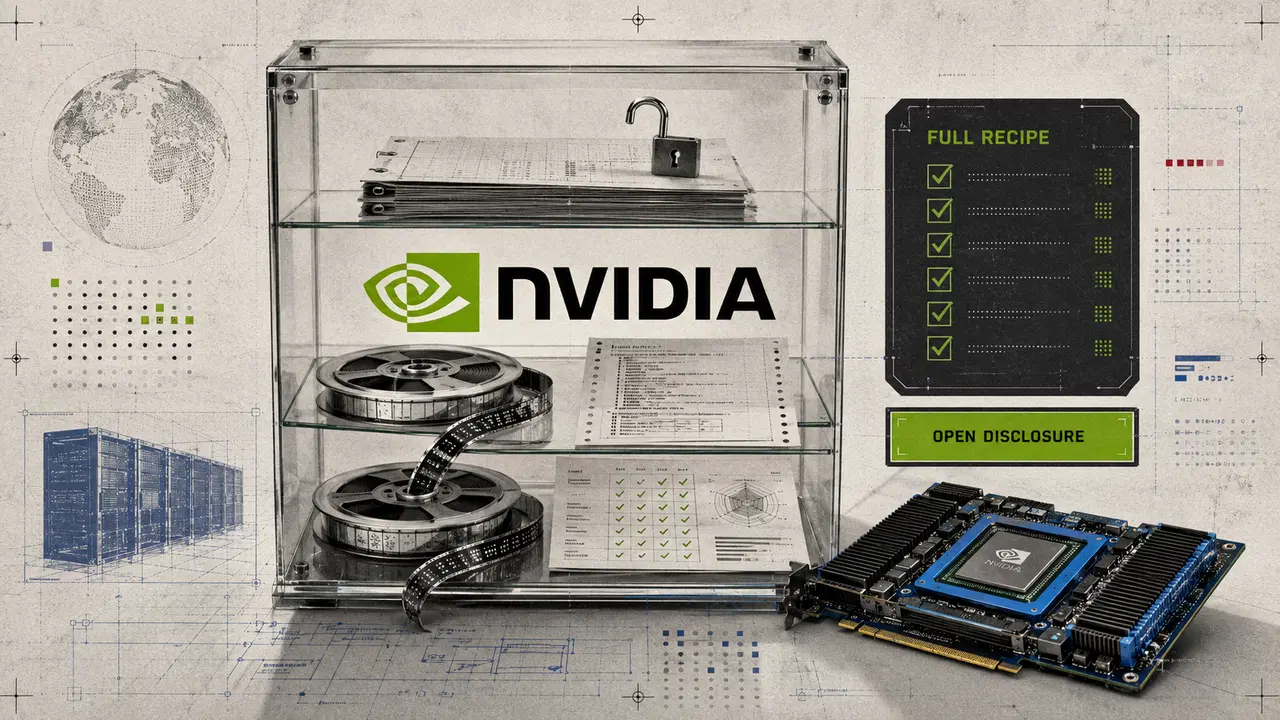
The transparency play. Open weights plus published training data, recipes and evaluation resources, which is why enterprise roundups favour it.
What it is
Nemotron 3 is NVIDIA’s family of openly released large language models, and its distinguishing feature is transparency. Where many “open” models publish only their weights, Nemotron 3 comes with published training data, training recipes and evaluation resources as well, which is why it is favoured on enterprise shortlists when buyers weigh up which open model to standardise on. In a field where most systems are opaque, that openness is the whole pitch, and it is what sets Nemotron 3 apart from models that are free to download but silent about how they were built.
Open weights versus genuine openness
The distinction between open weights and genuine openness is worth spelling out. A model that ships weights alone lets you run and fine-tune it, but tells you little about what it was trained on or how, which makes it hard to audit for licensing, bias or contamination and hard to reproduce. Reproducibility is not an academic nicety here: without the recipe, an organisation cannot know whether a model was trained on data it is contractually barred from using, nor whether the benchmark scores it is being sold reflect genuine ability or contamination of the test set. By also releasing the data, the recipes and the evaluation resources, NVIDIA lets an organisation inspect the ingredients, rerun parts of the process and check the published numbers for itself. For a regulated business, or any buyer that has to answer for the systems it deploys, that auditability can count for as much as raw benchmark performance, and it is a large part of why Nemotron 3 keeps appearing near the top of enterprise selections.
Why NVIDIA gives it away
There is a commercial logic to NVIDIA taking this position. The company sells the accelerators on which most large models are trained and served, so a widely adopted, well-documented open model that runs efficiently on its hardware supports the broader business rather than competing with a paid product. Publishing the full recipe lowers the barrier for enterprises to build on Nemotron 3 with confidence, and confident enterprise adoption of large models tends to translate into demand for the chips underneath them. The transparency play is therefore both a genuine contribution to the open ecosystem and a sensible strategic choice. It is a pattern several hardware and cloud providers have followed, giving away capable software to make their paid infrastructure more attractive, and Nemotron 3 is among the clearer examples of it.
Variants and standing
Within the Nemotron 3 family, a Super variant was highlighted in July 2026 rankings, indicating that the line is offered in more than one size or configuration and that at least one of them was performing well enough to draw attention in mid-2026 comparisons. As with any such ranking, the sensible reading is that Nemotron 3 was a strong, well-regarded option among open models at that point rather than a permanent leader, since open-model standings change with every fresh release. For a buyer, the practical takeaway is to treat any single ranking as a snapshot and to weigh the disclosure that comes with the model alongside its position on the board.
The wider shift and what to watch
For readers new to this corner of the field, Nemotron 3 is a useful example of a wider shift. The most valuable open releases are increasingly judged on how much they disclose as well as on how they score, because disclosure is what lets a serious organisation trust a model it did not train. NVIDIA has leaned into that expectation, and the resources for Nemotron 3, from the weights to the recipes, are published through its own channels at build.nvidia.com and nvidia.com rather than described second hand here.
What to watch next is how far the transparency approach spreads and whether later Nemotron releases keep the same level of disclosure as the field grows up. For the broader picture of how open and closed models compare, and where NVIDIA’s efforts sit among them, see our large language models hub and the wider AI section.
More in Large Language Models
All LLMs →- Google DeepMindGemini 4 Argonlonger reasoning, coding and cyber defence
- OpenAIGPT-5.6the flagship from 9 July to 3 September 2026
- OpenAIGPT-6 Astrathe new generation, rolling out from 3 September 2026
- OpenAIGPT-6.1 Solthe upgraded mid-price GPT-6 model, released 29 September 2026
- OpenAIGPT-6 Sol and Lunathe mid-price and budget GPT-6 models, released 22 September 2026
- AnthropicClaude Opus 5.5the first Claude 5.5 model, cheaper and faster than Opus 5