
Microsoft
Phi-4
small and on-device
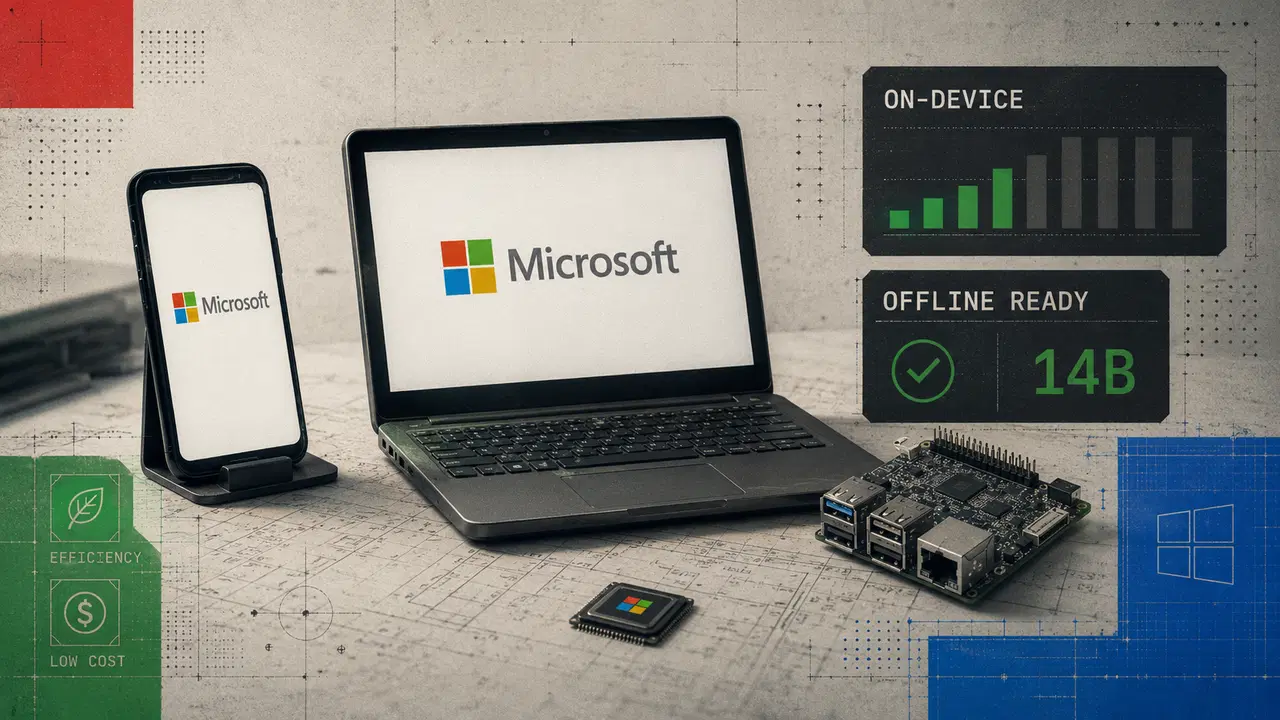
Key facts
- Small modellanguage model
- Class
- 14BPhi-4 dense
- Parameters
- On-devicelaptop, phone, edge
- Runs on
- MicrosoftAzure cloud
- Maker
- Yesno connection needed
- Works offline
Small and on-device. Microsoft's small-model line; the standard pick for fast, cheap, on-device work in 2026 roundups.
What Phi-4 is
Phi-4 is Microsoft’s family of small language models, and by 2026 it had become the standard reference point in industry roundups for teams that want capable text generation to run quickly, cheaply and close to the user. The best known systems from the largest laboratories are built to be as powerful as possible and served from vast data centres. Phi-4 sits in a different category: models compact enough to run on a laptop, a handset or an edge device, without a round trip to a distant server.
The term small language model describes a system with a comparatively modest number of parameters, the internal weights a model acquires during training. Fewer parameters means less memory and less computing power are needed to produce each response, which is precisely what makes on-device operation practical. The compromise is that a smaller model generally holds less knowledge and reasons less deeply than a frontier system many times its size. The engineering problem Microsoft set itself was to recover as much of that lost capability as possible from a deliberately small footprint, chiefly through careful curation of the data the model learns from.
What small models handle
In practice these compact models are used for the steady, high-volume tasks that do not need a frontier system: summarising documents, drafting and rewriting text, sorting and classifying content, and powering assistants built into products. Handled well, a small model can do this work at a fraction of the cost and delay of a large one, which is the whole reason the category has grown so quickly.
The case for on-device
The appeal of running a model such as Phi-4 on the device itself is easy to state. Data never leaves the hardware, which suits privacy-sensitive work and settings governed by strict data rules. There is no network round trip, so responses arrive with very low latency. There is no per-call inference bill from a cloud provider, so the running cost of a feature can fall close to zero once the model is deployed. And the software keeps working offline, on a train or a factory floor where connectivity is poor. These properties explain why the small-model category exists at all, and why Phi-4 is so often the name attached to it.
Why it suits Microsoft
For Microsoft the fit is natural. The company sells cloud services through Azure and builds software used on hundreds of millions of devices, so a house model that is cheap to run and easy to embed serves both sides of that business. A developer can call the model through Microsoft’s cloud when scale demands it, or ship the same class of system inside an application that runs locally. That flexibility, rather than any single benchmark score, is why the line keeps appearing as the default recommendation for fast, cheap, on-device work.
Where it sits
Anyone choosing a small model should treat the specific version as a moving target. Microsoft’s model programme continues to develop, and the branding and capabilities of its smaller systems have shifted more than once, so it is sensible to confirm the current Phi release and its stated strengths before committing to a deployment. The broader point holds regardless of version. On-device and near-device inference has become a serious part of the field, and Phi-4 is the entry most practitioners reach for first when they need it.
Where this sits in the wider field is straightforward. As frontier systems grow more expensive to run, the pressure to push routine work onto smaller, cheaper models has only grown, and much of that work now happens on hardware the user already owns. For a fuller picture of how compact systems relate to the flagship models they complement, see our large language models hub and the wider AI section.
More in Large Language Models
All LLMs →- Google DeepMindGemini 4 Argonlonger reasoning, coding and cyber defence
- OpenAIGPT-5.6the flagship from 9 July to 3 September 2026
- OpenAIGPT-6 Astrathe new generation, rolling out from 3 September 2026
- OpenAIGPT-6.1 Solthe upgraded mid-price GPT-6 model, released 29 September 2026
- OpenAIGPT-6 Sol and Lunathe mid-price and budget GPT-6 models, released 22 September 2026
- AnthropicClaude Opus 5.5the first Claude 5.5 model, cheaper and faster than Opus 5