
Lightricks
LTX-2.3
the cleanest open licence
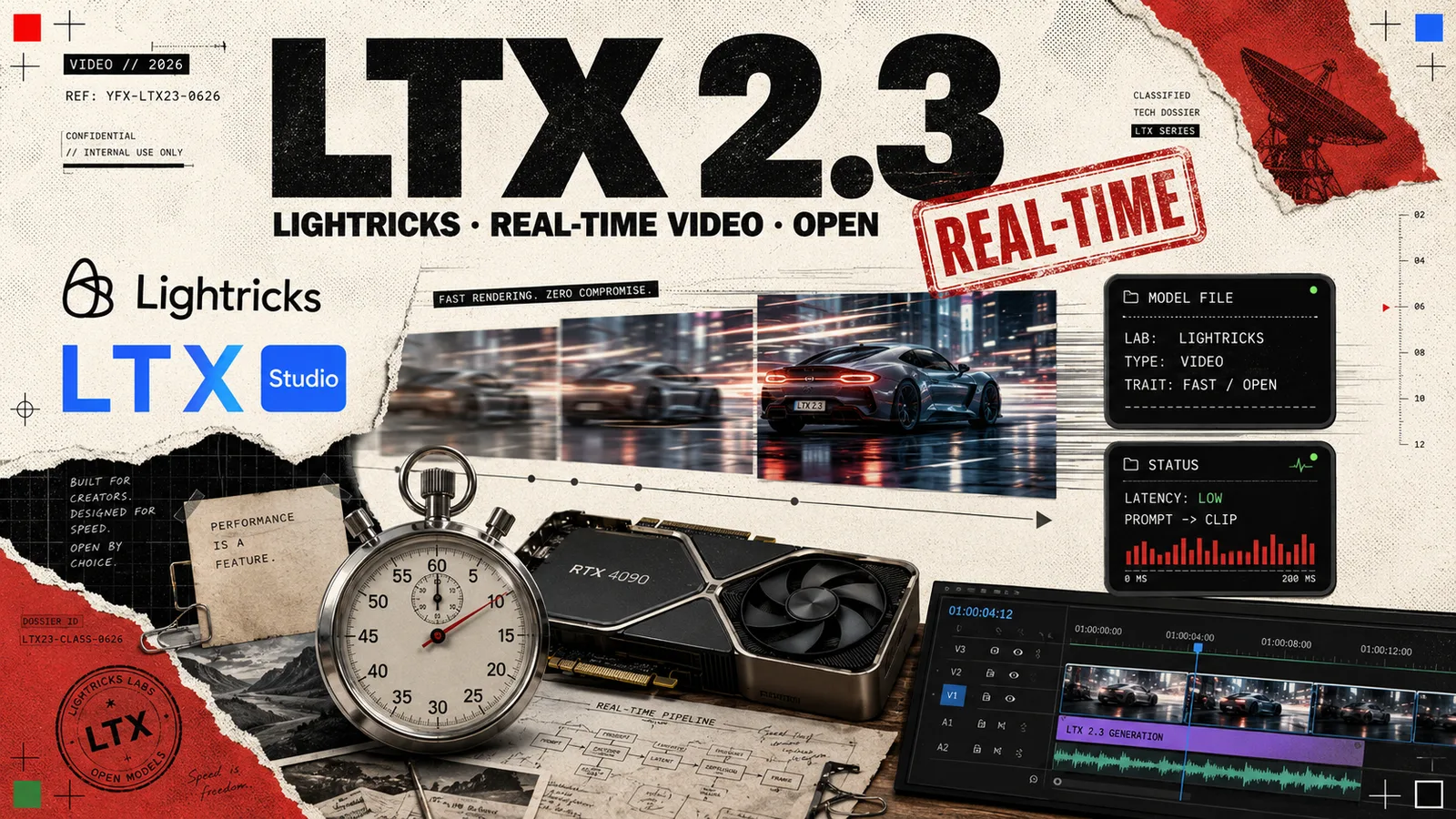
Key facts
- CommunityLTX-2 Community License
- Licence
- $10mannual revenue
- Free under
- 20ssingle-pass
- Max length
- 24kHzstereo, Mar 2026
- Audio
- Licensedcleared rights
- Training data
- LTX-2.522B open weights, 23 Jul 2026
- Successor
The cleanest open licence. The LTX-2 Community License makes it free for organisations under $10m in annual revenue, it is trained on licensed data, and its 22B successor LTX-2.5 has had open weights since 23 July 2026.
What it is
LTX-2.3, the video model from Lightricks, is the cleanest legal proposition in this section. It is released under the LTX-2 Community License, free to use for any organisation with annual revenue under $10m, and, most usefully, it is trained on licensed data. That combination gives LTX-2.3 the strongest legal position of any model covered here, and it is the reason the model deserves attention from anyone who has to think about where their training data came from.
The licence
Start with the licence, because it does a lot of work. LTX-2.3 ships under the LTX-2 Community License Agreement, dated 5 January 2026, which is the LICENSE file in Lightricks’ Hugging Face repository. It grants a royalty-free right to use, modify, distribute and build derivatives of the model for any purpose, subject to the use restrictions listed in its Attachment A, and it draws one commercial line: “Entities with annual revenues of at least $10,000,000” must obtain a paid commercial use licence from Lightricks. The threshold counts total annual revenue, recurring or one-off. A startup or an independent studio earning under $10m a year therefore pays nothing, which removes the model from the list of things to budget for and removes the negotiation that a closed API always eventually requires, while a larger firm agrees paid terms with Lightricks. Hugging Face files the licence under “other”, its label for a custom licence.
Training data
The training-data point is the one that will decide procurement conversations. Most video models are trained on data of uncertain provenance, scraped from the open web, and that uncertainty becomes a liability the moment a client, a broadcaster or a regulator asks the awkward question about rights. LTX-2.3 is trained on licensed data, which means Lightricks can stand behind what went into it. For any business that has to answer a procurement question about training-data provenance, this is the page to send them to. Legal comfort is rarely a glamorous feature, yet it is often the deciding one when a model moves from a creative experiment to something a company ships in a product.
Length and audio
On capability, the standout figure is length. LTX-2.3 produces the longest single-pass clips in the category, at around 20 seconds. Single-pass is worth understanding in the technical sense: the clip is generated as one continuous piece rather than assembled from shorter segments stitched together, which tends to hold motion and continuity more convincingly across the length of a shot. Most rivals stop well short of 20 seconds in a single generation, so a longer coherent take is a genuine practical advantage for anyone who needs a shot to run rather than cut. The model also added stereo audio at 24kHz in March 2026, so a generation now carries a soundtrack with left-right separation rather than a flat mono bed.
LTX-2.5 followed in July
Lightricks published LTX-2.5 on Hugging Face on 23 July 2026 under the LTX-2.x community licence, with the same $10m revenue line. Its model page describes “a 22B-parameter asymmetric dual-stream diffusion transformer” that generates audio and video together, says “the weights and code are publicly available”, and calls it free for companies under $10m in revenue. LTX-2.5 is Lightricks’ newest open video model, so a team starting a new project should test it alongside LTX-2.3.
Where it sits
Lightricks is a consumer software company that also ships editing apps, and that heritage shows in how the model is packaged for people who cut video for a living. The code is available on the company’s public repository, so it can be run and inspected rather than accessed only through a metered endpoint, which reinforces the open-weights claim. A company that has spent years building tools for editors tends to think about outputs in terms of a working timeline rather than a single showpiece clip, and that shows in the emphasis on longer takes and usable audio. The revenue threshold works commercially too: it lets Lightricks seed the model widely among smaller users while reserving paid terms for the larger firms that can afford them, a distribution approach the open-source world has used to good effect before.
In the AI video field at large, LTX-2.3 is the model to reach for when the legal position weighs as heavily as the picture. Alongside a small number of other genuinely open options, it forms the part of the market that competes on licence terms and data provenance as much as on raw quality. As generated video moves from novelty into commercial production, that clean legal footing is likely to count for more, not less, and Lightricks has staked out that ground earlier and more deliberately than most. For a broader view of how the open models compare, see the AI hub.
More in Video Generation
All Video →- GuideClaude + MCP for videofrom a written brief to a finished shot
- GuideSeedance 2.5 promptingthe official method, decoded
- Google DeepMindGemini Omni 1.1 Flashthe production release of Google's video line
- AlibabaWan 3.0hosted only, with nothing to download
- MiniMaxMiniMax H3the open flagship
- Google DeepMindVeo 3.1the safest Western default