
Google DeepMind
Veo 3.1
the safest Western default
Key facts
- $0.15per second, fast mode
- Price
- 14thof 36, video + audio, 25 Sep 2026
- Rank
- 48kHznative speech
- Audio
- SynthIDmandatory watermark
- Provenance
- 22 Oct 2026preview models shut down
- Gemini API
The safest Western default for compliance-led teams. Its Gemini API preview models shut down on 22 October 2026, with Gemini Omni 1.1 Flash the named replacement, while the Vertex AI release runs to 17 November 2026 or later.
What it is
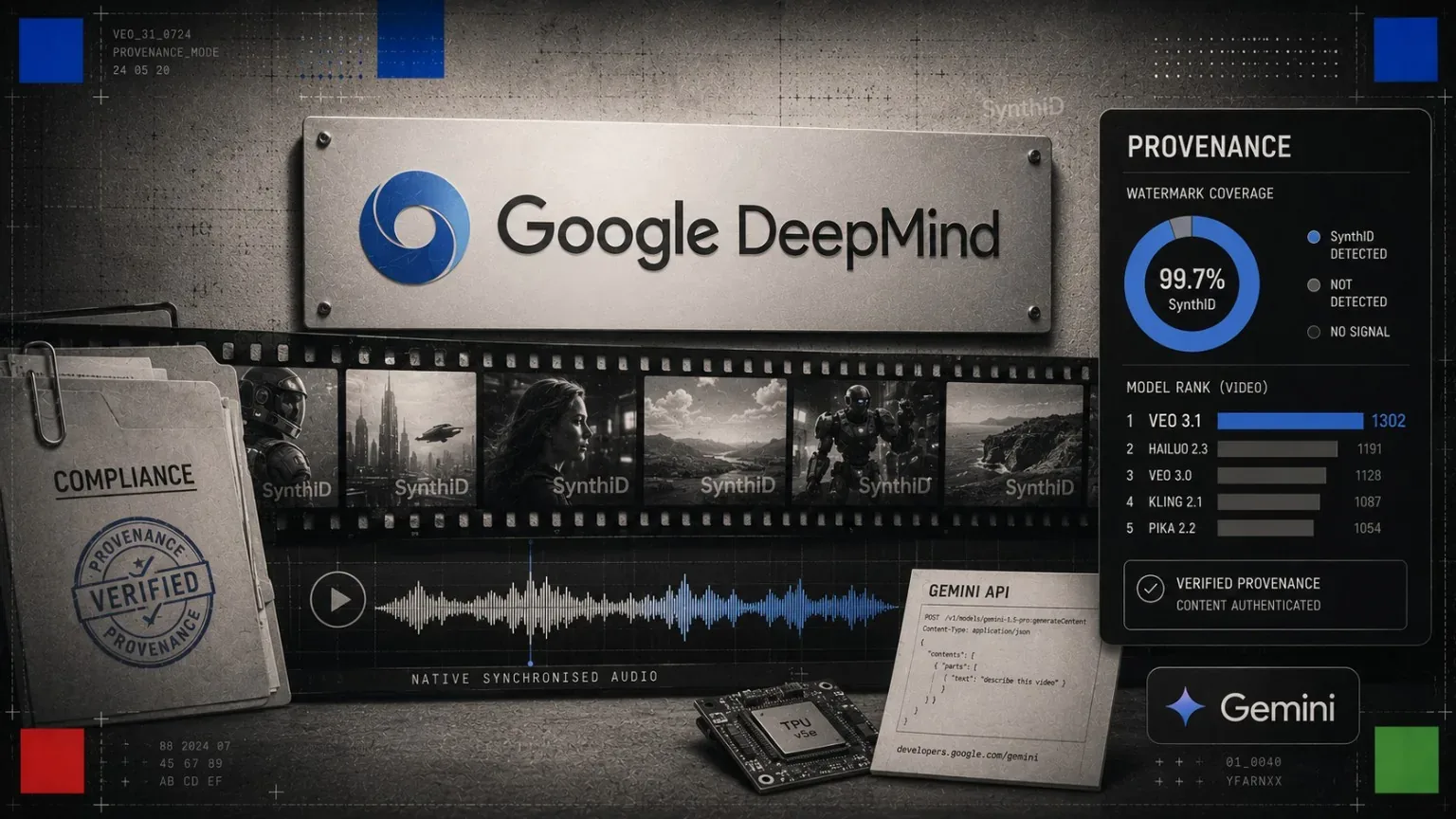
Veo 3.1, the video generation model from Google DeepMind, is the safest Western default for teams that want a capable text-to-video system without reaching for a Chinese lab. As of 25 September 2026 it sits 14th of 36 on the Artificial Analysis text-to-video-with-audio board, with Veo 3.1 Fast and Veo 3.1 Lite in the two places behind it, and the strongest Western entry on that board is Google’s own Gemini Omni Flash, which leads it. For any organisation that needs a familiar corporate supplier, a clear billing relationship and a compliance story it can explain to a legal team, Veo 3.1 is the obvious first port of call.
The audio case
The technical case rests on audio. Veo 3.1 produces native synchronised audio, with 48kHz speech generation, and that remains the reference point for dialogue. Plenty of rivals can render a convincing moving image; far fewer can attach speech that lands on the lips and holds up under scrutiny. Where a brief calls for spoken lines, an interview format or a character who has to say something to camera, this is where Veo 3.1 earns its keep, and it is the reason the model sits near the top of the audio-inclusive board rather than the silent one.
Cost and provenance
On cost, pricing starts at about $0.15 per second in fast mode, which places Veo 3.1 in the middle of the market rather than at either extreme. For studios that want to keep spend down during early exploration, Google also offers a Veo 3.1 Lite tier aimed at concepting, so a team can sketch ideas cheaply and reserve the full model for finished shots. That two-speed structure is sensible for anyone running a real production budget rather than a one-off demonstration.
The most distinctive feature of Veo 3.1, and the one most likely to decide a purchase, is SynthID watermarking. Every output carries it, and it is mandatory. For regulated buyers, banks, broadcasters, public bodies and anyone answerable to an auditor, that is a genuine advantage: provenance is baked in, and the origin of a clip can be demonstrated rather than argued. The same feature is a constraint for anyone who needs unmarked assets, and it is worth being honest that Veo 3.1 is not the tool for work that has to leave no trace of its machine origin. Which of those two readings applies depends entirely on the buyer, and it is the single question most worth settling before committing.
Distribution and roadmap
Distribution is the quieter advantage, and arguably the durable one. Veo 3.1 is available through the Gemini app for casual use, Google AI Studio and the Gemini API for developers, Vertex AI for enterprises already inside Google Cloud, and Flow for creative work. A lab can build a superb model and still lose on reach; Google has the opposite problem solved, because the model already sits inside surfaces that millions of people and thousands of companies use every day. For an enterprise buyer weighing procurement, the fact that Veo 3.1 arrives through channels the finance and security teams have already approved can count for as much as any benchmark score.
One further release has moved past the watching stage. Google took its Omni video line out of preview on 27 August 2026, and the launch post calls Gemini Omni 1.1 Flash “production-ready for professional use via the Gemini API in Google AI Studio”; Google’s own pricing page describes gemini-omni-1.1-flash as “now generally available to developers on the paid tier of the Gemini API”. It generates and edits video with native audio, adds control over the first and last frame of a shot and scene extension to a cumulative 40 seconds, and bills at roughly $0.10 per second of 720p against Veo 3.1’s $0.15 in fast mode. Anyone standardising on Veo 3.1 should read the two side by side, because the cheaper Google model is now a supported production option rather than a preview.
The Gemini API previews shut down on 22 October
Google will shut down the three Veo 3.1 preview models in the Gemini API on 22 October 2026, according to its deprecations table, read on 2 October 2026. The replacement it names for all three is gemini-omni-1.1-flash, and the Gemini API video guide now reads “Use Gemini Omni Flash as your default model for video generation”, keeping Veo 3.1 for scene extension, last-frame control and legacy pipelines. Enterprise customers on Google Cloud run separate, generally available models, and the Vertex AI model-versions table gives both a retirement date of “November 17, 2026 or later”.
| Model ID | Where | Released | Shutdown or retirement |
|---|---|---|---|
veo-3.1-generate-preview |
Gemini API | 15 October 2025 | 22 October 2026 |
veo-3.1-fast-generate-preview |
Gemini API | 15 October 2025 | 22 October 2026 |
veo-3.1-lite-generate-preview |
Gemini API | 31 March 2026 | 22 October 2026 |
veo-3.1-generate-001 |
Vertex AI | 17 November 2025 | 17 November 2026 or later |
veo-3.1-fast-generate-001 |
Vertex AI | 17 November 2025 | 17 November 2026 or later |
A team calling Veo 3.1 through the Gemini API has until 22 October 2026 to move its requests to Gemini Omni 1.1 Flash or to the Vertex AI models.
How it compares
Read against the wider field, Veo 3.1 is the model you choose when trust and integration outrank raw ranking. The top of the Artificial Analysis board as of 25 September 2026 is Google’s Gemini Omni Flash, with Alibaba’s Wan 3.0 and MiniMax’s H3 immediately behind it, and a buyer chasing the highest quality score alone will look at those first. For Western teams that need dependable dialogue, a compliance story built on SynthID, and delivery through infrastructure they already run, Veo 3.1 is the pragmatic default on Vertex AI, where its generally available models run to 17 November 2026 or later, while Gemini API users move to Gemini Omni 1.1 Flash by 22 October. For the fuller picture of how it sits against its rivals, see our AI video models hub and the broader AI coverage.
More in Video Generation
All Video →- GuideClaude + MCP for videofrom a written brief to a finished shot
- GuideSeedance 2.5 promptingthe official method, decoded
- xAIGrok Imagine Video 1.5 Liteshort video generation at three resolutions
- HeyGenHeyGen Video 1.0short video with native audio
- Google DeepMindGemini Omni 1.1 Flashthe production release of Google's video line
- AlibabaWan 3.0hosted only, with nothing to download