
MiniMax
MiniMax H3
the open flagship
Key facts
- #1Elo 1,494 · 29 Aug
- Arena I2V
- 2K4 to 15s clips
- Resolution
- $0.13per second
- 2K price
- Native32kHz stereo
- Audio
- Opennot UK, EU, US, KR
- Weights
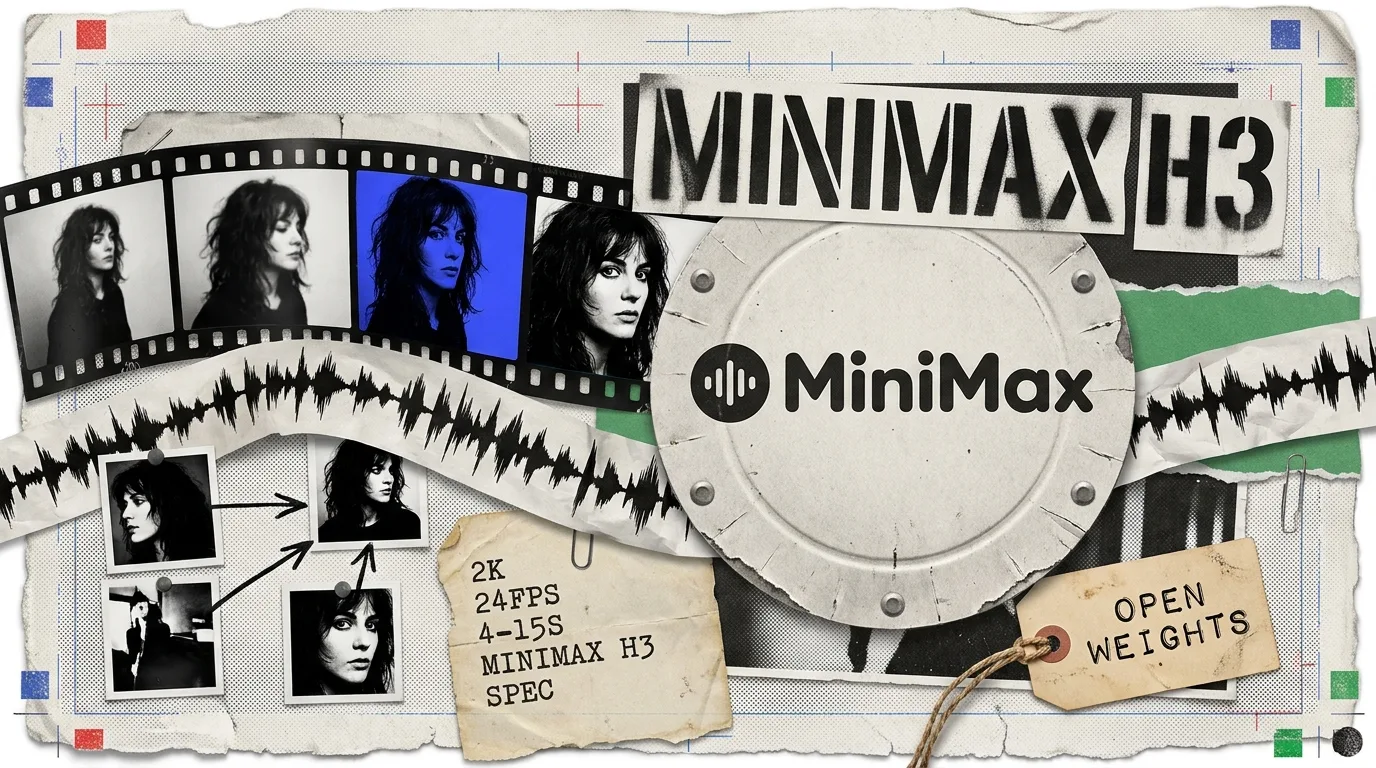
The open flagship. MiniMax H3, running in the Hailuo app as Hailuo 3.0, generates 2K video with native stereo audio in one pass and leads the open-weight field on the public arenas.
What it is
MiniMax H3 is the model that replaced Hailuo 2.3 at the top of MiniMax’s video line. It launched in the Hailuo app and API on 31 July 2026, where it appears as Hailuo 3.0, and the weights followed onto Hugging Face, GitHub and ModelScope on 3 August. Within days of that release the public arenas had it at or near the top of the field, and as the strongest openly published video model it now carries the standard for the open-weight side of the market.
What is actually new
The headline change is that H3 is one model rather than a toolbox. MiniMax describes the design as an Omni Transformer, a single 33-billion-parameter system that takes text, images, video and audio together as context. A single generation can draw on up to nine reference images, three reference clips and three reference audio tracks, which folds the jobs that used to need separate editing, reference and motion tools into one pass. Two checkpoints were published: a text-to-video model that also handles first-and-last-frame control, and an omni-reference model for generations steered by supplied material.
The second change is sound. H3 generates 32kHz stereo audio, including dialogue, effects and ambience, in the same pass as the picture. Hailuo 2.3 made no claim of native audio at all, so this closes the gap that had opened up against Google’s Veo line and ByteDance’s newest Seedance releases. Output runs up to 2K resolution at 24 frames per second, in clips of 4 to 15 seconds, with stable speech in eleven languages.
The scoreboard
On the Artificial Analysis video arena, checked on 8 August 2026, H3 sat second in text-to-video with audio on an Elo of 1,240, four points behind Google’s Gemini Omni Flash, second in image-to-video with audio, and first outright in video editing. Arena’s separate leaderboard put the same release 280 points clear of the next best open model, Tencent’s HunyuanVideo 1.5, with Hailuo 2.3 back at 27th. The arena.ai boards checked on 29 August 2026 keep it at the front: H3 holds first place on image-to-video at an Elo of 1,494, six points clear of Google’s Gemini Omni 1.1 Flash, while it sits third on video editing behind Alibaba’s Wan 3.0 and ByteDance’s Seedance 2.5, and sixth on text-to-video. Leaderboards move week to week, but on the boards that working teams actually watch, the open-weight crown changed hands at the end of July and has stayed put since.
Price and access
The published pay-as-you-go rates are $0.13 a second for 2K output and $0.08 a second at 768p, with a $0.05-a-second rate for upscaling an existing 768p generation to 2K. MiniMax’s own framing is that the 2K rate undercuts mainstream rivals by more than two thirds, which is its claim rather than an audited comparison, but the listed prices do sit well below Veo-class rates. Access runs through the Hailuo app, the MiniMax Hub desktop app, the Open Platform API under the model id MiniMax-H3, and the usual third-party hosts, including OpenRouter and fal.ai.
The licence catch
The open weights come with a serious geographic restriction, and it needs reading before anyone builds on them. The MiniMax H3 Community License, effective 2 August 2026, names the United Kingdom, the European Union, the United States and South Korea as excluded territories: the licence does not permit using the weights, or their outputs, inside them. Press reporting has linked the carve-out to ongoing copyright litigation against MiniMax, though the company’s own licence text gives no reason. Organisations with more than $20 million in annual revenue also need separate written authorisation. For a UK team the practical reading is short: the app and the API are fine, self-hosting the weights is not licensed here.
MiniMax Design, the desktop app built around it
H3 also has a dedicated application wrapped around it. MiniMax Design, at design.minimax.io, is a desktop program whose front page currently leads on “H3 LIVE NOW”, and it is a production tool rather than another prompt box: the work is laid out on a single canvas, and four agents run on it at the same time, one drafting copy, one generating stills, one assembling the video timeline and one producing voiceover and music.
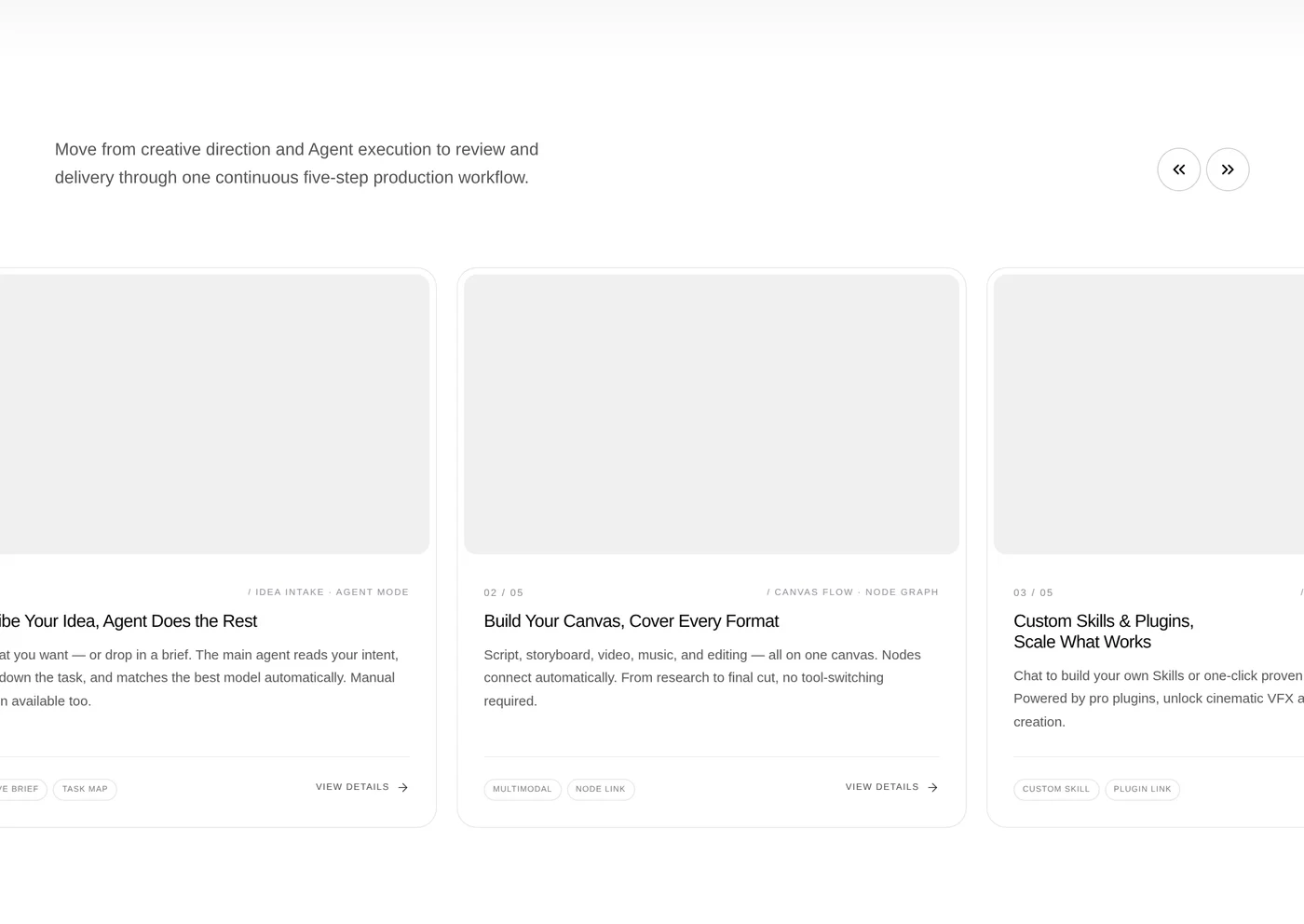
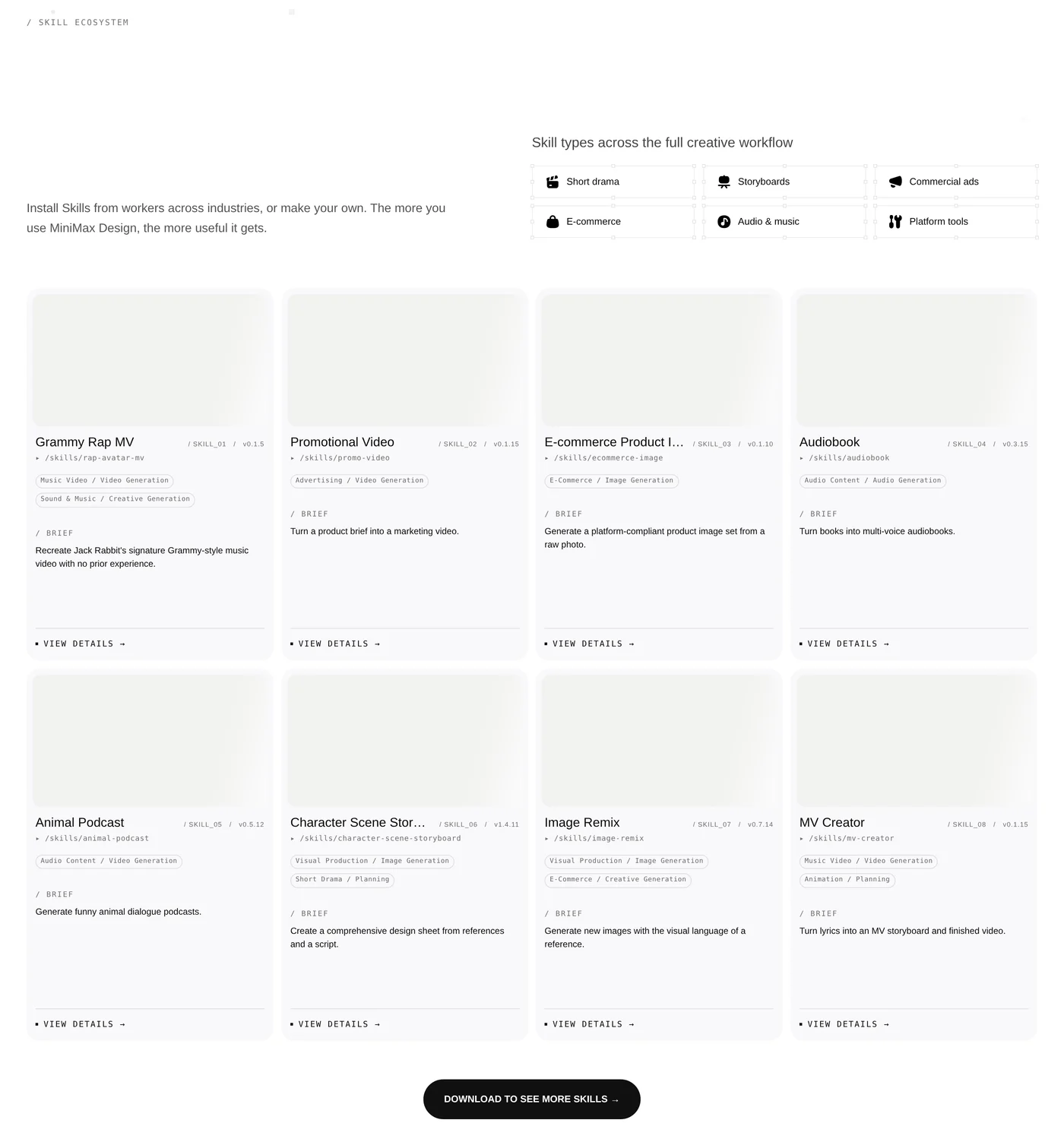
The five stages MiniMax describes run from an idea the agents interpret and route to the right model, through the canvas where nodes connect on their own, to a review loop with checkpoint approvals before anything is handed over. Two details make it a working tool rather than a demo. Assets auto-save to the local disk and open in the editing software a studio already uses, and the behaviours are packaged as Skills that can be installed, written from scratch and shared, with a Creator Program that pays a revenue share on the ones other people adopt. Paid access runs through the Media Plan subscription on top of a free tier, and there is a separate enterprise tier for studios and brands.
The app is Windows 10 and above on x64, or macOS 13 and above on Apple silicon or older Intel chips. There is no web version. It carries no dated release note: the version string in the footer reads V.1.0, the build is labelled Director’s Build, and MiniMax has published nothing about it on its news or blog pages, so the product page itself is the only account of what it does. The efficiency figures it advertises, six times faster from brief to first cut, three times the output, forty hours saved on a project, are the company’s own and carry no audit.
For a UK reader the licence problem on this page does not apply here. The excluded-territory clause covers the weights and what is made with them when they are run locally; a subscription to a hosted app is the route the licence leaves open, which is the same position as the Hailuo app and the API.
MiniMax Code, the company’s other desktop app, is a separate product on its own release track, and it picked up H3 generation in version 3.0.66 on 19 August 2026.
How it fits the field
H3 lands as the clearest statement yet of the pattern this hub has tracked all year: the strongest open video models come from China, and they are now trading places at the very top of the boards with the closed Western flagships rather than trailing them. Teams already on Hailuo 2.3 get character motion that no longer arrives silent; teams choosing a vendor fresh get frontier-grade output at open-market prices, with the licence question above deciding how they run it. The wider field, and where each rival stands, is on our AI video models hub, with the labs behind them covered across the AI section.
More in Video Generation
All Video →- GuideClaude + MCP for videofrom a written brief to a finished shot
- GuideSeedance 2.5 promptingthe official method, decoded
- xAIGrok Imagine Video 1.5 Liteshort video generation at three resolutions
- HeyGenHeyGen Video 1.0short video with native audio
- Google DeepMindGemini Omni 1.1 Flashthe production release of Google's video line
- AlibabaWan 3.0hosted only, with nothing to download