
ByteDance
Seedance 2.0 and 2.5
the long-form image-to-video pair
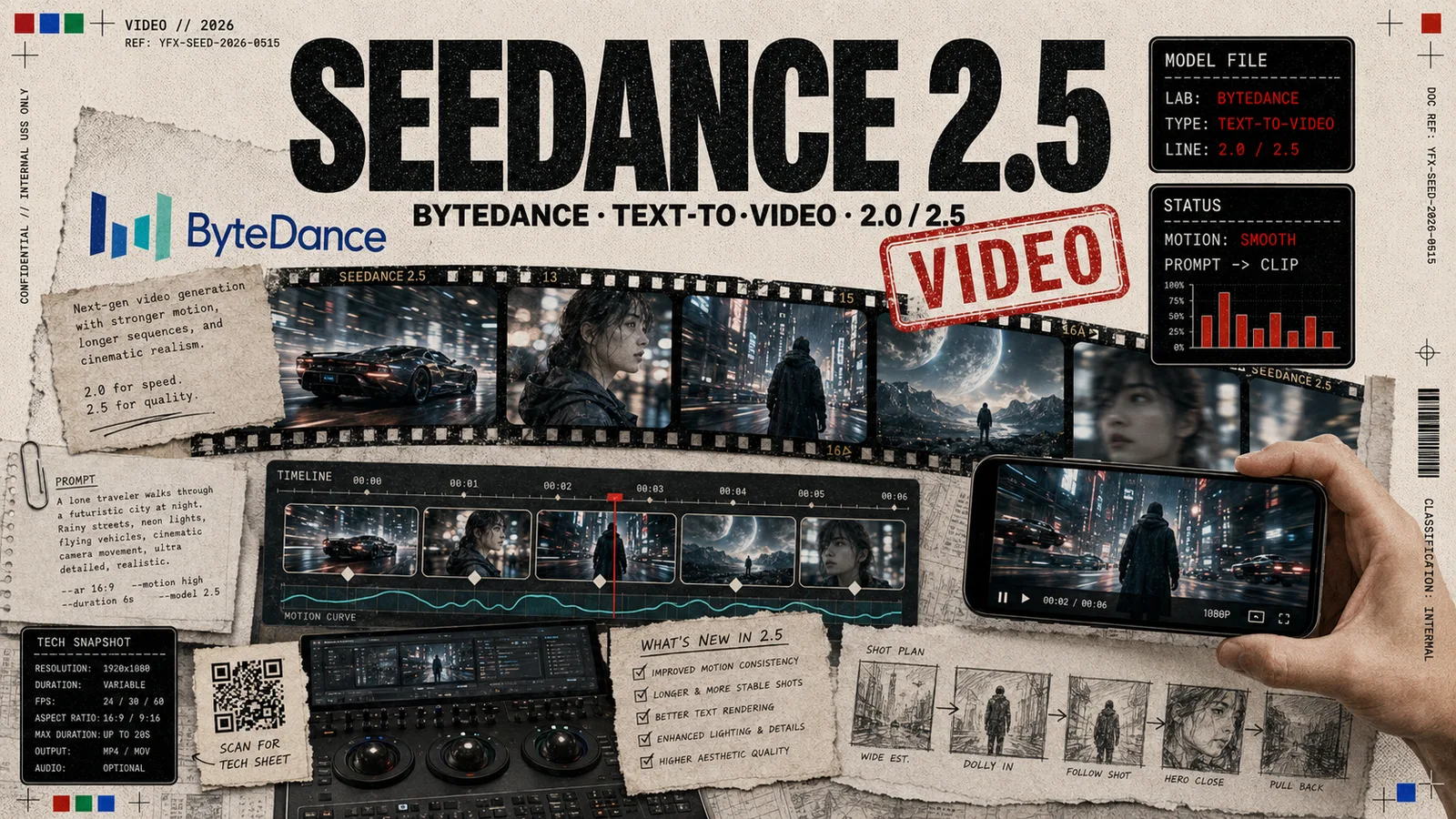
Key facts
- 2.5released 31 July 2026
- Newest
- 4th2.0, AA image-to-video with audio, read 27 Sep
- Rank
- 2nd2.5, arena.ai, read 27 Sep 2026
- Video editing
- 30sSeedance 2.5, single pass
- Max length
- Nativemulti-shot output
- Audio
Seedance 2.5 landed on 31 July 2026 with 30-second single-pass clips. On the arena.ai boards read on 27 September 2026 it sits second on video editing, four points behind Wan 3.0, and fourth on image-to-video; Seedance 2.0 is fourth for image-to-video with audio on Artificial Analysis.
What it is
Seedance 2.5 is ByteDance’s flagship video generation model, and the story of how the family got here is one of the fastest ascents anyone has managed. The line began with Seedance 2.0, which landed on 12 February 2026 and took first place on the Artificial Analysis board for image-to-video with audio. On that board, read on 27 September 2026, it sits fourth on an Elo of 1,176, behind fal’s post-trained MiniMax H3 Max on 1,194, MiniMax H3 on 1,181 and Google’s Gemini Omni Flash on 1,178. Seedance 2.5 followed on 31 July 2026 and pushed the family further still, arriving as the strongest long-form image-to-video option available, with native audio, multi-shot output, clips of up to 30 seconds in a single pass, and direction from up to 50 multimodal reference inputs. Resolution is the one place it went backwards: 2.5 generates at 480p or 720p only, where 2.0 offered a 1080p and 4K path. ByteDance published a full prompting guide for it on 7 August 2026. For anyone building from a still image rather than a text prompt, Seedance 2.5 is one of the references against which the rest are judged.
Image-to-video strength
The image-to-video distinction is worth dwelling on, because it is where Seedance 2.5 does its most useful work. A great many projects start from a fixed frame: a product shot, a piece of key art, a character design that has already been signed off. Turning that into motion while keeping the original faithful is a harder task than generating from scratch, and it is precisely the task Seedance 2.5 handles best. Add native audio, so the clip arrives with sound rather than needing a separate pass, and multi-shot output, so a sequence can be built without stitching each cut by hand, and the model covers most of what a production team actually needs from generated footage.
The ByteDance advantage
None of this happened in isolation, and the competitive point is the one worth making loudest. ByteDance owns TikTok, which means it controls both the distribution to put a model in front of an enormous audience and the video corpus to train it well in the first place. It has used both, and the result is that Seedance took first place from Runway and OpenAI inside twelve months, a turnaround that would have looked implausible at the start of 2025. A company that runs the world’s largest short-video platform sits on exactly the training data a video model needs, and Seedance 2.5 is the clearest evidence yet of what that advantage produces once a serious research effort is pointed at it.
How to access it
Access is broad and clearly structured. ByteDance ships Seedance through Volcano Engine, its cloud platform, for developers and enterprises, and through the Dreamina and Jimeng consumer surfaces for creators who want a finished product rather than an API. The underlying research is published by the Seed group, so the work behind Seedance 2.5 is documented rather than hidden, which is more than can be said for some competitors. That mix of enterprise cloud, consumer apps and open research gives the family reach across the whole spectrum of users, from a solo creator to a large studio.
The buyer calculation
For a buyer, the calculation is familiar from the rest of the Chinese cohort. Seedance 2.5 offers 30-second single-pass image-to-video from near the top of the board, and it does so from a vendor with formidable resources behind it. Against that sit the usual considerations for a Western team: data residency, procurement policy and the absence of the mandatory provenance watermarking that some regulated buyers treat as non-negotiable. For a studio whose first priority is output quality, especially image-to-video quality, those questions are answerable and the model is hard to beat. For a bank or a broadcaster with a strict compliance regime, the decision is more finely balanced.
Seen across the wider field, Seedance marks the moment the centre of gravity in generated video moved east. Runway and OpenAI defined the early era; ByteDance now sets the pace of releases. The arena.ai boards read on 27 September 2026 give the family’s current standing. Seedance 2.5 sits second on video editing on an Elo of 1,410, four points behind Alibaba’s Wan 3.0, which took the top slot in the last week of August. On image-to-video Seedance 2.5 ranks fourth on 1,477, behind MiniMax H3, Google’s Gemini Omni 1.1 Flash and Wan 3.0, with Seedance 2.0 fifth on 1,475. On text-to-video Seedance 2.0 is fifth on 1,479 and Seedance 2.5 seventh on 1,474. On the Artificial Analysis board for image-to-video with audio, read the same day, Seedance 2.0 is fourth on 1,176, behind fal’s post-trained MiniMax H3 Max on 1,194. Anyone tracking where this technology is heading should watch the Seed group’s output closely. For the full ranking and how the rivals compare, see our AI video models hub, part of our wider AI coverage.
More in Video Generation
All Video →- GuideClaude + MCP for videofrom a written brief to a finished shot
- GuideSeedance 2.5 promptingthe official method, decoded
- xAIGrok Imagine Video 1.5 Liteshort video generation at three resolutions
- HeyGenHeyGen Video 1.0short video with native audio
- Google DeepMindGemini Omni 1.1 Flashthe production release of Google's video line
- AlibabaWan 3.0hosted only, with nothing to download