
PixVerse
PixVerse V6
multi-shot for creators
Key facts
- V6PixVerse
- Version
- Multi-shotsocial clips
- Built for
- Nativesound attached
- Audio
- Repeatabletest and learn
- Workflow
- Alibabaalso R1 world model
- Backer
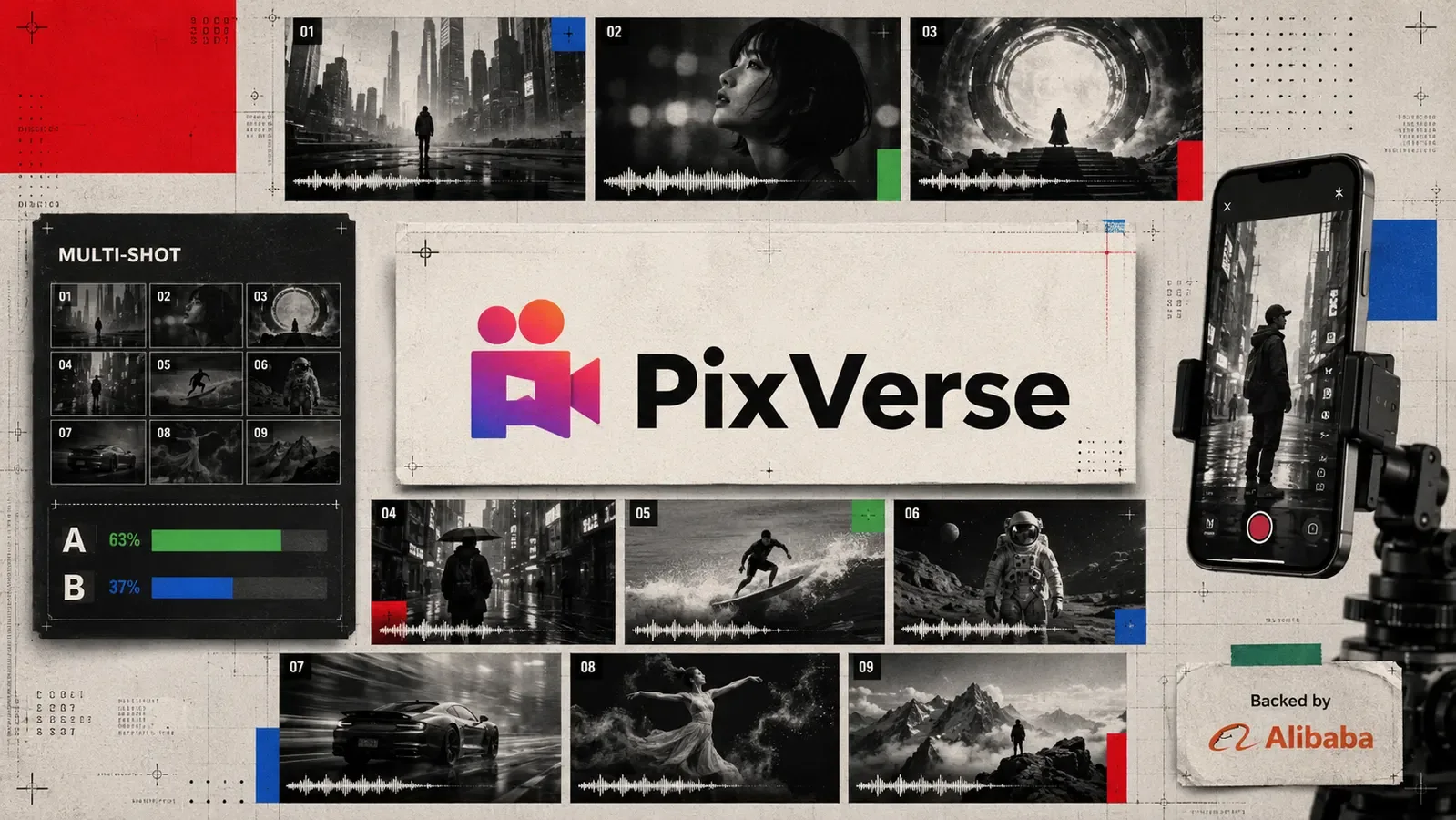
Multi-shot for creators. Built for creators who need multi-shot generation, native audio and repeatable testing.
What it is
PixVerse V6 is a video model built with a specific user in mind: the creator who has to produce a steady stream of short clips for social feeds. Where some models chase cinematic realism, PixVerse V6 is designed around multi-shot generation, native audio and repeatable testing, the three things a working creator needs when the job is volume and rhythm rather than a single perfect frame. That focus makes it the practical recommendation for social-first production, where the demands of the feed outrank strict photographic realism.
Multi-shot and native audio
The multi-shot capability is the core of it. A social clip is rarely a single continuous take; it is a sequence of short shots cut together to hold attention. A model that can generate multiple shots, rather than one long roll, fits that grammar directly, so a creator can assemble a finished piece from parts the system produces rather than fighting a tool that only wants to make one clip at a time. Native audio adds to that: the generation arrives with sound already attached rather than needing a separate pass to add a track, which removes a step from an already tight production loop. For a team that has to keep a channel fed, that reduction in steps is worth more than a marginal gain in fidelity, because the constraint is time and consistency far more often than raw quality.
Repeatable testing
Repeatable testing is the least glamorous of the three features and often the most useful. Anyone producing for social platforms is, in effect, running experiments: trying variations of a hook, a style or a pace to see what the feed rewards. A model that supports repeatable testing lets a creator hold most variables steady and change one, which is the only reliable way to learn what works. PixVerse V6 treats that iterative, test-and-learn workflow as a first-class use case rather than an afterthought, which is exactly what a social-first operator wants.
Ownership and the trade-off
The ownership is worth noting. PixVerse is Alibaba-backed, and it is the same company behind the R1 interactive world model. That connection places PixVerse V6 inside the broader Chinese push into generative video, and it links a consumer-facing social tool to more experimental work on interactive world models, the systems that generate an environment a user can move through rather than a fixed clip to watch. A company working on both ends, the immediately practical and the more speculative, has a wider view of where the technology is heading than a single-product studio.
The honest framing of the model is that it trades strict realism for fitness to purpose. For a feature film or a photoreal advertisement, a creator would reach elsewhere; for a channel that has to post several times a day and lives or dies by watch-through, the priorities invert, and feed rhythm outweighs the last few per cent of realism. Understanding that trade-off is the key to using the model well. It is not trying to win the realism benchmarks, and judging it by them would miss the point of how it is built.
Where it sits
Across the AI video field, PixVerse V6 is the pragmatist’s tool for social production. As generated video floods short-form platforms, models tuned for multi-shot output, built-in sound and fast iteration are likely to do more everyday work than the headline-grabbing realism engines, simply because that is where the volume is. The link back to Alibaba and to interactive world models is the thread to watch: a social video tool today can be the on-ramp to something more immersive tomorrow. For the broader context of what these labs are building, the AI hub follows the same companies across other kinds of model.
More in Video Generation
All Video →- GuideClaude + MCP for videofrom a written brief to a finished shot
- GuideSeedance 2.5 promptingthe official method, decoded
- Google DeepMindGemini Omni 1.1 Flashthe production release of Google's video line
- AlibabaWan 3.0hosted only, with nothing to download
- MiniMaxMiniMax H3the open flagship
- Google DeepMindVeo 3.1the safest Western default