
Shengshu Technology
Vidu Q3
the efficient challenger
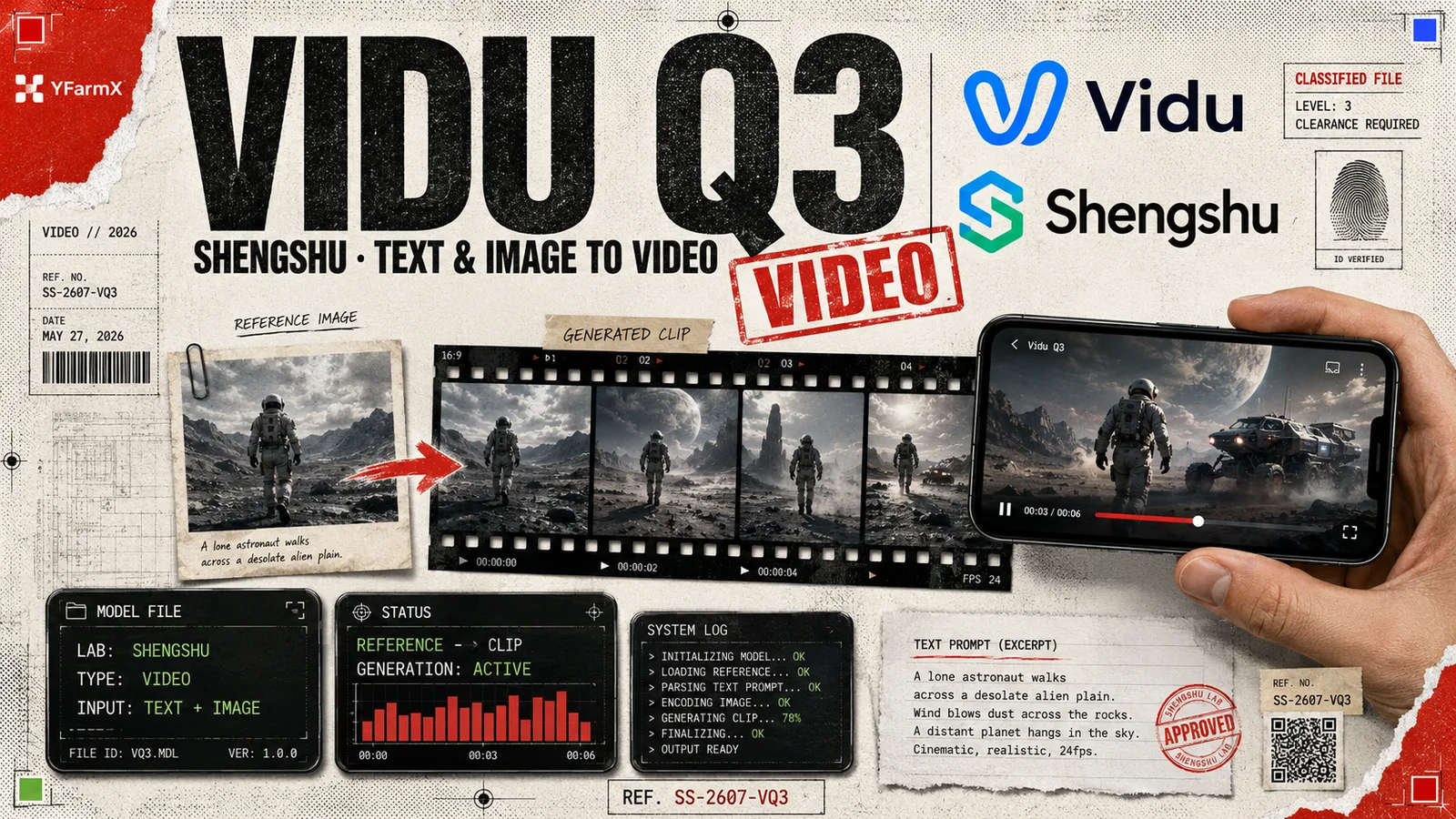
Key facts
- Q3Vidu
- Version
- 15-16ssingle-pass
- Max length
- With-audiocompetitive
- Leaderboard
- ShengshuTsinghua-affiliated
- Lab
The efficient challenger. Chinese video model with single-pass clips in the 15 to 16 second band, competitive on the with-audio boards.
What it is
Vidu Q3 is the video model from Shengshu Technology, a Chinese lab that deserves a place in any serious survey of the field even if it does not top the headlines. Its calling card is efficiency: Vidu Q3 produces single-pass clips in the 15 to 16 second band and is competitive on the leaderboards that rank models with audio. In a section crowded with better-known names, it is the efficient challenger, and a reminder that the Chinese video field runs deeper than the three or four companies that usually get named.
Single-pass length
The single-pass length is the technical point worth understanding. A single-pass clip is generated as one continuous piece rather than assembled from shorter segments stitched together, and holding coherence across a longer continuous generation is genuinely hard: motion has to stay consistent, objects have to keep their shape, and the scene has to remain stable from the first frame to the last. A model that can hold that together for 15 to 16 seconds in a single pass is doing serious work, and it puts Vidu Q3 in the same practical bracket as models that advertise their length far more loudly.
The with-audio boards
The reference to the with-audio boards places the model against its peers. Several public leaderboards now rank video models specifically on generations that include sound, since native audio has become part of what these systems are expected to deliver rather than an optional extra. Being competitive on those boards means the model is judged as a complete package, picture and sound together, and holds its own there, which is a more demanding test than being ranked on silent footage alone. Adding sound that fits the picture is harder than it sounds, because the model has to keep audio and motion aligned, and a leaderboard that scores the two together rewards that discipline rather than letting a strong image carry a weak soundtrack.
The lab and the field’s depth
The lab behind it is part of the story. Shengshu Technology is affiliated with Tsinghua University, one of China’s leading research institutions, and that academic lineage sits behind the model. A system coming out of a top university lab tends to carry a research pedigree that a purely commercial operation may not, and it points to the depth of talent working on generative video inside the Chinese system. This is why the model earns its place here for completeness. Leaving it out would give a misleading picture of how many capable teams are active.
That completeness point is the one to hold on to. The Chinese video field is often summarised through its largest names, ByteDance, Alibaba and Kuaishou, as though those companies were the whole story. Vidu Q3 is the counter-example: a smaller, university-linked lab producing a model that competes on length and on the with-audio boards, which shows the field has real depth beyond the obvious three. Overlooking that depth leads to a lopsided view of who is actually building capable video models.
Where it sits
Vidu Q3’s place in the AI video field is as evidence of breadth. The efficient challenger will not be the first model most people reach for, yet its existence changes the map: it shows that the capability to generate long, audio-equipped clips is spread across many teams rather than concentrated in a few, and that a Tsinghua-affiliated lab can hold its own against far larger companies. As the field matures, that breadth is likely to keep prices down and quality up across the board, and Shengshu is one of the reasons the Chinese part of the market looks as strong as it does. For the broader view, the AI hub tracks the same labs across other kinds of model.
More in Video Generation
All Video →- GuideClaude + MCP for videofrom a written brief to a finished shot
- GuideSeedance 2.5 promptingthe official method, decoded
- Google DeepMindGemini Omni 1.1 Flashthe production release of Google's video line
- AlibabaWan 3.0hosted only, with nothing to download
- MiniMaxMiniMax H3the open flagship
- Google DeepMindVeo 3.1the safest Western default