
Alibaba
Wan 2.7
the open workhorse
Key facts
- 2.2 openpermissive
- Licence
- 1.3BT2V params
- Small variant
- Localconsumer GPU
- Runs on
- Wanseveral sizes
- Family
- 2.7Alibaba
- Version
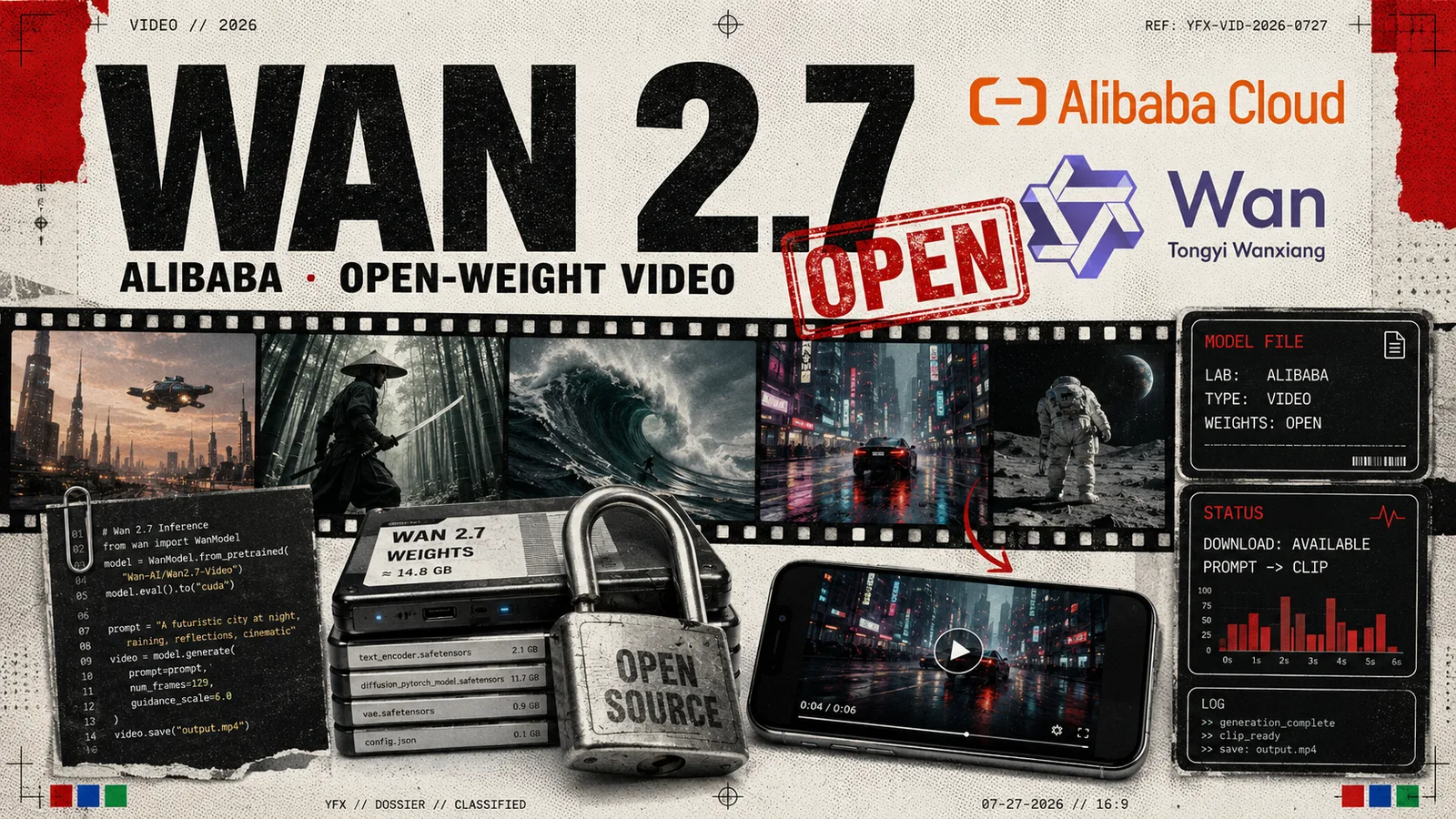
The workhorse of Alibaba's Wan video family. Wan 2.7 runs on hosted APIs, while the openly downloadable weights on Alibaba's own repositories stopped at Wan 2.2 when this page was checked in August 2026, under Apache 2.0, including a small variant that runs on consumer hardware.
What it is
Wan 2.7 is the generation of Alibaba’s Wan video family covered here, the workhorse line of the open-source end of this section. A precision that most write-ups skip, and the state of play re-checked on 30 August 2026: Wan 2.7 itself was available through hosted APIs, while the weights openly published on Alibaba’s own repositories stopped at Wan 2.2, released under the permissive Apache 2.0 licence in several sizes, including a compact variant small enough to run on consumer hardware. That combination of a free licence and a model that fits on an ordinary graphics card is what made the Wan family the default choice for people who want to generate video without paying for an API, and the thing to check before self-hosting is which generation the downloadable weights have reached.
The family has since moved on above the open line. Wan 3.0, generally available from 24 August 2026, took first place on the arena.ai video-editing board at an Elo of 1,414.1, 4.3 points ahead of ByteDance’s Seedance 2.5, on the reading taken 30 August 2026. It is hosted access only, which is the arrangement described above rather than a departure from it: the Wan organisation on Hugging Face still lists nothing newer than the Wan 2.2 line, whose newest uploads were last modified on 13 August 2026, so Wan 3.0 has no published weights, and this page’s self-hosting advice is unchanged.
The model family
The family structure is the first thing to understand. Rather than shipping a single monolithic model, Alibaba publishes the open Wan line, which stops at Wan 2.2, as a range of sizes, from larger variants aimed at quality to the 1.3-billion-parameter text-to-video model built for reach. The small model is the interesting one. At 1.3 billion parameters it will run on the kind of graphics card a hobbyist or a small studio already owns, which means a creator can generate short clips locally, in a tight loop, without sending anything to a server or paying per generation. Alibaba positions that variant for concepting loops: quick, cheap, repeatable passes where the point is to try an idea rather than to produce a finished frame.
Why workhorse fits
That local, low-cost workflow is why the word workhorse fits. A model that runs on your own hardware can be used all day without a bill mounting up, and it can be woven into a pipeline in ways a metered endpoint cannot. For iteration, where a creator might generate dozens of variations before settling on one, the economics of a free, locally hosted model of this kind are hard to argue with. The larger variants in the family cover the cases where output quality outranks cost, so the range as a whole spans from fast concepting to more polished delivery.
The strategic picture
The strategic picture is the part worth stepping back for. The open Chinese video stack now mirrors the open Chinese approach to large language models: permissive licences, competitive quality, and a clear intent to make paid Western tools look expensive. The Wan line is a central piece of that. By putting Wan 2.1 and 2.2 under Apache 2.0 and making the smaller versions genuinely runnable on consumer hardware, Alibaba applies the same pressure to the video market that its open language-model releases applied to the language-model market, driving the price of a baseline capability towards zero and forcing the paid tools to justify their premium on quality and integration alone.
That pressure changes the calculation for everyone else in the field. A Western startup weighing whether to build on a closed API now has a credible free alternative it can host itself, and the closed vendors have to price and position against a model that costs nothing to license. The model is not the flashiest in this section, and it does not need to be; its role is to be good enough, free, and everywhere, which is a more disruptive position than being briefly best. Because the Wan 2.2 weights are open, a community of tool-builders can wrap, fine-tune and optimise the model without asking permission, and that unpaid ecosystem work tends to compound over time in a way a single vendor cannot match on its own.
Where it sits
For anyone mapping the open end of the AI video field, Wan 2.7 sits alongside a small group of genuinely open models as the workhorse option, the one to reach for when you want capability without a contract. The parallel with the open language-model story is the thing to watch: if video follows the same path, the base level of quality will keep rising while the price of access keeps falling, and Alibaba’s Wan family will have been one of the reasons why. For the wider context, see the AI hub.
More in Video Generation
All Video →- AlibabaWan 3.0hosted only, with nothing to download
- MiniMaxMiniMax H3the open flagship
- TencentHunyuanVideo 1.5open weights from a hyperscaler
- GuideClaude + MCP for videofrom a written brief to a finished shot
- GuideSeedance 2.5 promptingthe official method, decoded
- Google DeepMindGemini Omni 1.1 Flashthe production release of Google's video line