Stablecoins in Europe: ECB sounds the alarm as dollar tokens storm the gates
Stablecoins in Europe are dominated by dollar tokens, the ECB warns, threatening sovereignty, raising costs and risking bank contagion. Act fast.
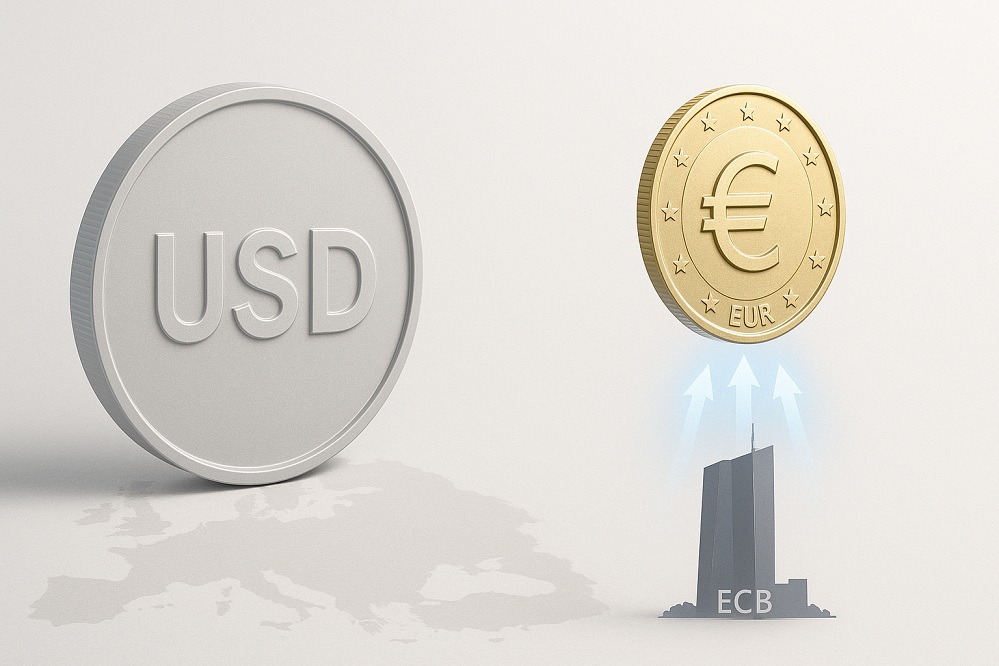
Stablecoins in Europe are no longer a sideshow; they have become a stage on which the US dollar is stealing the spotlight. The European Central Bank’s latest broadside warns that, without a deliberate counter-strategy, Europe may see its monetary sovereignty and financial stability eroded by privately issued, dollar-denominated tokens edging into everyday payments, savings and settlement rails.
Stablecoins in Europe: sovereignty on the line
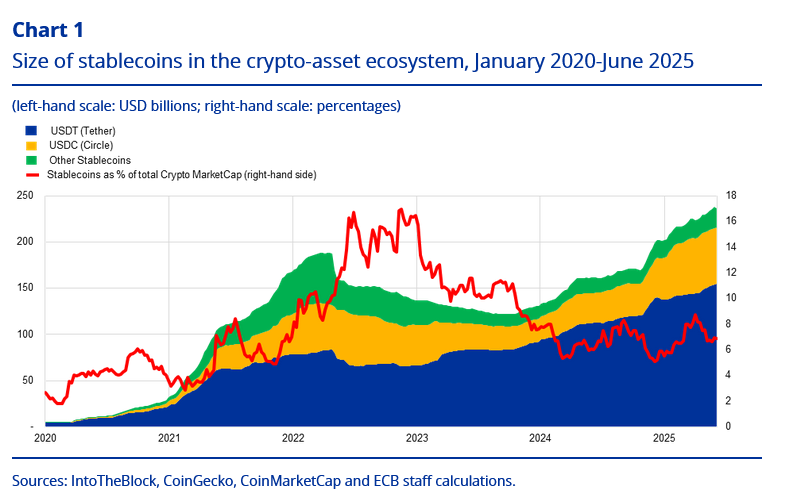
Call them crypto’s grown-ups: stablecoins promise one euro (or dollar) in, one token out – redeemable at par and backed by safe assets. Yet 99 per cent of market capitalisation sits in dollar tokens such as USDT and USDC. Euro-based offerings, by contrast, remain rounding errors at under €350 million. The ECB’s concern is not volume today, but velocity tomorrow: once network effects take hold, undoing them is notoriously difficult.
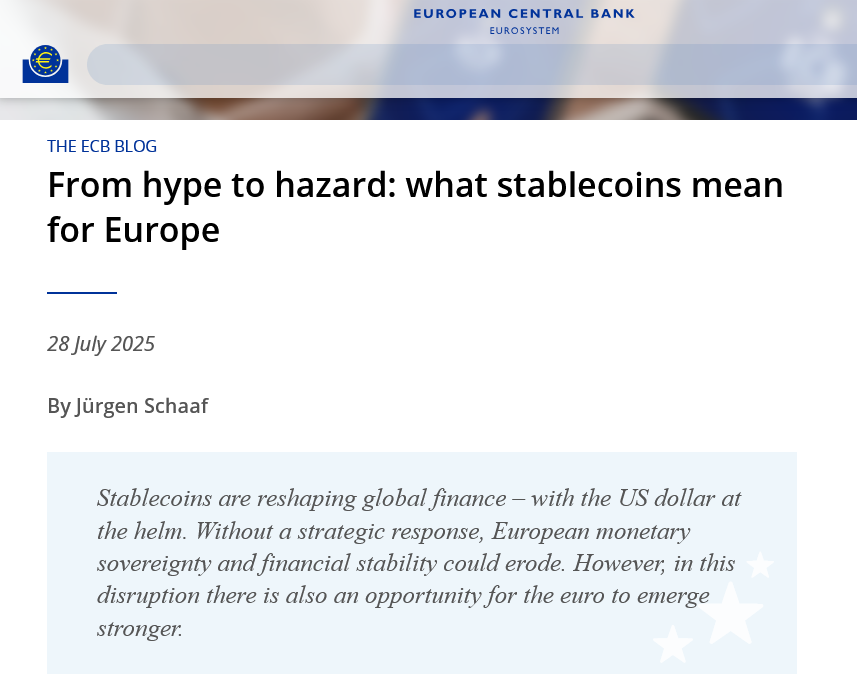
Stablecoins are reshaping global finance – with the US dollar at the helm. Without a strategic response, European monetary sovereignty and financial stability could erode. However, in this disruption there is also an opportunity for the euro to emerge stronger.
— European Central Bank (@ecb) July 28, 2025
From hype to hazard
Stablecoins began as grease for the crypto rails, zipping value between exchanges and across borders. These days they are plugging into traditional finance through bank custody, derivatives and settlement arrangements, scaling up the associated risks. A messy de-pegging would not just bruise speculators; it could ricochet through money markets and balance sheets. The Bank for International Settlements’ 2025 report echoed this view, highlighting fragile pegs, opacity and the possibility of capital flight from weaker jurisdictions. Europe, with its bank-centric system, is especially exposed if deposits leak into token vaults offering quasi-savings yields.
Washington writes the rulebook, Brussels reads the footnotes
Across the Atlantic, the GENIUS Act – signed on 18 July – introduces a federal framework for stablecoins. Analysts reckon it is broadly MiCA-shaped but looser at the edges, and could swell dollar stablecoin supply from roughly $230 billion to $2 trillion by 2028. Meanwhile, US heavyweights such as Visa, Mastercard, Amazon and Walmart are piloting stablecoin rails. If they scale, Europe could wake up to a de facto dollar overlay running atop its own payment infrastructure. The political intent is scarcely disguised: embed the dollar into digital platforms worldwide and funnel yet more demand into US Treasuries via stablecoin reserves. Cheaper US financing; tighter US grip. Europe picks up the tab.
Pontes, Appia and the digital euro: Europe’s counter-move
What is on the ECB’s menu?
- Support credible euro stablecoins. Neutrality is fine – until it hurts. Properly supervised, well-designed euro tokens could satisfy market demand and buttress the currency’s international role.
- Finish (and promote) the digital euro. At the point of sale, a central-bank digital currency is the “robust line of defence” for sovereignty. If consumers can tap a digital euro as easily as a dollar token, network effects can be tackled on home turf.
- Modernise wholesale settlement. Distributed-ledger technology is not just for crypto enthusiasts. The Eurosystem’s Pontes (short term) and Appia (long term) aim to let tokenised assets settle in central-bank money, slicing costs and delays while reducing reliance on correspondent banking.
- Push global coordination. Fragmented regimes invite regulatory arbitrage and lock in US-dollar dominance. Europe wants common rules – or at least compatible ones.
Remittances, e-commerce checkouts, delivery-versus-payment for tokenised bonds – stablecoins are slipping into use cases far beyond Telegram channels. Some platforms already dangle yields on parked tokens. Should that trend spread, deposits could bleed from banks into token vaults, squeezing credit creation. In a downturn, that is more than a rounding error.
Opportunity in the turmoil
Europe’s hidden advantage is its reputation for being, well, a bit dull – in the best possible way. A rules-based, predictable framework can be a selling point when the rest of the world looks jumpy. With the right mix of regulation, infrastructure and innovation, the ECB argues, the euro could emerge stronger – a dependable anchor while others surf volatility.
 https://www.ecb.europa.eu/press/blog/date/2025/html/ecb.blog20250728~e6cb3cf8b5.en.html
The warning shot is clear: stablecoins are here, and the dollar currently wears the crown. Whether Europe shrugs or strategises will help decide who writes the next chapter of digital money.
*Not financial advice.
From the YFarmX archive · originally published on the previous site