What is x402? The internet native payments protocol
What is x402? A machine to machine payment standard that revives HTTP 402 Payment Required so clients can pay for web resources using stablecoins inside the request itself.
What is x402? A machine to machine payment standard that revives HTTP 402 Payment Required so clients can pay for web resources using stablecoins inside the request itself. Built as an open, chain agnostic specification, x402 removes accounts, API keys and subscription walls, letting AI agents and apps purchase data, compute and content on demand with near instant settlement and zero protocol fees.
What is x402?
x402 treats payment as part of HTTP rather than a separate billing system. A client requests a resource, the server replies with a 402 Payment Required plus instructions, the client signs a payment payload and retries, and the server verifies and fulfils. Because the payment message rides with the request, the transaction doubles as authentication. No separate logins, no cookies, no key management overhead. For builders, that means lower integration cost and fewer moving parts. For users and autonomous agents, it means predictable micropricing for one off access rather than coarse subscriptions.
Coinbase launched the standard in May this year, explicitly targeted for the AI economy. Agents can pay cents or fractions of a cent for API calls, model inference, GPU minutes or single article access, then move on. Settlements target seconds on modern L2s, and the protocol design hides gas and RPC complexity behind libraries and optional facilitators. The result is a web native payment rail that finally matches the latency and granularity of API driven commerce.
It’s been incredible to see x402 go viral this week!
For anyone new, welcome to the movement.
I designed x402 to be the HTTP of money: a universally accepted, neutral, core primitive to help make the internet ready for the AI era.
I can’t wait to see what people build 🛠ï¸
— erik.eth 🛡 (@programmer) October 24, 2025
Adoption has accelerated as infrastructure firms integrate x402 into their stacks. Cloud platforms, CDNs and AI tooling vendors have piloted support, while payments and stablecoin providers see a straightforward path to wider utility for tokenised dollars. Weekly usage has spiked as agentic workloads ramp, with tens of thousands of unique buyers and six figure volumes flowing through early deployments. The draw is simple: low fees, instant fulfilment, global reach and programmatic control.
How x402 works in practice (technical)
At the protocol layer, the resource server defines payment requirements in a standard JSON body when returning HTTP 402. Those requirements describe the scheme, chain, asset, pay to address and the amount or ceiling. The client library constructs a signed payload (typically EIP 712 for EVM chains) and resubmits the original request with an X PAYMENT header carrying the base64 encoded payment data. The server validates locally or calls a facilitator to verify signatures, balances, nonces and limits. If valid, the server settles and returns 200 OK, optionally attaching an X PAYMENT RESPONSE with execution details such as tx hash.
The first production scheme is exact, a fixed price payment that pairs cleanly with USDC and other EIP 3009 capable tokens to support gasless approvals and swift transfers. Metered and deferred schemes are emerging to support per unit billing or batch settlements. Each scheme network pair is explicit, so non EVM chains can implement their own cryptography and authorisation semantics without contorting to EVM assumptions.
Facilitators are optional but useful. They expose verify, settle and discovery endpoints, abstracting signature checks, nonce handling, broadcast and confirmations. A facilitator can be run by an exchange, a cloud platform or the resource owner. Because the signed payload scopes spending to the exact requirements, a facilitator cannot arbitrarily move funds. This keeps trust minimised while delivering a workable developer experience.
What you can build with it
The obvious fit is AI agents that pay per use for context, tools and compute. An agent can buy a single dataset query for two cents, rent a model endpoint for a few milliseconds, or unlock an article for a quarter. Content platforms can drop subscriptions and sell per view access without handling card data or building entitlement systems. DePIN networks can charge per gigabyte served or per GPU minute consumed. Developer utilities (crawlers, indexers, social APIs, workflow runners) can expose public endpoints and let x402 gate them cleanly.
Because payment equals authentication, even small teams can ship paywalled endpoints with one line of middleware in common frameworks. Client libraries handle signing and retries. Documentation templates make it easy to publish pricing and supported assets. For marketplaces, a directory of x402 endpoints creates a discovery layer where agents can price compare and switch suppliers without new accounts.
x402 is finally catching fire, but how do you actually build with it?
In this video you’ll learn how to build custom x402 agents in just 5 minutes. 🔥
The app is Open Source and gets you started with both a client and a merchant agent, everything you need to build your own… pic.twitter.com/USHl3iSN4A
— nader dabit (@dabit3) October 24, 2025
Benefits and trade offs
Compared with card rails, x402 cuts away 2 to 3 percent fees and minimum ticket sizes. Settlement is seconds rather than days. Chargebacks disappear, which simplifies operations but removes a consumer protection vector. Compliance can be layered via attestations when required, but the base protocol carries no personal data, which is good for privacy and global reach. The trade offs are familiar to crypto builders (wallet UX, key management, and the need to plan for network fees, even if small). Facilitator decentralisation and robust nonce handling are important to avoid lock in and replay risk. On performance, L2s keep latency tight enough for interactive flows, and schemes like deferred help where batching makes sense.
The adoption picture
Ecosystem growth now spans facilitators, client SDKs, server middleware and early service providers across AI, infra and content. Stablecoin issuers, cloud vendors and CDNs are experimenting with built in support so developers can flick a switch rather than stitch components. Directory style sites make endpoints discoverable, while grants and hackathons are seeding new use cases. A cluster of community tokens backs tooling and attention, but the core driver remains practical utility: cheaper, faster, programmable access.
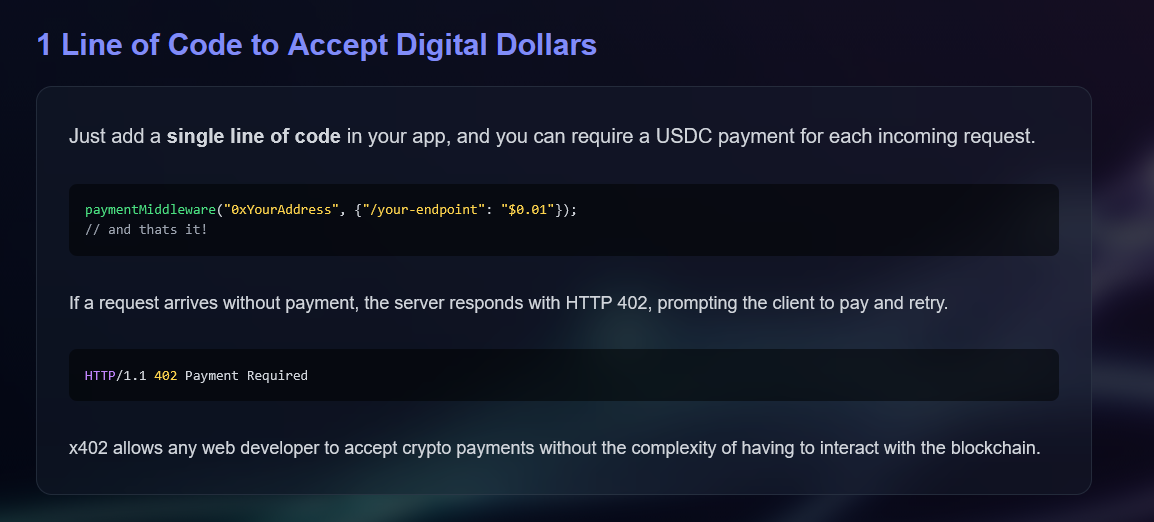
For teams already selling APIs, the migration path is incremental. Keep existing auth for enterprise accounts, expose a parallel x402 tier for agents and long tail users, then observe conversion and support load. For new products, start with x402 first and avoid building an auth and billing stack you do not need.
What to watch next
Three signals matter over the next quarters. First, standardisation of new schemes such as upto and deferred that unlock metered and subscription like patterns. Second, cross chain breadth so Solana, NEAR and others have first class flows alongside EVM. Third, governance that keeps the specification neutral while coordinating security practices, test suites and reference implementations. If these land, x402 becomes a default choice for pay per use APIs and agent to agent commerce.
This article is for information only and is not financial advice.
From the YFarmX archive · originally published on the previous site