
Adobe
Adobe Firefly Image Model 5
the licensing answer
Key facts
- 5Image Model 5
- Version
- Indemnifiedlicensed data
- Licence
- Content Credentialson every output
- Provenance
- Creative Cloudbundled
- Access
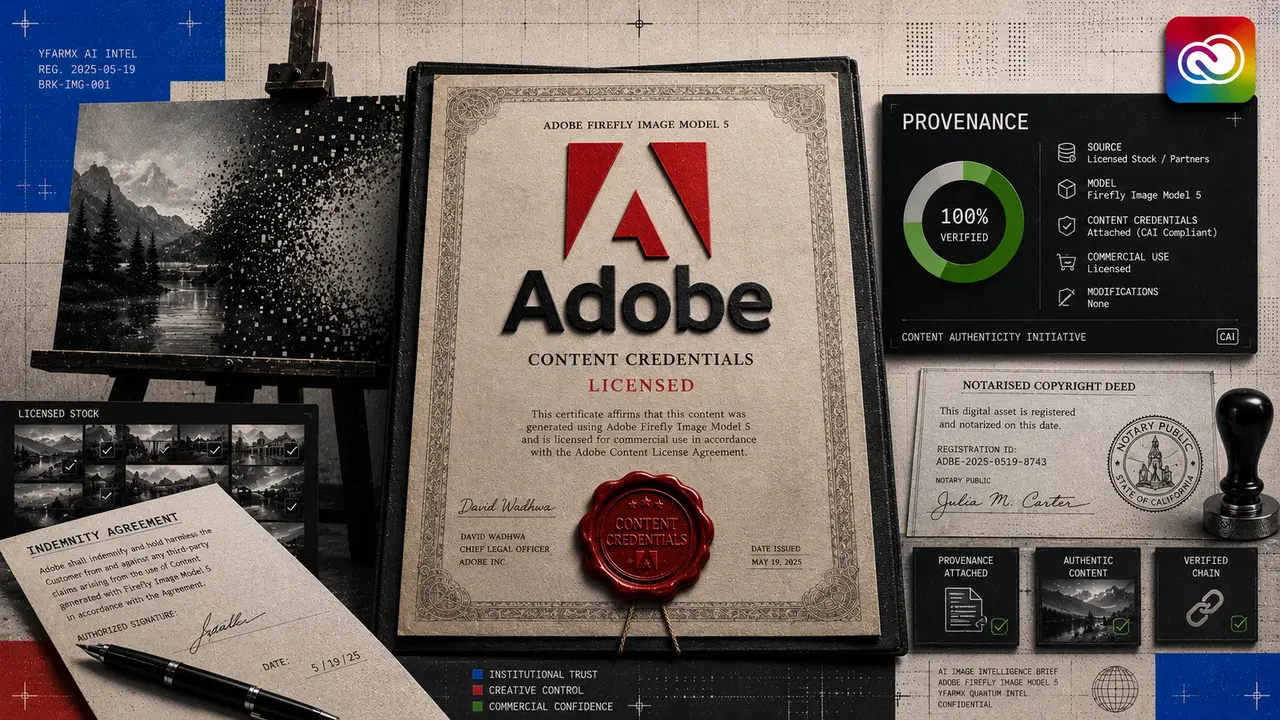
The licensing answer. The clearest provenance story of any commercial image model, trained on licensed and Adobe Stock content, bundled into Creative Cloud, with Content Credentials attached to output.
What it is
Adobe Firefly 5 is the image model that sells on paperwork as much as on pixels. Formally Adobe Firefly Image Model 5, it carries the clearest provenance story of any commercial image generator on the market: it is trained on licensed and Adobe Stock content, bundled into Creative Cloud, and ships with Content Credentials attached to every output. For a working designer, that combination answers the question a client’s legal team tends to ask first, which is where the training data came from and who is liable if it turns out to be a problem.
Why buyers choose it
The commercial argument for Adobe Firefly 5 rests less on raw quality than on indemnification and an audit trail. Adobe’s position is that the material behind the model was either licensed or drawn from its own stock library, so the company is prepared to stand behind what the model produces. For an agency operating under client contracts that assign liability for training data, that willingness can settle the decision on its own. The image does not need to be the best available anywhere; it needs to be defensible, and defensible is precisely what Firefly is engineered to be. This is a narrower promise than “the highest fidelity model”, and a more valuable one to a certain kind of buyer.
Content Credentials are the mechanism that carries the claim downstream. They embed a tamper-evident record inside the file describing how the image was made and with which tool, so an asset generated with Adobe Firefly 5 arrives with its origin documented rather than merely asserted. As buyers increasingly want to know whether an image is synthetic and where it came from, that metadata does real commercial work: it converts a vague assurance into something an art director or a compliance officer can actually inspect. Provenance stops being a marketing line and becomes a property of the file.
Where it lives
Distribution is the other half of the story. Firefly is not a separate purchase for most of the people who use it; it sits inside the Creative Cloud applications designers already open every day, which is how Adobe reaches an installed base that a standalone generator would take years to assemble. The model does not have to win an open contest for attention, because it is already in the room. For a broader sense of how it fits alongside the rest of the field, see our image models hub.
The Firefly-as-surface complication
There is a complication. Firefly now aggregates third-party models inside the Adobe interface, which changes what “using Firefly” means. The word Firefly now describes two things at once: Adobe’s own model, and a surface that can route a prompt out to models Adobe did not train. The provenance and indemnity guarantees that make Adobe Firefly 5 attractive apply to Adobe’s own model, and are easy to assume cover everything in the app. A buyer who selects an external model through the same familiar interface should check which of those promises still hold, rather than assume the whole surface is covered by the same paperwork.
Where it sits
Where this leaves Adobe Firefly 5 is a distinctive position in the wider AI field. Most labs compete on fidelity and prompt-following; Adobe competes on the licence, the indemnity and the documented paper trail, and it delivers all of that through software its audience already pays for. The open question is whether rivals can match those provenance guarantees without a stock library of their own to train on, and whether “commercially safe” keeps commanding a premium as the industry’s licensing practices are tested in the courts. For now, it has staked out the one part of the image market where the answer to “can we actually publish this?” is written into the product.
More in Image Generation
All Image →- Black Forest LabsFLUX 3 ImageFLUX 3 Image creates and edits pictures with up to ten reference images
- Google DeepMindNano Banana 2.1Image generation, reference pictures and conversational edits
- OpenAIGPT Image 2.5two variants, one price, the top two seats
- OpenAIGPT Image 2the leading line
- AlibabaQwen-Image-2.1one small model for making pictures and editing them
- GoogleNano Banana Pro and Nano Banana 2the 4K value leader