
ByteDance
Seedream 5.0
the reasoning image model
Key facts
- 8 Jul 2026Seedream 5.0 Pro
- Pro released
- $0.026per image
- Lite price
- ~2sfastest high-res
- Lite speed
- Reasoningchain-of-thought
- Capability
The reasoning image model. Seedream 5.0 Pro arrived 8 July 2026; Seedream 5.0 Lite runs at about $0.026 per image and roughly two seconds, the fastest high-resolution option.
What it is
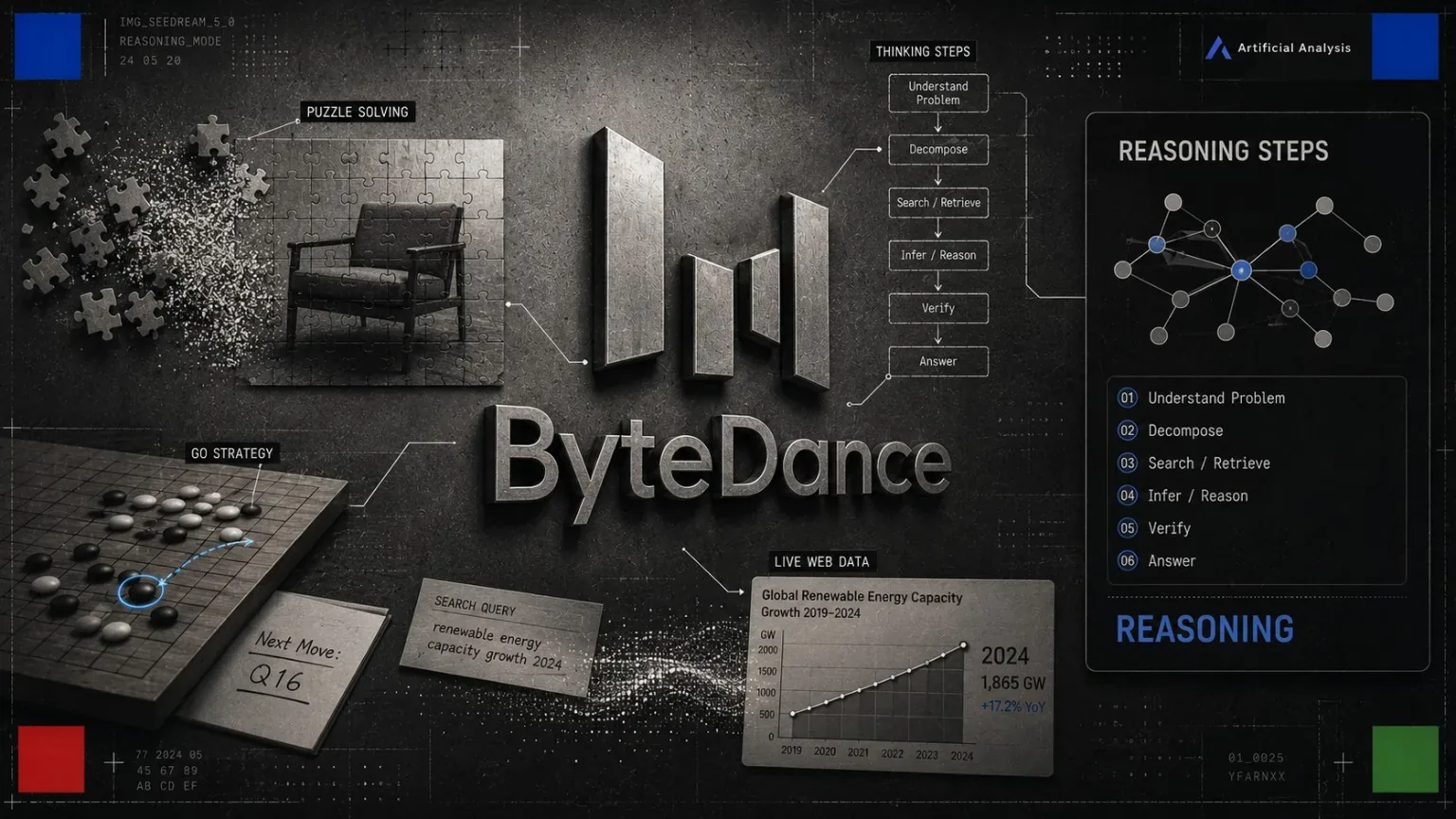
Seedream 5.0 is ByteDance’s image model family, and its defining feature is unusual enough to give it a category of its own: it is the reasoning image model. Where most systems translate a prompt straight into pixels, the family can think through a visual problem before it draws, using chain-of-thought reasoning and live web search in much the way a language model works through a question. Seedream 5.0 Pro, the higher-quality tier, arrived on 8 July 2026, alongside a faster Seedream 5.0 Lite that runs at about $0.026 per image in roughly two seconds, which makes it the quickest high-resolution option currently available.
What the reasoning does
The reasoning is best understood through what the model can do with it. Shown a set of scattered puzzle pieces, it can infer the assembled object they would form and render it. Given a photograph of a Go board, it can read the position and propose a plausible next move. Asked for a chart, it can use live web search to pull current data and draw the figures accordingly, rather than inventing numbers to fill the space. Each of these tasks requires the model to work out something that the prompt does not state, which is the behaviour that earns Seedream 5.0 its reasoning label.
This is the first image family to behave like a reasoning model, and that is the genuine novelty worth dwelling on. Ordinary image generators are, in effect, very capable illustrators that do as they are told. The family adds a step of inference in front of the drawing, closer to how a designer interprets a brief, questions it and fills in the gaps before putting pen to paper. The connection to the wider move towards reasoning in large language models is direct: the same techniques that let a text model plan its answer are being turned towards pictures.
Two generations at once
The aesthetics are strong, but on this page they come second to the reasoning, which is the reason to pay attention. Seedream 4.5, the previous generation, remains widely deployed and continues to serve teams that want dependable, good-looking output without the newer reasoning features, so the family now spans a conventional workhorse and an experimental frontier at once. The Lite tier’s speed and low price also open interactive uses, where a person waits a couple of seconds for a result and the cost per image has to stay small.
That two-track shape, a proven previous generation still in service beneath a reasoning-led flagship, gives buyers an unusually clear choice. Teams that simply need attractive pictures can stay on Seedream 4.5, while those exploring inference and live search can adopt the newer Pro tier without abandoning the older model or rebuilding their workflow around it.
Why ByteDance built it
That ByteDance is behind it is telling. The company runs consumer apps at enormous scale and has the traffic to justify heavy investment in image generation, and it distributes Seedream 5.0 through its own developer platforms and creative tools. A reasoning-capable image model fits naturally into products where a user’s request is vague and the system has to work out what they actually want, which is the everyday condition of consumer software, and it hints at how ByteDance intends to use the technology across its own apps.
What to watch
Within the field of image models, Seedream 5.0 points at a direction the others have not yet taken. If reasoning turns out to reduce the number of attempts needed to reach a correct image, especially for diagrams, data visuals and anything that has to be factually right, the approach could spread quickly. What to watch is whether rivals fold similar reasoning into their own models, and whether the extra thinking step stays fast and cheap enough to use at scale rather than remaining a novelty reserved for demonstrations.
More in Image Generation
All Image →- Black Forest LabsFLUX 3 ImageFLUX 3 Image creates and edits pictures with up to ten reference images
- TencentHY Image 3.5 PreviewTencent’s image generation and editing preview
- IdeogramIdeogram 4.5image generation and precise editing
- AlibabaQwen-Image-2.1-TurboAn eight-step image generator with downloadable weights
- Google DeepMindNano Banana 2.1Image generation, reference pictures and conversational edits
- OpenAIGPT Image 2.5two variants, one price, the top two seats