
Recraft
Recraft V4
native vector output
Key facts
- V4.1V3 + V4 current
- Version
- Vectorno raster step
- Output
- Logosicons + branding
- Best for
- Recraftvector specialist
- Lab
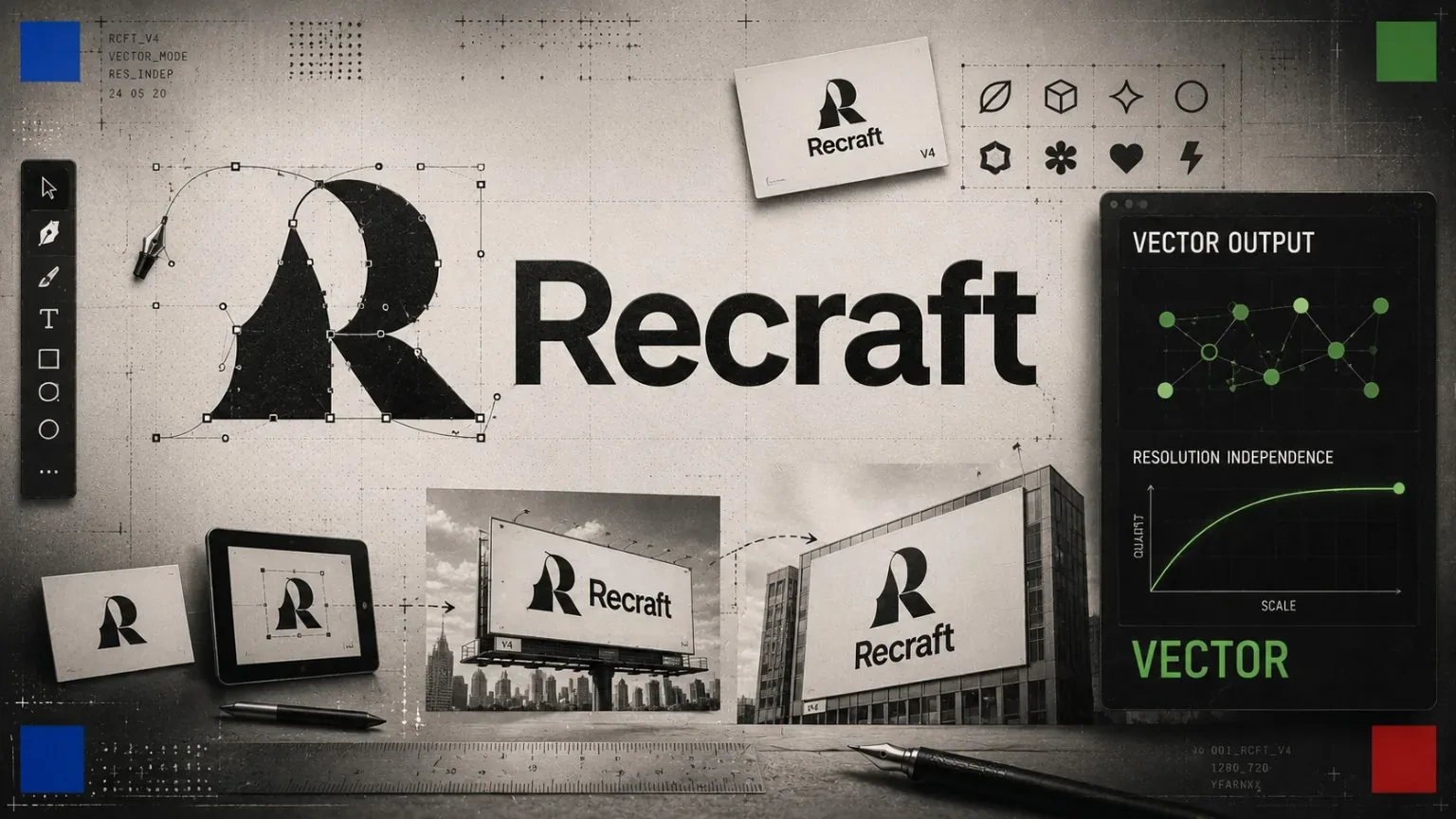
Native vector output. Recraft V3, V4 and V4.1 produce native vector output, which removes the raster-to-vector conversion step entirely.
What it is
Recraft V4 is the image model from Recraft, and its distinguishing feature is technical rather than stylistic: native vector output. Along with the earlier V3 and the newer V4.1, Recraft V4 generates images directly as vector artwork, which removes the raster-to-vector conversion step that every other approach still depends on. For designers who work in vectors, that single capability changes the shape of the job.
Raster versus vector
The distinction is worth spelling out for anyone new to it. Most image models produce raster images: grids of coloured pixels fixed at a certain resolution, which blur or show jagged edges when enlarged beyond that size. Vector images instead describe a picture as mathematical shapes, lines, curves and fills, that can be scaled to any dimension without losing a scrap of sharpness. A logo, an icon or a piece of signage almost always has to exist as vector artwork for exactly that reason, and turning a raster generation into clean vectors after the fact is a fiddly, imperfect process that often needs manual repair.
By producing vectors from the outset, Recraft V4 skips that clean-up entirely. The output arrives already in the format a designer needs, editable shape by shape and ready to drop into a brand system or an illustration suite. This is a genuine workflow advantage that no competitor currently replicates, and it is the reason the model has found a specific, loyal audience rather than competing purely on the beauty of its pictures.
Why it earns its place
The practical consequences are felt at every later stage of a project. A vector file can be recoloured to a new brand palette, resized for a favicon or a shopfront, and handed to a printer or a web developer without a fresh round of generation, because the artwork is a set of editable shapes rather than a flat grid of pixels. Recolouring a single element, thickening a line or exporting only part of a design are routine operations on a vector and awkward or impossible on a raster. For an icon set that has to stay visually consistent across dozens of symbols, that editability is the whole purpose, and it is why the studio’s approach has taken root among working designers rather than remaining a curiosity.
Who it is for
That audience is easy to name. The model has become the standard pick for brand designers assembling visual identities, for teams building consistent icon sets, and for any work that has to scale from a business card to a billboard without a single artefact creeping in. These are the jobs where resolution independence is a firm requirement rather than a nicety, and where a raster model, however handsome its output, simply cannot deliver the finished asset a client can use.
The specialism reflects a sensible reading of where general-purpose models leave a gap. The mainstream leaders compete to produce ever more convincing photographs and illustrations, all of them raster. Recraft has taken the quieter, more technical ground of production-ready vector artwork, the unglamorous output that professional design actually runs on. Serving that need well has proved more durable than chasing the same photorealism as everyone else, and it has given the studio a defensible corner of the market.
What to watch
Within the wider set of image models, Recraft V4 fills a slot the leaderboard chasers leave open. It will not top a photorealism arena, because that is not what it is built to win, yet for the specific and commercially large task of generating scalable vector graphics it stands effectively alone. What to watch is whether the general-purpose models add native vector output of their own, which would challenge the advantage directly, and whether Recraft can extend its lead in the meantime by deepening the editing and brand-consistency features its professional users depend on.
Recraft added V4.1 Flash on 23 September
Recraft’s 23 September changelog introduced V4.1 Flash as a faster generation option. Treat the speed comparisons as the maker’s measurements and test the output quality for the intended design. The original V4 and V4.1 releases retain their own specifications.
More in Image Generation
All Image →- Black Forest LabsFLUX 3 ImageFLUX 3 Image creates and edits pictures with up to ten reference images
- TencentHY Image 3.5 PreviewTencent’s image generation and editing preview
- IdeogramIdeogram 4.5image generation and precise editing
- AlibabaQwen-Image-2.1-TurboAn eight-step image generator with downloadable weights
- Google DeepMindNano Banana 2.1Image generation, reference pictures and conversational edits
- OpenAIGPT Image 2.5two variants, one price, the top two seats