
Black Forest Labs
FLUX.2
the strongest open-weight family
Key facts
- 5klein to max
- Tiers
- $0.015per standard image
- Pro price
- Open weightdev + klein
- Licence
- Germanyex-Stable Diffusion
- Origin
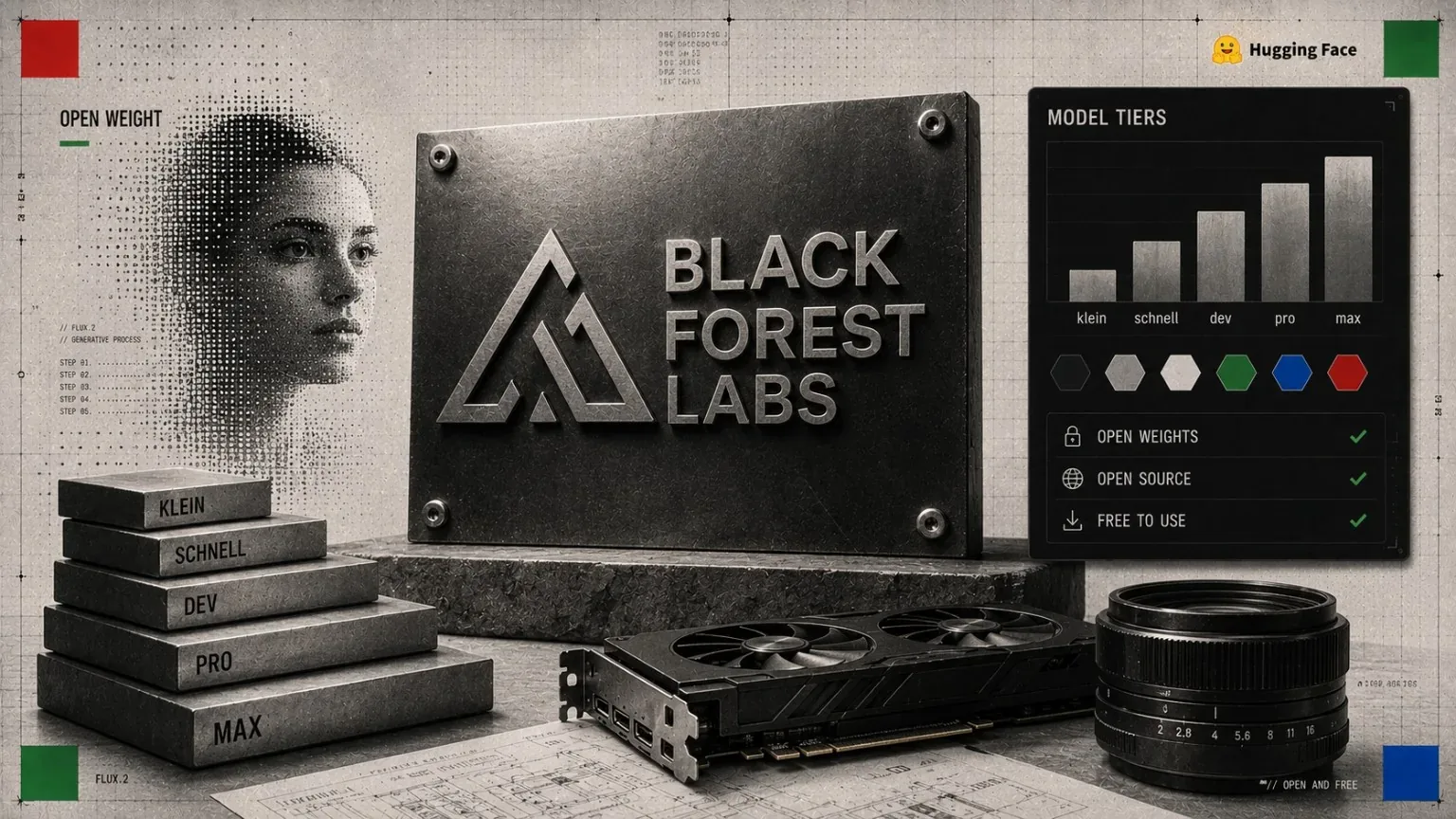
The strongest open-weight family. Five tiers as of August 2026: [klein], [dev], [flex], [pro] and [max].
What it is
FLUX.2 is the image model family from Black Forest Labs, and as of August 2026 it is the strongest open-weight offering in the field. The lineup spans five tiers: [klein], [dev], [flex], [pro] and [max], arranged from the smallest and most efficient up to the most capable. The spread is the point. The family is designed to cover the whole range of needs, from a hobbyist running a model on a single graphics card to an agency pushing thousands of brand-consistent images through an API, all from one coherent set of releases.
Why open weights count
The open-weight structure is what sets FLUX.2 apart. The [dev] and [klein] weights are published and free to run on your own GPU, which means a studio can generate images entirely on its own hardware, with no per-image fee and no data leaving the building. That is a decisive consideration for anyone handling confidential briefs or working to a fixed budget. The heavier tiers are offered as a paid API instead, and [pro] is the cheapest premium option per standard image, starting near $0.015 through some providers, which keeps the economics competitive even at the top of the range.
Open weights carry a second benefit beyond cost. Because the [dev] and [klein] models can be downloaded, a studio can fine-tune them on its own images, teaching the model a house style or a specific product range that a closed API will never learn. The middle [flex] tier sits between the free weights and the premium options for teams that want more capability than a local model provides without committing all the way to [max]. Few closed competitors allow that degree of adjustment, and for technically minded teams the ability to inspect, adapt and host the model themselves is a large part of the appeal.
What it does well
The family has earned particular praise for two capabilities that production teams care about. The first is hex colour precision, the ability to hold an exact brand colour specified by its hexadecimal code rather than drifting to an approximate shade. The second is multi-reference consistency, keeping a character, product or style stable across a set of images drawn from several reference pictures. Both are the difference between a novelty and a tool a brand can rely on, which is why FLUX.2 has settled into agency and marketing workflows where consistency is non-negotiable.
At the top of the range, [max] leads the family on editing consistency and prompt following, the two measures that decide how much manual correction a job needs afterwards. For a team that has to deliver finished assets rather than pleasing first drafts, that reliability is where the value sits, and it lets the free tiers below handle drafting and experimentation at no cost before the paid tier finishes the work.
The lab behind it
The company behind it explains a good deal about why the family exists. Black Forest Labs was founded by the researchers who created the original Stable Diffusion, the model that first opened image generation to the public. When they left to start their own venture, the centre of gravity of the open image ecosystem moved with them to Germany, and FLUX.2 is the continuation of that lineage. Keeping the strongest weights open is a philosophical stance as much as a commercial one.
What to watch
Within the wider set of image models, FLUX.2 holds a position no closed competitor occupies: professional-grade output that a team can run privately and inspect for itself. The closed leaders may edge ahead on individual benchmarks, but they cannot be downloaded, audited or fine-tuned, and for a large share of studios that freedom outweighs a few points of arena rating. What to watch is whether the open tiers keep pace with the closed frontier as models grow more demanding, and whether the German lab can sustain a business that gives its best research away.
FLUX 3 Image arrived on 1 October
Black Forest Labs released FLUX 3 Image, the image model of its FLUX 3 generation, on 1 October 2026, two months after FLUX 3 Video went on general sale on 4 August. The lab’s release notes describe one endpoint that generates from a prompt, edits marked parts of an image and combines up to ten reference images, with bounding boxes written into the prompt to place each element of a layout. Output runs from 768-pixel square previews to 4K, about 16 megapixels, at 15 aspect ratios, priced per image by resolution:
| Resolution | API price per image |
|---|---|
| 768 square | $0.041 |
| 1K | $0.048 |
| 2K | $0.100 |
| 4K | $0.607 |
The weights are where the two families part. FLUX 3 Image is offered for self-hosting under a commercial weights licence that Black Forest Labs sells to companies running image generation at scale, according to its model page, and the newest repositories on the lab’s Hugging Face account are the three FLUX 3 Action checkpoints of 22 September 2026. FLUX.2 [dev] and [klein] are therefore still the image weights a studio can download and run on its own GPU for free, while FLUX 3 Image is the newer model to test through the API.
The FLUX 3 Image reference lists its temporary launch prices alongside those standard rates. The half-price offer ends on 8 October 2026 at 15:00 UTC.
More in Image Generation
All Image →- Black Forest LabsFLUX 3 ImageFLUX 3 Image creates and edits pictures with up to ten reference images
- TencentHY Image 3.5 PreviewTencent’s image generation and editing preview
- IdeogramIdeogram 4.5image generation and precise editing
- AlibabaQwen-Image-2.1-TurboAn eight-step image generator with downloadable weights
- Google DeepMindNano Banana 2.1Image generation, reference pictures and conversational edits
- OpenAIGPT Image 2.5two variants, one price, the top two seats