
Black Forest Labs
FLUX 3
the world-model bet
Key facts
- 20ssingle generation
- Clip length
- $0.17per second
- HD price
- $0.80per second, 3840x2176
- UHD price
- Nativeno extra charge
- Audio
- 4 Aug 2026BFL API
- GA date
- 1,4933rd, read 27 Sep 2026
- Arena T2V
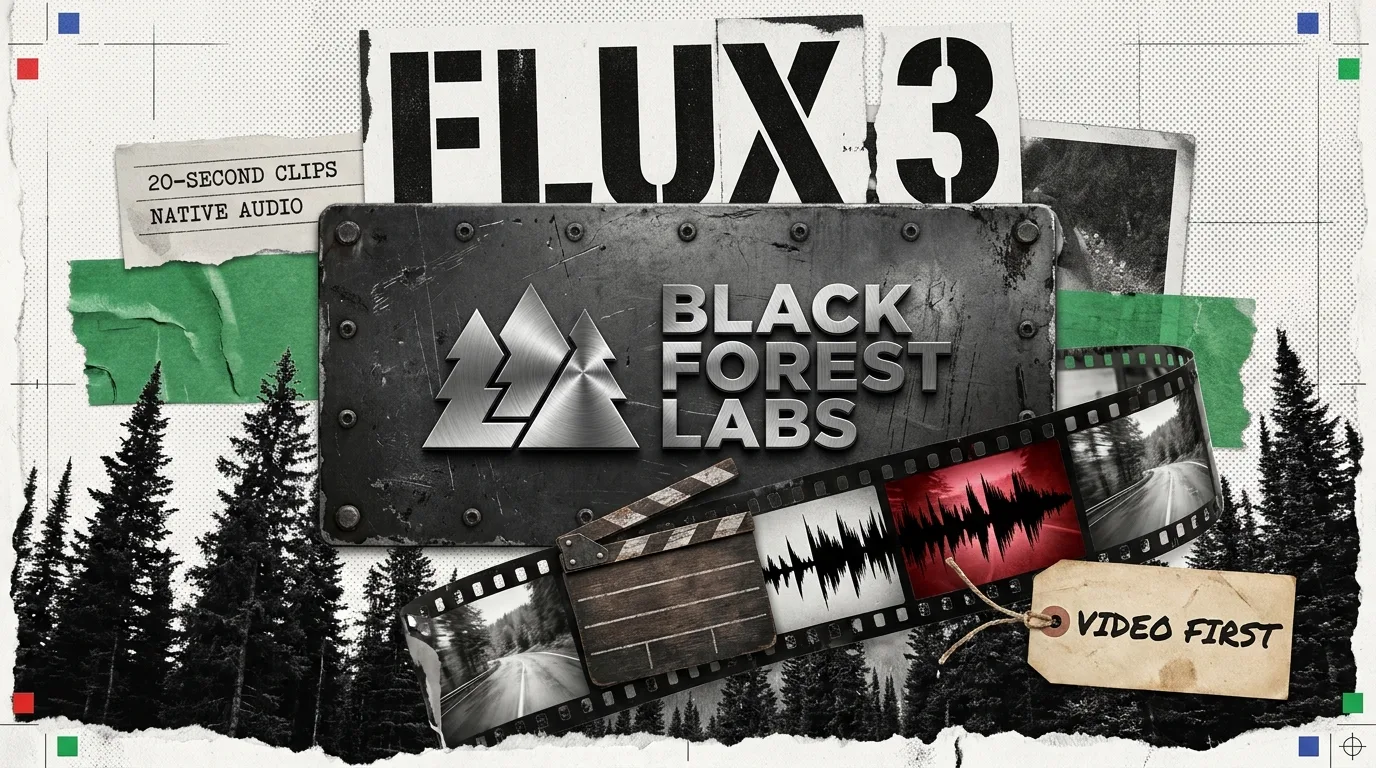
The world-model bet. FLUX 3 arrived as a video model first: 20-second clips with native audio, generally available from 4 August 2026, followed by FLUX 3 Image on 1 October 2026.
What it is
FLUX 3 is Black Forest Labs stepping out of still images. The German lab behind the FLUX.2 image family announced the generation on 23 July 2026 under the banner of “real world models”, and note the branding: it is FLUX 3 with a space, not FLUX.3, a deliberate break from the dot notation of the image line. The surprise is the order of arrival. The first FLUX 3 product to ship is a video model, generally available through the BFL API since 4 August 2026, and the image successor to FLUX.2, FLUX 3 Image, followed on 1 October 2026, eight weeks later.
What the video model does
FLUX 3 Video generates clips of up to 20 seconds in a single pass, in HD with a Full HD upscale path, and produces its soundtrack natively in the same generation: multilingual dialogue with lip-sync, effects and ambience, included in the per-second price rather than billed separately. Beyond text-to-video and image-to-video it handles video-to-video editing, continuation from up to 4 seconds of existing footage, keyframe transitions, and chaining multi-scene sequences, which BFL pitches at agent-driven production pipelines. The 20-second single-pass ceiling is the standout spec: most of the field still tops out at 8 to 15 seconds per generation.
The benchmark question
BFL’s own published evaluations have FLUX 3 preferred over Runway Gen-4.5 in 77 percent of comparisons and over Luma’s Ray 3.2 in 93 percent, with an internal Elo chart placing it first among the systems it tested. Those are the lab’s own numbers, and the independent picture has filled in since: on the Artificial Analysis text-to-video board checked on 8 August 2026 FLUX 3 was absent from the top five, but on the arena.ai text-to-video board read on 27 September 2026 (dated 21 September), FLUX 3 Video sits third on an Elo of 1,493, behind Google’s Gemini Omni 1.1 Flash on 1,516 and Gemini Omni Flash on 1,513. xAI’s Grok Imagine Video 1.5 in agent mode is fourth on 1,492, a one-point gap inside both models’ margins, and both scores are still marked preliminary. Alibaba’s Wan 3.0, level with FLUX 3 Video in early September, is now sixth on 1,476. Third place directly behind the two Google models is a serious showing for a lab’s first video release; the vendor’s chart put it first, the public board puts it third, and the second number is the one a buying decision should use.
Price and access
The API is pay-as-you-go with no subscription. Text-to-video and image-to-video run $0.06 a second in draft HD, $0.17 a second in standard HD and $0.29 a second in Full HD; video-to-video editing is dearer at $0.12, $0.41 and $0.53 respectively. A release note dated 10 September 2026 extended the ladder upwards: QHD output at 2560x1440 for $0.40 a second and UHD at 3840x2176 for $0.80 a second, both for text-to-video and image-to-video. That puts a standard HD clip in the same band as Veo-class pricing rather than the budget tier, with the native audio softening the comparison since rivals often price sound separately or lack it. There is no consumer app: access is the BFL API and selected partner platforms.
The rest of the line
The announcement sketched a wider family than the video model. FLUX 3 Action, the robotics variant, shipped on 23 September 2026 as an open-weight 7-billion-parameter world action model, downloadable from Hugging Face, and it sits first on NVIDIA’s RoboLab-120 leaderboard at 42.9 per cent, 515 successes in 1,200 trials, where BFL’s own figure is a 42.2% mean across six seeds; the release credits mimic robotics, whose systems tested on Audi production lines run FLUX-mimic, the earlier model the two companies built together in July. FLUX 3 Dev, the open-weight backbone that would continue BFL’s practice of publishing runnable weights, is listed as coming soon with no licence terms published yet. The image model that succeeds FLUX.2, FLUX 3 Image, shipped on 1 October 2026 according to BFL’s release notes: one API endpoint generates, edits and combines up to ten reference images, at up to 4K, priced from $0.041 an image at 768-pixel square to $0.607 at 4K, with self-hosted weights sold under a commercial licence.
How to read it
The honest summary is a lab making a serious bet that one architecture can span video, images and robot control, with three shipped products, the video model, the image model and the open-weight Action model, and a benchmark case that now has independent arena.ai standings behind the video model. For teams already paying for video generation the 20-second clips and bundled audio are worth a trial against the incumbents on our AI video models hub; the answer to “is FLUX 3 out?” is yes on all three fronts, with video since 4 August, robot control since 23 September and images since 1 October 2026. The wider field sits across the AI section.
Related pages
All Video →- Black Forest LabsFLUX 3 Actioncamera views and an instruction in, arm movements out
- GuideClaude + MCP for videofrom a written brief to a finished shot
- GuideSeedance 2.5 promptingthe official method, decoded
- xAIGrok Imagine Video 1.5 Liteshort video generation at three resolutions
- HeyGenHeyGen Video 1.0short video with native audio
- Google DeepMindGemini Omni 1.1 Flashthe production release of Google's video line