
Black Forest Labs
FLUX 3 Action
camera views and an instruction in, arm movements out
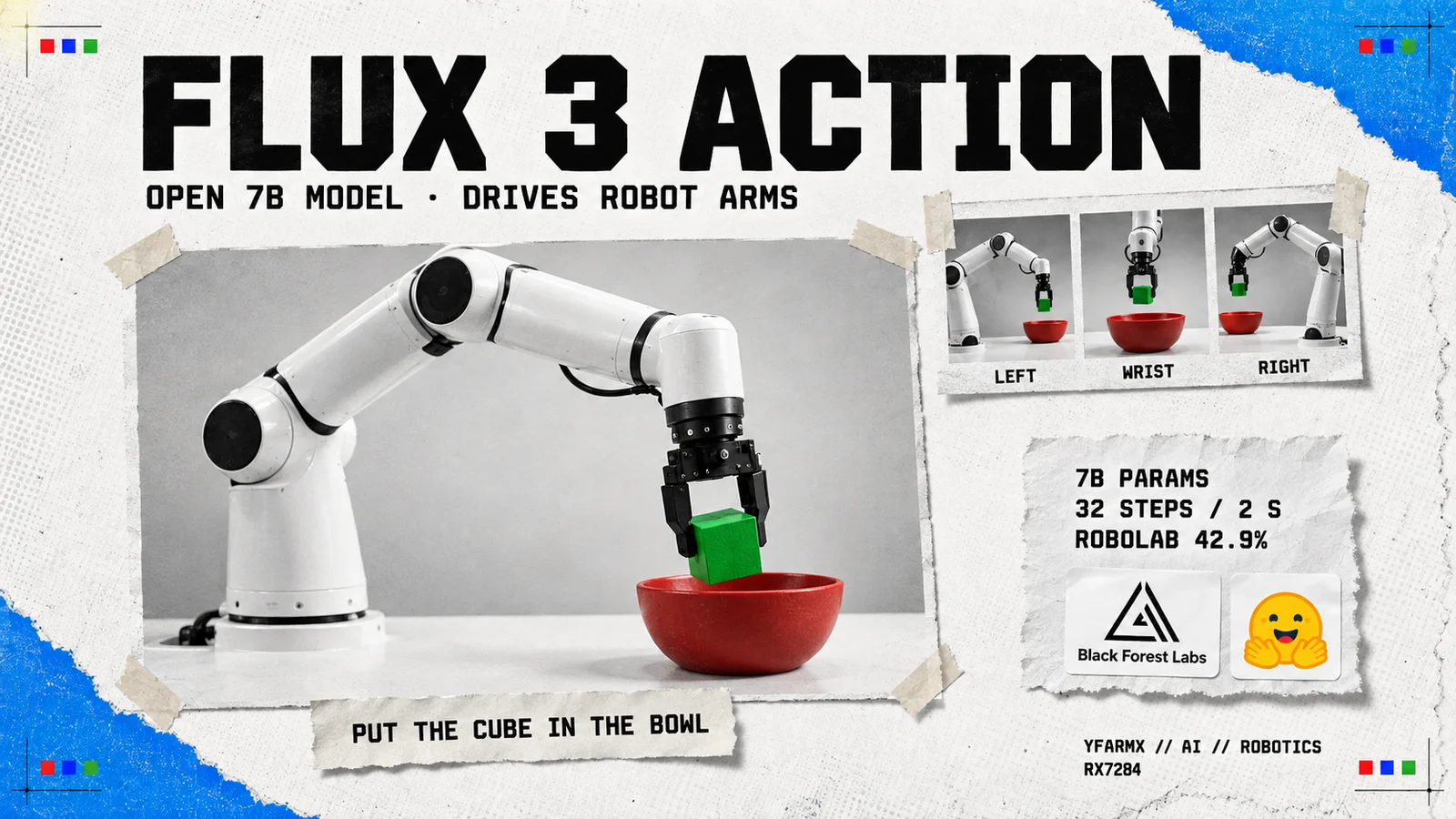
Key facts
- 7Bopen weights
- Parameters
- 42.9%1st, read 2 Oct 2026
- RoboLab-120
- 28 / 30blind third-party test
- Real Franka arm
- 32 stepsabout 2 s at 15 Hz
- Plan length
- 32 GBBF16; 24 GB cards in FP8
- GPU memory
- Kommunitynon-commercial, or firms under $5m
- Licence
FLUX 3 Action is an AI model that drives a robot arm: it watches the arm's cameras, reads an instruction such as "put the red cube in the left bin", and sends the next two seconds of joint movements. Black Forest Labs released the weights free to download on 23 September 2026.
It turns camera views and an instruction into arm movements
FLUX 3 Action is an AI model that drives a robot arm. It watches the arm’s cameras, reads the robot’s joint positions and a typed instruction such as “put the red cube in the left bin”, then predicts the next stretch of motor commands jointly with a compressed forecast of the video those movements should produce. The released inference code hands back the motor commands alone, and the video forecast stays inside the model as latents (docs.bfl.ai). The robot carries out part of that plan, looks again, and asks for a fresh one.
Black Forest Labs, the lab behind the FLUX image models, released it on 23 September 2026 as a 7-billion-parameter model with free, downloadable weights. The lab calls it a world action model: one network predicts the future video and the robot’s actions together, where a vision-language-action model such as π0.5 predicts the actions alone. It is built on the same multimodal FLUX 3 backbone as FLUX 3 Video, and its launch post on X put it in “first place on the RoboLab benchmark”.
What goes in and what comes out
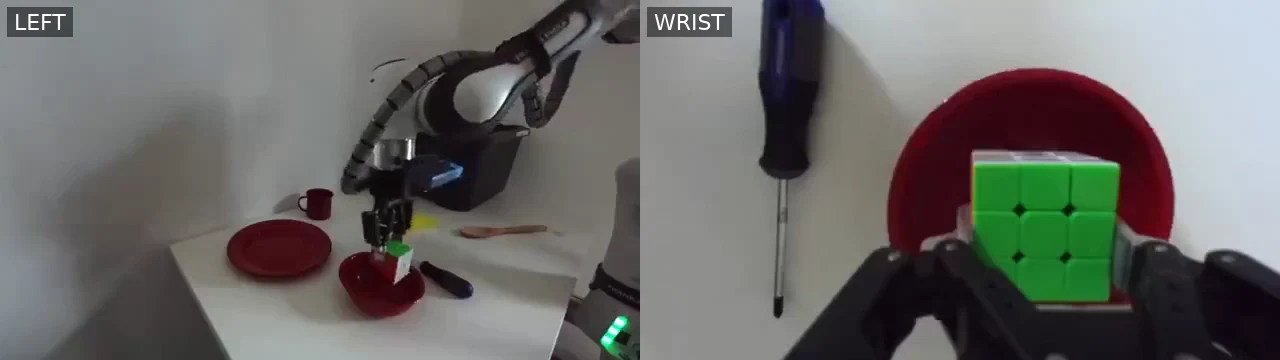
On a DROID-style Franka arm, FLUX 3 Action reads three camera feeds and eight state values and returns 32 joint commands, about two seconds of motion at 15 Hz. Black Forest Labs ships ready-made checkpoints for two robots and documents two more setups as fine-tuning examples:
| System | Cameras | State it reads | Commands it sends |
|---|---|---|---|
| DROID (Franka arm) | 3: wrist, left, right | 7 joint angles and the gripper | 32 steps of 7 joint targets and the gripper, at 15 Hz |
| SO-101 (LeRobot arm) | 2: scene and wrist | 6 joint positions | 42 steps predicted, 32 run, at 30 Hz |
| Video game (example) | 1 frame | the last action | 3 or 4 values between -1 and 1 |
| Drone in Isaac Sim (example) | 1 onboard frame | the last action | forward, lateral, up and yaw |
The instruction goes through a text encoder that is an unmodified copy of Qwen3-VL-4B-Instruct. The action base checkpoint carries a shared trunk with two sets of output heads, one for arm and hand poses and one for games, and a new robot gets heads of its own through fine-tuning. The SO-101 package includes a LoRA recipe for teaching the arm a new task, and a pick-and-place skill takes about 200 demonstrations to learn that way.
The reference setup is Linux with an NVIDIA GPU. The DROID policy runs in about 32 GB of GPU memory in BF16 on an H200, and with FP8 and the text encoder moved off the card it fits 24 GB cards. Both robot policies load through Hugging Face’s LeRobot library as well as Black Forest Labs’ own loader.
It came first on RoboLab at 42.9 per cent
RoboLab-120 is a simulated test of 120 tabletop tasks in NVIDIA’s Isaac Sim, each tried 10 times on a DROID-style Franka arm, and a trial counts only when the robot finishes the task as instructed. On the public leaderboard read on 27 September 2026, FLUX 3 Action sits first with 515 successes out of 1,200 trials, 42.9 per cent:
| Policy and rank | Type | Parameters | Success |
|---|---|---|---|
| FLUX 3 Action, 1st | World action model | 7B | 42.9% |
| HiDream-O1-Embodied, 2nd | Vision-language-action | 6B | 39.9% |
| Atomic-WAM, 3rd | Vision-language model + world action model | 16.2B | 39.6% |
| OASIS WAM, 4th | Vision-language model + world action model | 16B plus a vision-language model | 39.0% |
| Cosmos3-Nano-Policy, 5th | World action model | 16B | 36.8% |
| π0.5, 9th | Vision-language-action | 3.3B | 28.0% |
Split by difficulty, FLUX 3 Action completes 49.1 per cent of the simple tasks, 39.2 per cent of the moderate ones and 28.2 per cent of the complex ones. At launch, Black Forest Labs measured its lead against NVIDIA’s Cosmos3-Nano-Policy, the best open model before it: 6.1 percentage points higher with 56 per cent fewer parameters.
The fastest version plans two seconds of motion in 32 milliseconds
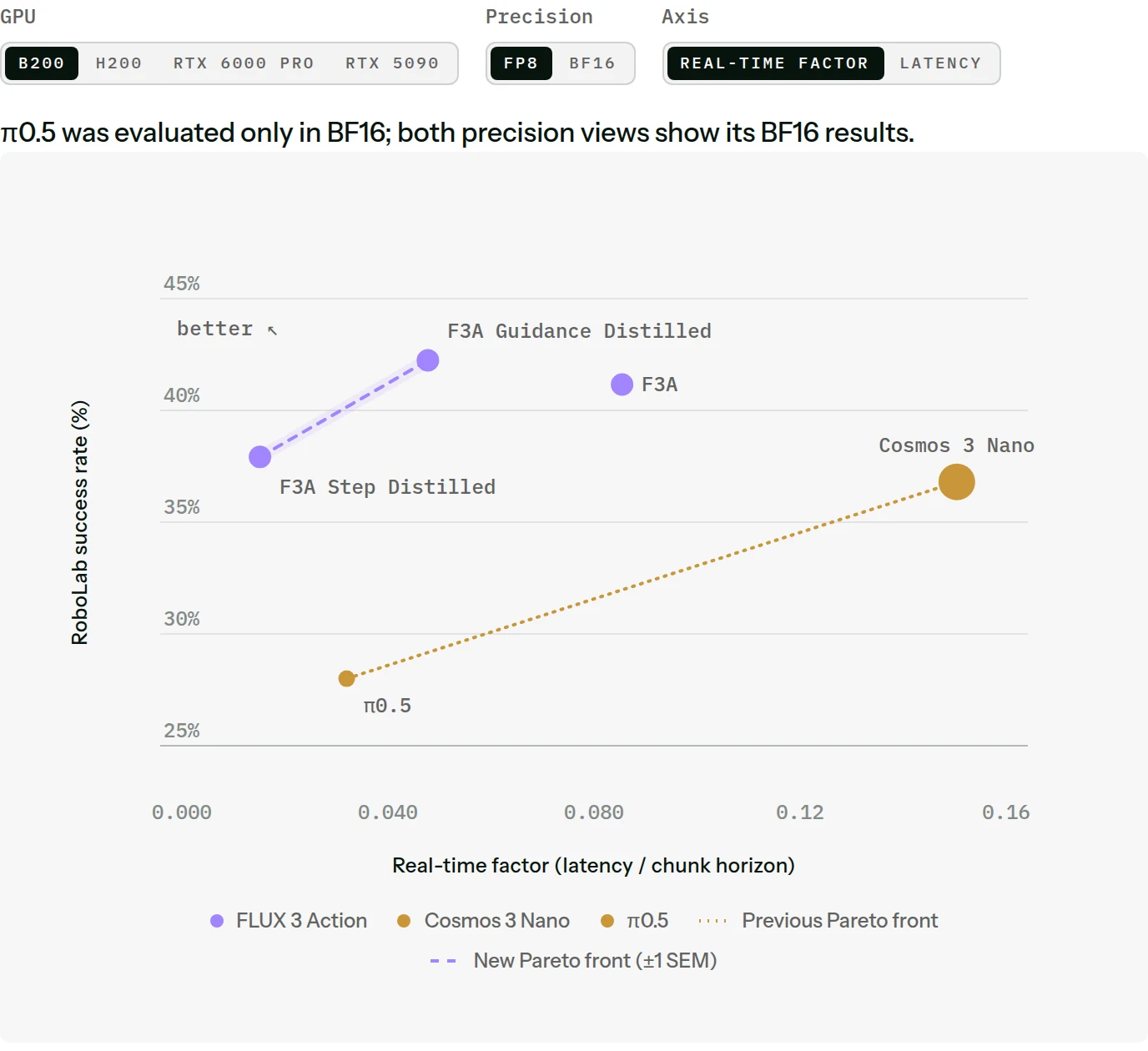
Black Forest Labs publishes three versions of the DROID policy, and on an NVIDIA B200 in FP8 the step-distilled one returns a 2.13-second plan in 32.29 milliseconds. Each distillation stage trims the sampling work: the guidance-distilled version drops the second pass that guidance needs, and the step-distilled version samples once instead of four times. BFL’s own figures, with RoboLab success averaged over six seeds and the median time to return one plan on a B200:
| Version and sampling | RoboLab, FP8 | Time per plan, FP8 | Time per plan, BF16 |
|---|---|---|---|
| Base, 4 steps with guidance | 41.16% ± 0.30 | 182.00 ms | 246.42 ms |
| Guidance-distilled, 4 steps | 42.24% ± 0.36 | 101.71 ms | 136.25 ms |
| Step-distilled, 1 step | 37.92% ± 0.31 | 32.29 ms | 41.06 ms |
| Cosmos 3 Nano, 4 steps with guidance | 36.8% | 320.40 ms | 387.71 ms |
| π0.5, 10 steps | 28.0% | BF16 only | 31.99 ms |
The guidance-distilled version is the accurate one, and on these runs it scored slightly higher than the base model it was trained from. The step-distilled version is the fast one.
π0.5 plans 1.0 second of motion at a time against 2.13 seconds for FLUX 3 Action, so Black Forest Labs compares processing time per second of robot motion. On that measure the step-distilled model in FP8 runs 1.34 to 2.28 times faster than π0.5 in BF16 on workstation and datacentre GPUs, and slower than π0.5 on a consumer RTX 5090. The base and guidance-distilled versions in FP8 run 1.52 to 3.95 times faster than Cosmos 3 Nano in FP8 across consumer, workstation and datacentre GPUs.
It succeeded on 28 of 30 attempts on a real Franka arm
Positronic Robotics ran FLUX 3 Action on a Franka arm in its own lab for Black Forest Labs, on ten DROID tasks with three attempts each, and it succeeded on 28 of the 30 attempts. Three other open policies ran the same tasks with the same setup, the same 240-second limit per attempt and the same scoring, under an operator kept blind to which model was driving, and every attempt was recorded on video. The results, as Black Forest Labs publishes them:
| Policy | Successes | Rate |
|---|---|---|
| FLUX 3 Action | 28 / 30 | 93.3% |
| Cosmos 3 Nano | 27 / 30 | 90.0% |
| DreamZero | 20 / 30 | 66.7% |
| π0.5 | 13 / 30 | 43.3% |
The tasks are single-object tabletop jobs: a cube, a sponge or a marker into a bowl, a fork onto a plate, a cup moved left, a drawer closed. FLUX 3 Action completed eight of the ten tasks on every attempt and the sponge and marker tasks on two of three.
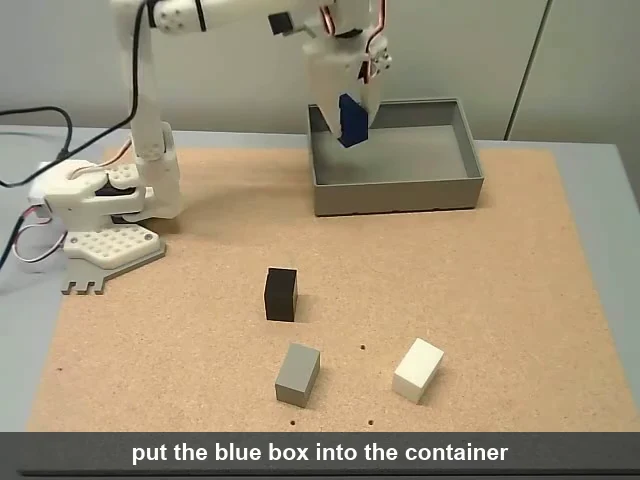
Black Forest Labs also fine-tuned the model for the SO-101, the small arm used with LeRobot, and shows it handling new objects, containers and camera positions outside its training data. The released SO-101 checkpoint was trained on the SO-101 episodes of LeRobot’s community dataset.
Paired with GPT-6 Astra, each success costs $8.77
Black Forest Labs tested FLUX 3 Action as the fast hand under OpenAI’s GPT-6 Astra, which plans and steps in when needed, and the pairing cost $8.77 and 8 minutes 8 seconds per successful task at a 90 per cent success rate. The setup copies a published study by Su and colleagues (2026): Astra follows each episode and, at every turn, can run part of the policy’s plan, edit one to five of its actions, write its own, or stop. Each setup ran 50 episodes across ten RoboLab tasks:
| Setup | Success | Cost per success | Time per success |
|---|---|---|---|
| FLUX 3 Action + Astra, low effort | 90% | $8.77 | 8m 08s |
| FLUX 3 Action + Astra, xhigh effort | 94% | $11.00 | 11m 53s |
| π0.5 + Astra, medium effort | 86% | $12.28 | 14m 26s |
| Astra alone, xhigh effort | 100% | $13.47 | 16m 23s |
FLUX 3 Action on its own costs $0.087 and about 1.75 minutes per success on an H200 rented at $3.00 an hour, most of that time spent waiting while the arm moves. The harder tasks, such as stacking blocks in a set colour order, still need the planner: in BFL’s demonstration FLUX 3 Action picks up and stacks the blocks, and Astra steps in briefly as it reaches for the yellow block, moving the gripper towards the green one so the order comes out right.
It learned from video before it learned from robots
Black Forest Labs pretrained the FLUX 3 backbone on images, video and audio, with video more than 95 per cent of the training tokens, then added an action stage. In a test run with preliminary settings, fine-tuning on DROID from random weights reached 0.75 per cent on RoboLab, and the same fine-tune from the pretrained backbone reached 11.6 per cent.
The action stage mixed the pretraining video back in with footage that carries matching actions:
| Data in the action stage | Share of samples |
|---|---|
| Video with audio from pretraining | 36.95% |
| Game recordings | 19.55% |
| Teleoperated robots, 14 embodiments | 15.93% |
| Handheld grippers | 14.03% |
| First-person video of human hands | 13.54% |
After that stage the same test reached 18.63 per cent, and the full DROID fine-tune took the model to 40.13 per cent after 20,000 steps. The model was trained on NVIDIA GB200 systems.
What you can download, and what the licence allows
Black Forest Labs released three checkpoints on Hugging Face with the model on 23 September 2026, open to download without an access request, under the FLUX Kommunity License v1.0:
| Checkpoint | What it is |
|---|---|
| flux-3-action-base | the action-trained trunk plus the shared video autoencoder and text encoder, for adapting to a new robot, simulator or game |
| flux-3-action-droid | a ready policy for the DROID Franka setup, with guidance-distilled and step-distilled versions in BF16 and FP8 |
| flux-3-action-so101 | a ready policy for the SO-101 arm, with a LoRA recipe for new tasks |
The licence splits use by purpose and by the size of the company:
| Use | Terms |
|---|---|
| Research, study and hobby projects, including non-commercial robotics | Free |
| Companies testing it outside production | Free |
| Commercial use of the outputs, which include action predictions, by a company under US$5,000,000 in gross annual revenue with its affiliates | Free |
| Any other commercial or production use | A licence from Black Forest Labs, which may carry a fee or revenue share |
| Military use, surveillance, biometric processing, or using it or its outputs to improve a competing model | Barred |
The text encoder keeps its own Apache-2.0 licence. The application running the arm has to enforce its own safety limits. BFL asks for caps on joint velocity, force and workspace, a hardware stop within reach, and a first run in a simulator or with the arm’s safety limits engaged before the robot works near people.
It shares a backbone with FLUX 3 Video
FLUX 3 Action is the second FLUX 3 product to ship, after FLUX 3 Video on 4 August 2026, and both come from the multimodal backbone Black Forest Labs announced on 23 July 2026. On that July day BFL also published FLUX-mimic, a design study with mimic robotics: a video-action model that reads the backbone’s features through a separate action decoder, “running robots that have been tested and deployed at Audi”. FLUX 3 Action takes the other route, predicting the video and the actions together in one model, and it is the version with public weights.
Related pages
All Robotics →- Black Forest LabsFLUX 3the world-model bet
- Robot foundation modelsone brain, many bodies
- NVIDIANVIDIA Cosmosthe self-hostable one
- Embodied AIintelligence with something to lose
- Teleoperation and robot datathe person inside the demonstration
- Humanoid robotsthe human template, and why every lab is copying it