
NVIDIA
NVIDIA Cosmos
the self-hostable one
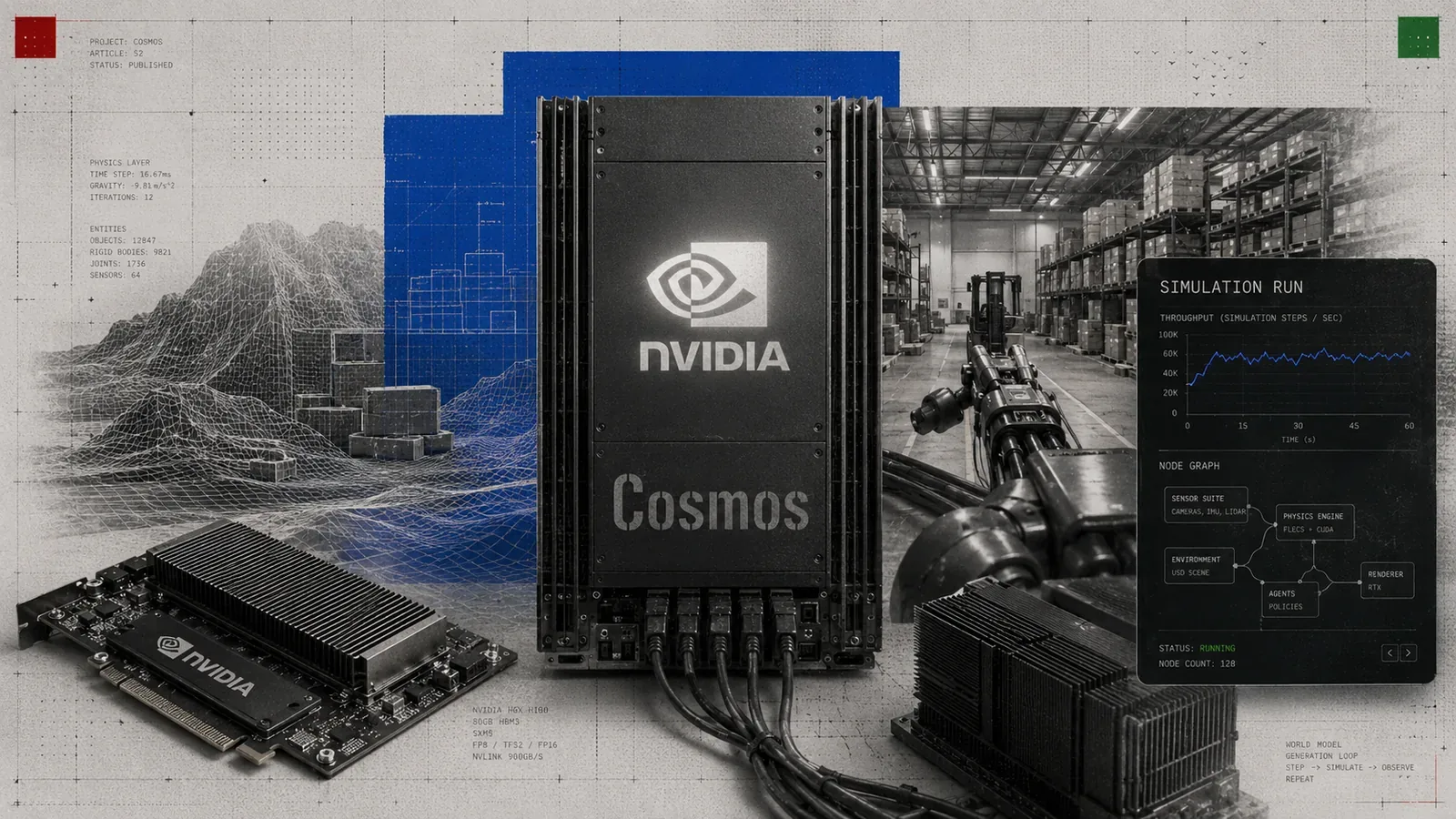
Key facts
- 2M+by mid-2026
- Downloads
- 7B / 14Btwo model sizes
- Parameters
- Apache 2.0open weights
- Licence
- 1x H10080GB, 7B model
- Hardware
- 1.5 min/hr720p per GPU-hour
- Throughput
- 1 Jun 2026GTC reveal
- Cosmos 3
The self-hostable one. World foundation model platform for physical AI, past 2 million downloads.
What it is
NVIDIA Cosmos is a world foundation model platform built for physical AI, and by mid-2026 it had passed two million downloads. A world model learns how a physical environment behaves and can then generate what happens next within it, and the platform is aimed squarely at the practical end of that: producing synthetic training data and teaching robots how to act. Its defining feature within this field is openness of a particular kind, because NVIDIA Cosmos is the one serious option teams can run on their own hardware.
How it works
The platform supports three generation modes, Text2World, Image2World and Video2World, each turning a prompt, an image or a clip into a generated environment. What distinguishes it is physics awareness, meaning the generated worlds are meant to respect how objects move and interact rather than merely looking plausible. That focus follows from the intended use. If the output is going to train a robot policy or stand in for real sensor data, it has to behave like the physical world, not simply resemble it.
The phrase world foundation model is doing real work here. A foundation model is one trained broadly enough to be adapted to many downstream tasks, and the platform applies that idea to physical environments rather than to text or still images. For a company whose core business is the hardware these systems run on, seeding a widely downloaded, self-hostable platform also has an obvious logic: every team that adopts Cosmos is a team buying or renting the GPUs it demands.
Running it yourself
Self-hosting is the heart of the NVIDIA Cosmos proposition, with Cosmos 3 now the open flagship of the line. The earlier Cosmos-Predict source is released under Apache 2.0, with weights under the NVIDIA Open Model License, so organisations can download, inspect and run the models rather than depending on someone else’s API. The hardware requirements are concrete: Cosmos-Predict 7B runs on a single H100 80GB, while the larger 14B model needs an H200 or two H100s. For robotics labs and companies that cannot send proprietary data to a hosted service, keeping everything in-house is the whole appeal. That combination of open source, open weights and a single-GPU entry point is rare in this field, and it is why the platform has become a reference for teams that need to run generation on their own machines rather than through a vendor.
NVIDIA has folded Cosmos into a bigger strategy. NVIDIA announced Cosmos 3 on 31 May 2026, around GTC Taipei, as a fully open omnimodel for physical AI, in Super and Nano variants, with a compact Cosmos 3 Edge 4B added on 20 July at SIGGRAPH, and the whole line is positioned as part of a pipeline for manufacturing synthetic data at scale. The public Cosmos GitHub organisation stays active, which suits a product whose users are developers expecting source, issues and updates in the open.
The cost of generation
One figure worth publishing is the cost of running these systems. At 720p and 24 fps, a single H200 generates roughly 1.5 minutes of video per GPU-hour for diffusion-based world models. Put another way, each minute of finished video costs about 40 minutes of GPU time. That arithmetic is easy to overlook when a demo looks effortless, and it explains why serious users care about efficiency, model size and whether a given task really needs generated video at all. Published honestly, that figure sets realistic expectations for anyone budgeting a synthetic-data run.
Where it fits
In the wider field, NVIDIA Cosmos occupies the export-and-integrate and self-host corner, close in spirit to World Labs on portability but distinct in handing users the weights and the freedom to run them. It builds on the same video model advances as its closed rivals, then trades some polish for control and physics fidelity. What to watch is how far the data-factory blueprint reaches into real robotics and manufacturing, and whether the open licence keeps NVIDIA Cosmos the default for teams that will not, or cannot, hand their data to a hosted world model. The trade is deliberate: less turnkey polish in exchange for weights an organisation can own outright. YFarmX maps the field on its world models hub.
More in World Models
All World Models →- OdysseyOdyssey-3one pretrained world model behind robots, cars, drones and games
- Google DeepMindGenie 3the reference interactive world model
- RunwayRunway GWM-1the most general commercial family
- World LabsMarble3D assets you can actually export
- WaymoWaymo World Modelthe first serious industrial deployment
- TencentTencent HY-World 2.0the open Chinese entry