
World Labs
Marble
3D assets you can actually export
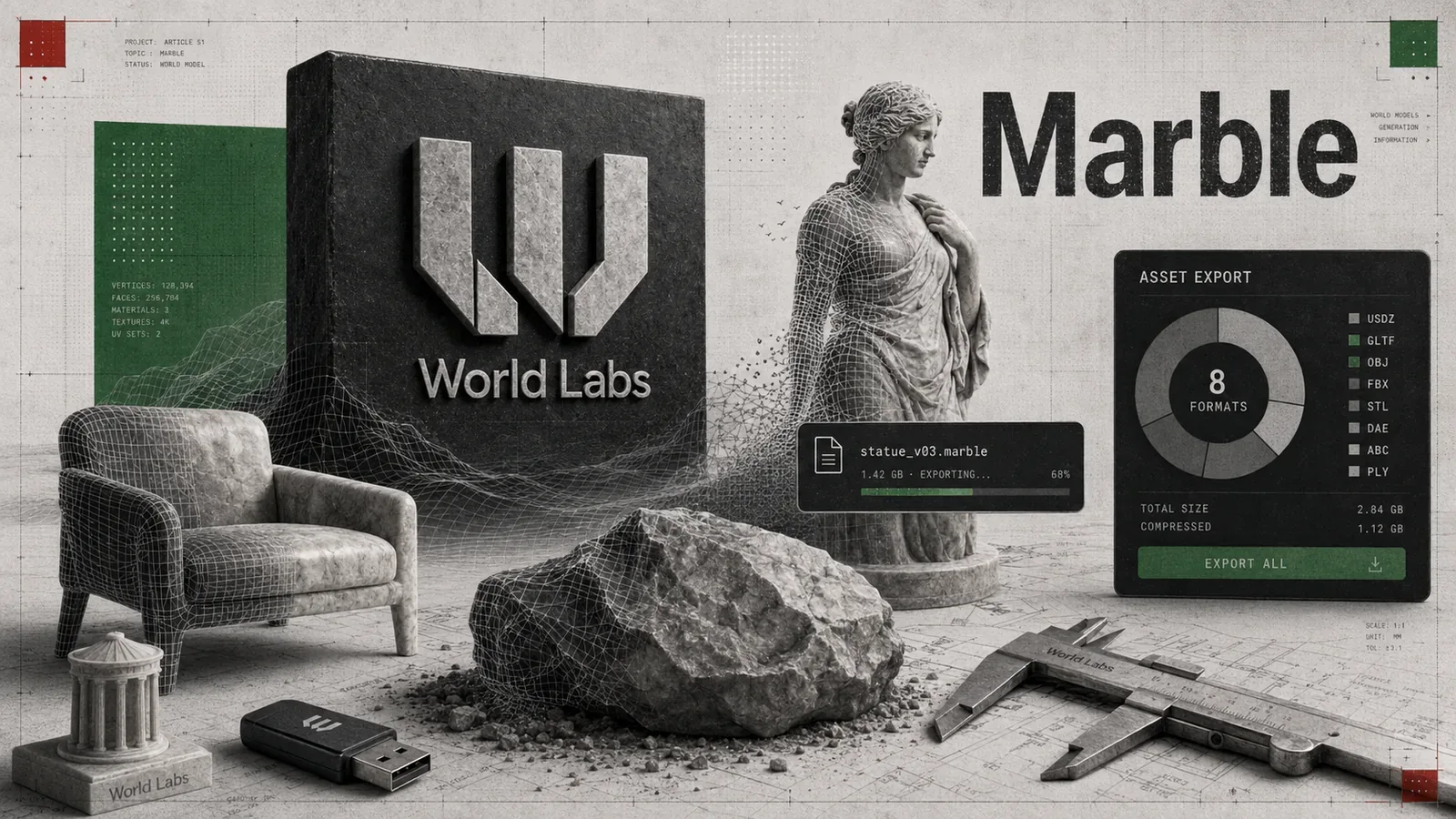
Key facts
- Nov 2025commercial release
- Launched
- $35/moPro tier
- Pro price
- $95/moMax tier
- Max price
- 3 formats.spz .ply .glb
- Export
- Hosted onlynot self-host
- Hosting
- $8.2bnall-stock, agreed 28 Sep 2026
- AMD deal
3D assets you can actually export. From Fei-Fei Li's World Labs, launched commercially November 2025, which AMD agreed to buy on 28 September 2026 in an all-stock deal valued at about $8.2bn.
What it is
Marble, the world model from Fei-Fei Li’s World Labs, launched commercially in November 2025 with a distinctive promise: 3D assets you can actually export. A world model is an AI system that learns how a scene or environment behaves so it can generate one and let you move through it, and most such systems produce video frames that exist only inside the tool that made them. Marble takes a different path. It produces geometry, and the scenes it generates leave the system as standard 3D files. That single decision by World Labs defines where the product fits.
How it works
Marble generates interactive 3D scenes from text, images, video or panoramas, using a technique called 3D Gaussian splatting. Rather than storing a scene as a mesh of polygons, Gaussian splatting represents it as a cloud of soft, coloured points that render quickly and hold up from many angles. The output is editable and exports in .spz, .ply and .glb, the formats that game engines and 3D tools already read. This is the heart of the Marble World Labs proposition: usable assets rather than throwaway clips.
Why does exportable geometry make such a difference? A video of a room is only ever a video: you cannot walk a game character through it, drop it into a simulation or measure distances inside it. Geometry can be lit, edited, imported and reused, which is the currency the tools professionals already run expect. That is the practical core of the Marble World Labs approach, and the product is judged on the fidelity and cleanliness of what it exports rather than on how its previews look on screen.
The product and pricing
The product has moved quickly. Marble 1.1 Plus, released in April 2026, added auto-expanding dynamic cubes that let generated worlds grow larger without breaking down at the edges. A REST World API allows programmatic generation, so studios can call Marble from their own software instead of working only through a web interface. It integrates with NVIDIA Isaac Sim, Unity and Unreal, three of the environments where 3D content is built and tested, which lowers the effort of moving a generated scene into an existing pipeline.
On pricing, World Labs offers a free tier, Pro at $35 per month and Max at $95 per month. Marble is not self-hostable, so users work through the hosted service rather than running the model on their own hardware. For teams that need on-premise control, that is a real constraint; for most creative and prototyping work, the hosted route is the point. The tiered pricing, from a free entry point up to Max, suggests World Labs is courting individual creators and studios alike rather than betting solely on large enterprise contracts.
AMD is buying World Labs
AMD agreed on 28 September 2026 to acquire World Labs, the maker of Marble. AMD’s press release values the all-stock transaction at approximately $8.2 billion and expects it to close by the end of 2026, subject to regulatory approvals. Fei-Fei Li will join AMD as executive vice president and chief scientist, reporting to chief executive Lisa Su, and World Labs’ own post says co-founders Justin Johnson and Ben Mildenhall will work with her to keep leading the team inside AMD.
| Deal term | Figure |
|---|---|
| Buyer | AMD |
| Agreed | 28 September 2026 |
| Consideration | All AMD stock |
| Value | About $8.2bn (company figure) |
| Expected close | By the end of 2026, subject to regulatory approval |
Why it stands apart
The export format is what sets Marble apart. Nearly everything else in this part of the field generates frames, a stream of images you watch. Marble produces geometry you can pick up and reuse, which is why it lands naturally in game level prototyping, digital twins and VR pipelines, all cases where a durable 3D asset is worth far more than a video of one. It grows out of the same video model and 3D research as its rivals, but aims the result at builders.
In the wider field, Marble marks out the export-and-integrate position, alongside NVIDIA, while other labs race on resolution and latency. Fei-Fei Li’s involvement gives World Labs unusual credibility, now backed by a chip maker that is paying about $8.2bn for the company, and the strategy is coherent: if world models are going to be useful in production, someone has to make their output portable. What to watch is whether the Gaussian splatting assets hold up as source material for large, detailed projects, and whether the ties to Unity, Unreal and Isaac Sim harden into standard tooling. For now, Marble World Labs occupies a lane of its own in this part of the field. YFarmX follows the full field on its world models hub.
More in World Models
All World Models →- OdysseyOdyssey-3one pretrained world model behind robots, cars, drones and games
- Google DeepMindGenie 3the reference interactive world model
- RunwayRunway GWM-1the most general commercial family
- NVIDIANVIDIA Cosmosthe self-hostable one
- WaymoWaymo World Modelthe first serious industrial deployment
- TencentTencent HY-World 2.0the open Chinese entry