
Google DeepMind
Genie 3
the reference interactive world model
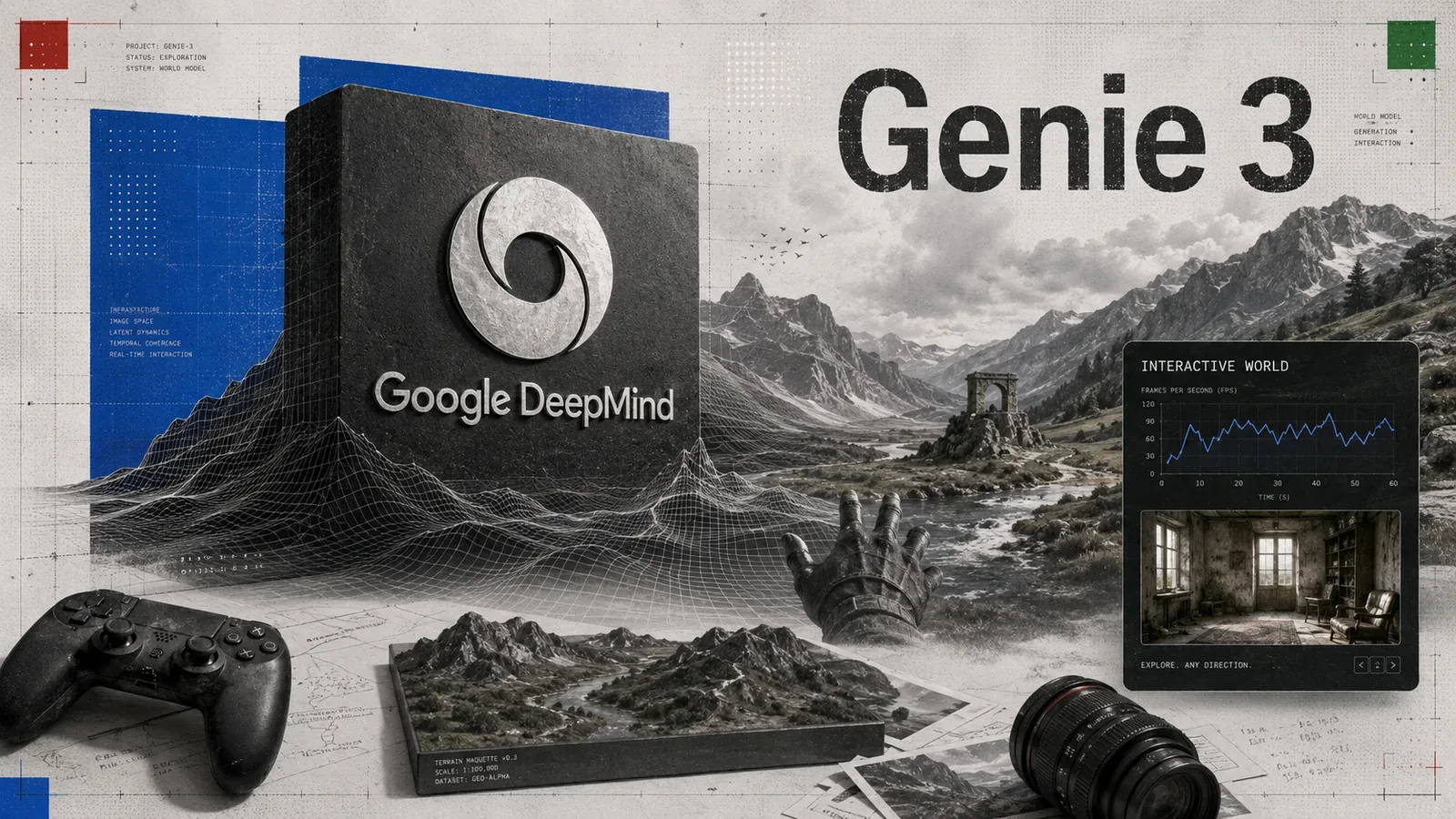
Key facts
- Aug 2025introduced
- Released
- 720pat 24 fps
- Resolution
- ClosedAPI only
- Licence
- $100/moGoogle AI Ultra
- Consumer tier
- Feb 2026Waymo build
- Industrial use
The reference interactive world model. Introduced August 2025, generates persistent interactive 3D environments at 720p and 24 fps from a text prompt or single image, with an integration that generates streets from Google Street View.
What it is
Genie 3, introduced by Google DeepMind in August 2025, is the model most people now treat as the reference point for interactive world models. It generates persistent, interactive 3D environments at 720p and 24 fps from a single text prompt or one image, and holds those environments together as a user moves through them. That mix of quality, persistence and real-time response is why Genie 3 has become the benchmark against which newer entrants are judged.
How it works
It helps to be exact about what a world model is, because the phrase is used loosely. A world model is an AI system that learns how an environment behaves and then generates what happens next in response to your actions. Where a video model produces a fixed clip that plays the same way every time, a world model reacts: turn left, and the view to your left is generated on the fly, then stays consistent if you turn back. World models build directly on video generation, and Genie 3 is one of the clearest demonstrations of the step up. YFarmX keeps a wider world models hub covering the full field.
The idea underneath the system is a compressed latent action space learned from unlabelled video. Rather than being told which control produces which movement, the model infers a small vocabulary of actions purely from watching footage, then uses that vocabulary to let a person steer the generated world. The output responds coherently to input in real time, which is the difficult part: keeping objects, geometry and lighting stable frame after frame as the viewpoint shifts.
Persistence is the quality that gives the description its weight. An environment is persistent when it remembers itself: an object you passed does not vanish or change when you return to it, and the layout of a space stays fixed as you explore. Holding that consistency at 720p and 24 fps, in real time, is what marks this model out from systems that generate striking single shots but lose track of the world from one moment to the next.
Where it is used
Google DeepMind positions the model mainly for training agents in 3D environments and for game prototyping, while saying that game development is not the goal. The value the lab sees is in generating rich, controllable environments where software agents can learn, not in shipping playable titles. The system has stayed closed through 2026, available by API only, with no open weights.
The most consequential use so far arrived in February 2026, when Waymo adopted Genie 3 and built a specialised derivative, the Waymo World Model, for autonomous driving simulation. That system produces dual-modal camera and LiDAR output and generates rare long-tail scenarios, the flooding, tornadoes and wildlife on carriageways that a real test fleet almost never meets yet still has to handle safely. It is the first case of this lineage moving from demonstration into a regulated industrial setting, which says a great deal about where the technology genuinely pays off.
There is also a consumer surface. Project Genie is the public face of the system, tied to eligible Google AI Ultra subscribers on the $100 per month tier and grounded on Google Street View scenes, so a person can generate and explore environments derived from real streets. It is a narrow, subscription-gated door rather than an open release, consistent with DeepMind’s API-only stance.
What to watch
As the reference model, Genie 3 defines the frontier on interactivity and persistence, and every rival now frames its pitch against it: more general, more open, higher resolution, or exportable to real geometry. The model itself has chosen depth over breadth, staying closed and focusing on agent training and serious industrial partners such as Waymo. What to watch is whether DeepMind widens access, and whether the Street View grounding hints at a larger ambition to model the real world in place of invented ones. For now it remains the system the rest of the field is chasing.
More in World Models
All World Models →- OdysseyOdyssey-3one pretrained world model behind robots, cars, drones and games
- RunwayRunway GWM-1the most general commercial family
- World LabsMarble3D assets you can actually export
- NVIDIANVIDIA Cosmosthe self-hostable one
- WaymoWaymo World Modelthe first serious industrial deployment
- TencentTencent HY-World 2.0the open Chinese entry