
Waymo
Waymo World Model
the first serious industrial deployment
Key facts
- Feb 2026first deployment
- Announced
- Genie 3DeepMind base
- Built on
- Dual-modalcamera + LiDAR
- Output
- Long tailrare road scenarios
- Use case
The first serious industrial deployment. Built on Genie 3 and announced February 2026.
What it is
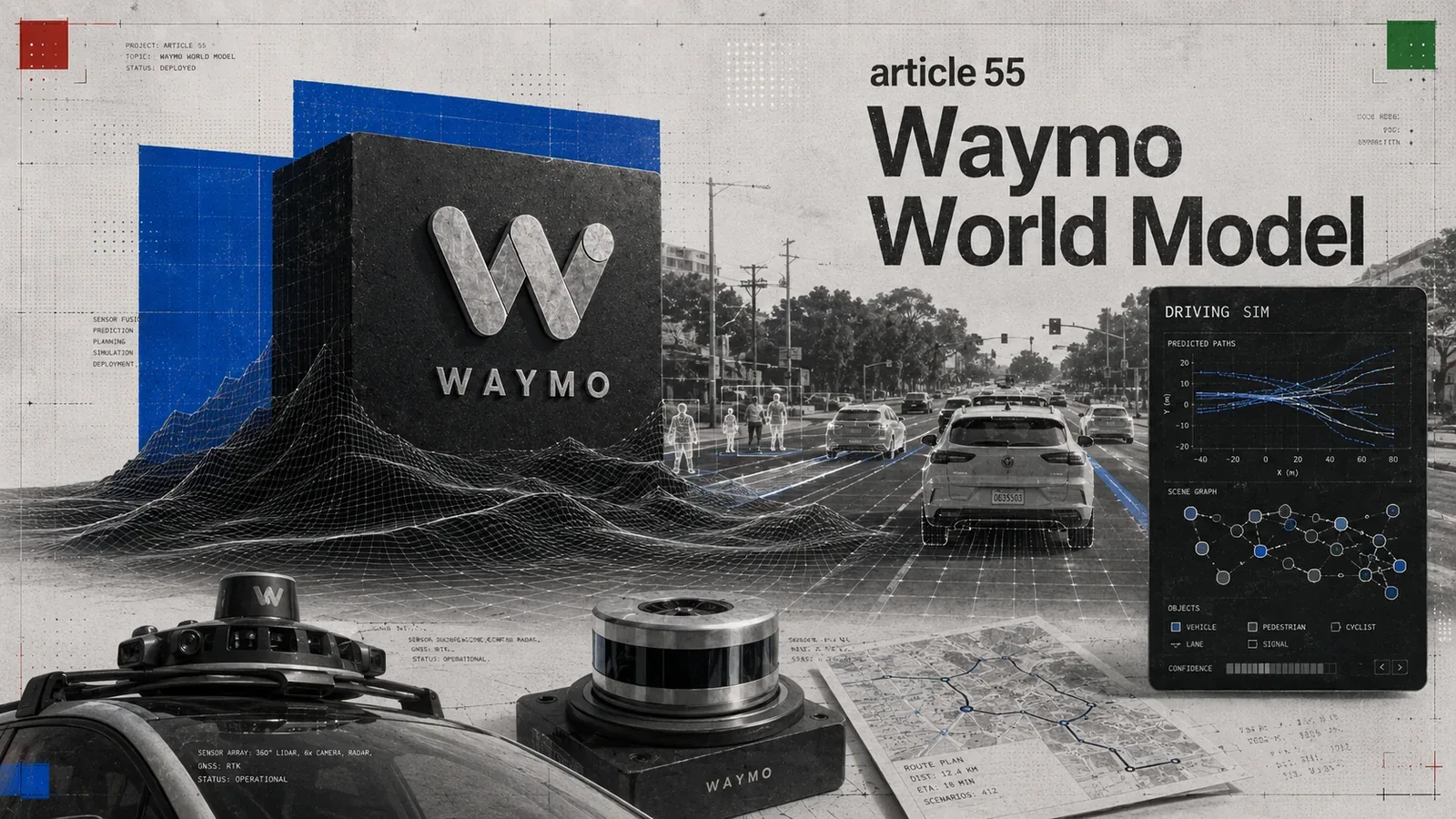
The Waymo World Model, announced in February 2026 and built on Google DeepMind’s Genie 3, is the first serious industrial deployment of world model technology. A world model is an AI system that learns how an environment behaves and can then generate new, plausible situations within it, and Waymo has put that capability to work on a hard, high-stakes problem: proving that a self-driving system is safe. The Waymo World Model generates rare driving scenarios for safety validation, reaching beyond what a fleet’s logged data can ever supply on its own.
The dual-sensor output
What sets the system apart technically is its dual-modal camera and LiDAR output. A self-driving car does not read the road through cameras alone; it also builds a depth picture using LiDAR, which measures distance with laser pulses. For simulated scenarios to be useful in validation, they have to feed both of these senses at once, so the system is designed to generate matching camera and LiDAR views of the same invented moment. That coherence is what lets the output stand in for a real drive rather than a mere video.
Why logged data falls short
There is a simple reason logged data falls short. A fleet can only record what it happens to encounter, and the most dangerous events are precisely the ones it meets least. Waiting for enough real examples of the rarest, most dangerous road events would take an unacceptable span of driving. Generating them lets validation cover cases that would otherwise stay untested until they occurred for real.
The purpose is to cover the long tail. Most miles a vehicle drives are ordinary, and a test fleet collects those easily. The events that decide whether a system is truly safe, the near-impossible edge cases, are by definition rare, and a fleet may run for years without meeting them. A world model can manufacture those situations on demand, which is exactly what logged data cannot do. This is why the deployment resonates well beyond Waymo itself: it shows a concrete, defensible reason to build such a system.
From demo to regulated use
The real significance is the shift from demonstration to regulated industry. Until now, world models have largely been shown off in research posts and product launches. Autonomous driving validation is one domain where a simulated long tail carries a direct, auditable safety argument: a regulator or a court can ask what a system was tested against, and generated edge cases become part of that answer. That gives the Waymo World Model a seriousness a technology demo, however impressive, does not have.
This makes the system the clearest proof that world models can earn their compute. Generating high-quality, dual-sensor scenarios is expensive, and the honest question about the whole field is whether the results justify the cost. Here they plausibly do, because a single avoided failure in a deployed fleet is worth a great deal. Set against that is an open question Waymo and its regulators will have to keep answering: are the generated scenarios statistically representative of real risk, or do they merely look dangerous? A simulator that produces vivid but unrepresentative events could breed false confidence, so the value of the exercise depends on how faithfully the invented long tail mirrors the real one.
What to watch
Within the wider field, the Waymo World Model is the deployment others will point to when they argue that world models are ready for real use. It inherits Genie 3’s interactivity and persistence, then narrows them to a single, accountable job. It also builds on years of video model and simulation work now being turned toward safety instead of spectacle. What to watch is whether other regulated industries, from aviation to industrial robotics, adopt the same pattern, and whether independent scrutiny confirms that generated scenarios genuinely represent the risks they are meant to test. YFarmX follows the field on its world models hub.
More in World Models
All World Models →- OdysseyOdyssey-3one pretrained world model behind robots, cars, drones and games
- Google DeepMindGenie 3the reference interactive world model
- RunwayRunway GWM-1the most general commercial family
- World LabsMarble3D assets you can actually export
- NVIDIANVIDIA Cosmosthe self-hostable one
- TencentTencent HY-World 2.0the open Chinese entry