
Tencent
Tencent HY-World 2.0
the open Chinese entry
Key facts
- Open weightsplus inference code
- Licence
- 11 May 2026code + weights
- HY-Pano 2.0
- 18 May 2026code + weights
- WorldStereo 2.0
- Hunyuantext, image, video, 3D
- Stack
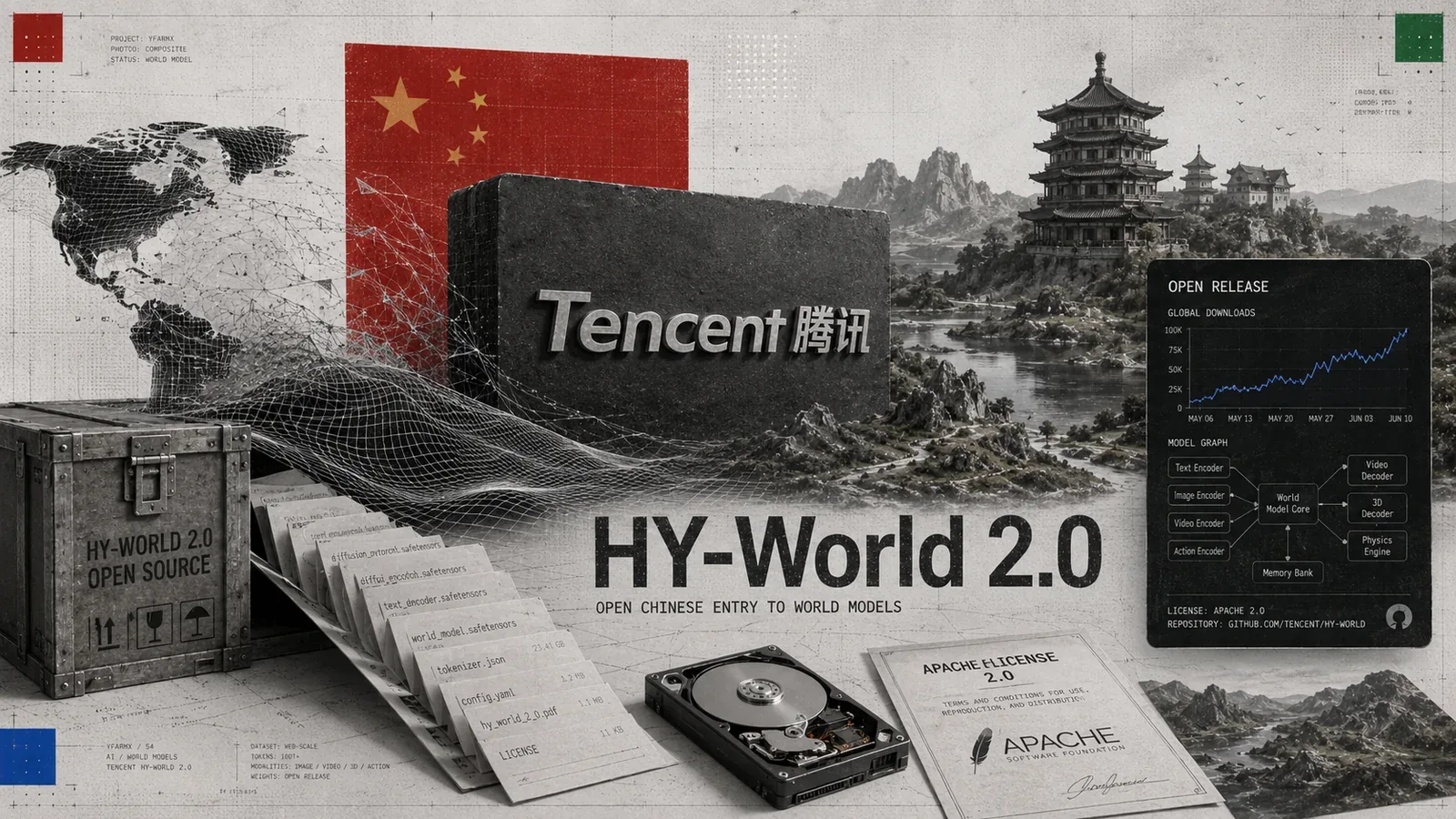
The open Chinese entry. Tencent's official HY-World 2.0 repository added HY-Pano 2.0 inference code and weights on 11 May 2026, then world-generation inference code and WorldStereo 2.0 weights on 18 May 2026.
What it is
Tencent HY-World is the open Chinese entry in the world model field, and its distinguishing feature is stated in the description: it is open. A world model is an AI system that learns how an environment behaves and can then generate one and let you move through it, and most of the strongest examples are locked behind commercial APIs. Tencent HY-World takes the opposite route, publishing the code and the trained weights so that anyone can download, run and examine the system for themselves.
The two-step release
The rollout came in two steps in May 2026. Tencent’s official HY-World 2.0 repository added HY-Pano 2.0 inference code and weights on 11 May 2026, then followed on 18 May 2026 with world-generation inference code and the WorldStereo 2.0 weights. Releasing inference code alongside weights is what makes the difference in practice, because weights on their own are hard to use; with both in hand, a researcher can reproduce results rather than take a company’s word for them.
It is worth separating the pieces Tencent has released. Weights are the trained numbers that make a model work; inference code is the software that loads those numbers and runs them to produce output. A lab that publishes only a paper, or only weights with no runnable code, leaves others to guess at the missing steps. By shipping both for HY-Pano 2.0 and WorldStereo 2.0, the family lets outside groups run the system as its authors intended and build on a known-good starting point.
What open access gives
This openness gives Tencent HY-World a particular position. It is the only major world model family shipping open weights and inference code at this scale, which makes it the default choice for academic groups and for anyone who needs to inspect exactly what the model does. Closed systems can be probed only from the outside, through their outputs; an open one can be read, modified and tested line by line. For research, for reproducibility and for organisations wary of sending data to a third party, that transparency is decisive.
Tencent HY-World does not stand alone. It sits inside Tencent’s wider Hunyuan stack, which spans text, image, video and 3D, so the assets a world model produces can flow straight into an existing pipeline rather than living in isolation. A team already using Hunyuan for image or video generation can add world generation without stitching together tools from different vendors. That integration is a real advantage, since much of the cost of adopting any model lies in fitting it to everything around it. Open weights inside a full multimodal stack is a combination few competitors can currently match.
Why it shapes the field
The reason this family earns its own entry is that open releases shape a field out of proportion to their raw benchmark scores. When capable weights are freely available, they become the substrate other people build on, the baseline experiments are run against and the reference implementations that teach the next cohort of researchers. Even labs that never ship a product this way are affected by the fact that a serious open option exists. For a field this young, that gravitational pull can shape the direction of research as much as any single benchmark result.
In the wider field, Tencent HY-World anchors the open, inspectable corner, a deliberate contrast with the closed commercial families that dominate on polish and headline demonstrations. It also signals how hard Chinese labs are pushing across every part of world modelling, from resolution to openness. What to watch is how quickly the community builds on the HY-World 2.0 and WorldStereo 2.0 releases, and whether keeping the work open turns into a durable lead in research adoption. How complete and well maintained those repositories stay will decide whether the openness turns into lasting influence or fades after the initial release. YFarmX tracks the field on its world models hub.
More in World Models
All World Models →- OdysseyOdyssey-3one pretrained world model behind robots, cars, drones and games
- Google DeepMindGenie 3the reference interactive world model
- RunwayRunway GWM-1the most general commercial family
- World LabsMarble3D assets you can actually export
- NVIDIANVIDIA Cosmosthe self-hostable one
- WaymoWaymo World Modelthe first serious industrial deployment