
Runway
Runway GWM-1
the most general commercial family
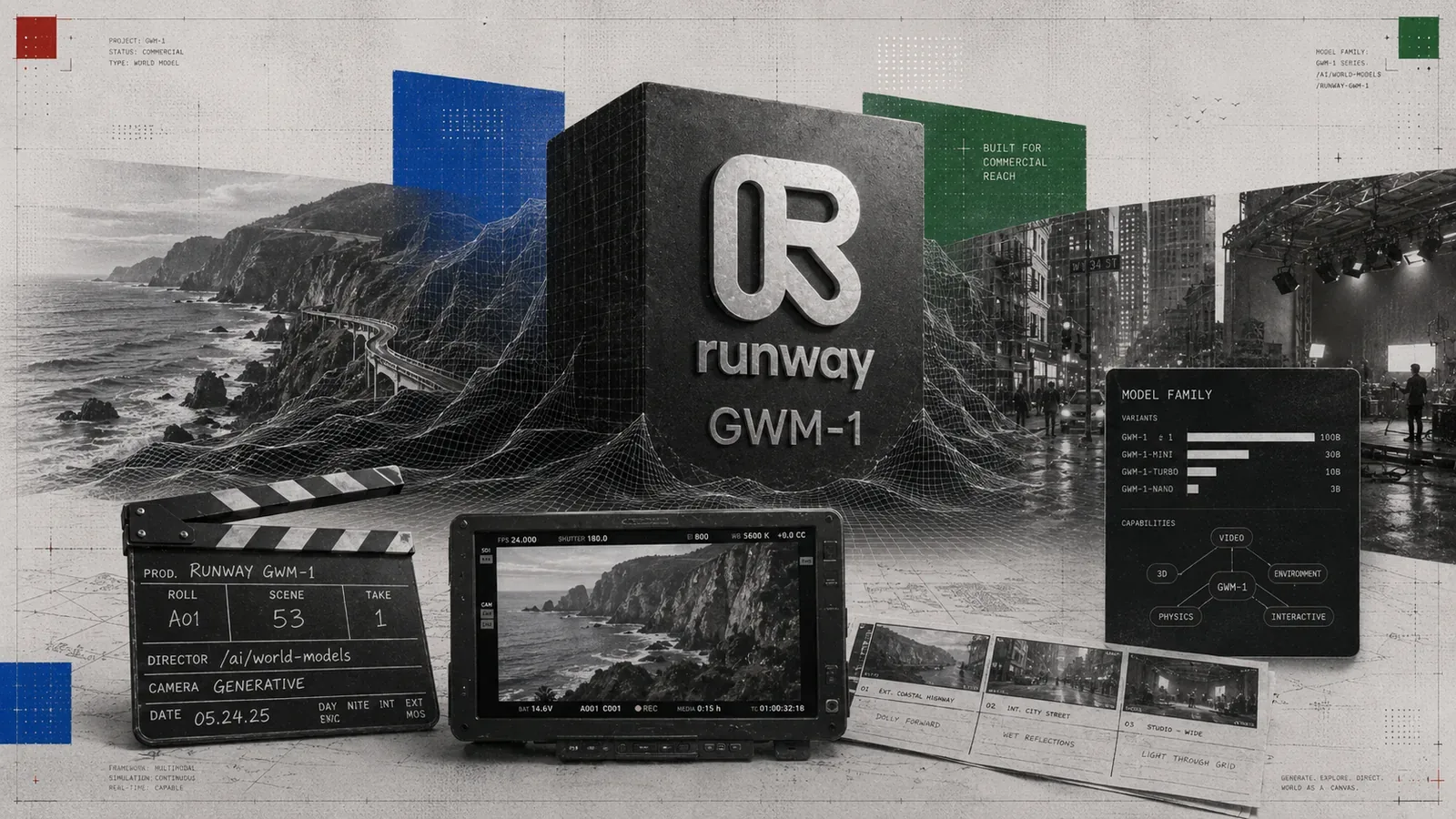
Key facts
- 11 Dec 2025GWM-1 family
- Announced
- 1280x720at 24 fps
- Resolution
- 2 minper generation
- Max length
- 3post-trained models
- Variants
- Gen-4.5autoregressive
- Base model
The most general commercial family. Announced 11 December 2025.
What it is
Runway GWM-1, announced on 11 December 2025, is Runway’s bid to ship the most general commercial world model family available. A world model is an AI system that learns how an environment behaves and then generates what comes next in response to a user’s actions, rather than playing back a fixed clip. Runway GWM-1 is designed to do this across several settings at once, from conversational characters to explorable spaces to robot training, which is the sense in which the company calls it general.
How it works
Technically, it is an autoregressive model built on top of Runway’s Gen-4.5. It generates frame by frame, runs in real time and accepts a wide set of action inputs, including camera pose, robot commands and audio. That breadth of control is central to Runway’s claim that the family is more general than Google DeepMind’s Genie 3. Because it grows out of a video model lineage, it inherits Gen-4.5’s visual quality while adding the interactivity that separates a world model from ordinary video generation.
On the July 2026 reading taken for this page, the family shipped in three post-trained variants. Runway Characters produces audio-driven conversational characters from a single image and is available both as an API and inside the web app. GWM-Worlds generates explorable environments. GWM-Robotics acts as a learned simulator that produces synthetic training data, with an SDK offered by request. Runway has said it is working toward unifying these on a single base model, which would turn three specialised tools into one system reached through different interfaces.
The three variants also show what the action inputs are for. Camera pose lets a user move a virtual viewpoint through a scene; robot commands drive GWM-Robotics as a training simulator; audio drives the conversational characters, whose faces and voices are generated together in response to speech. Building all of this on a single Gen-4.5 base is what lets Runway argue for generality: one underlying model, exposed through interfaces tuned for support, storytelling and robotics rather than three unrelated products.
What the specs say
On the specifications published to July 2026, Runway GWM-1 generates up to two minutes of output at 1280x720 and 24 fps. Beyond that, the company has kept the details close: parameter count, training data and performance metrics were all undisclosed at that reading. That reticence is common among commercial world model providers, and it means outside assessment has to rest on observed behaviour rather than on figures the lab will stand behind. Without published parameter counts or benchmarks, a buyer essentially takes the capability on trust and on their own testing, which puts a premium on hands-on trials before committing a workflow to the family.
The strategy
The strategic argument behind the family is that real-time generated video can replace the text box as the way people interact with software, for uses such as customer support, storytelling and branded experiences. Instead of typing to a chatbot and reading its replies, a user would talk to a generated character that responds live. Whether that holds up in practice comes down to two things: latency, because any perceptible lag breaks the feel of a conversation, and consistency, because the characters need to keep their quality across long exchanges rather than drifting as a session runs on.
Within the field, Runway GWM-1 stakes out the breadth position. Where some rivals go deep on one use, such as Google DeepMind on agent training or World Labs on exportable geometry, Runway is betting that a single flexible family covering characters, worlds and robotics is the more valuable shape. The unresolved questions are the ones the company itself invites: sustained latency and long-conversation quality. If it clears both, the case for generated interactive video as a mainstream interface grows a good deal stronger. It is a bold reading of where interfaces are heading, and the next year of real deployments will show whether users want to talk to generated video or still prefer to type. For the wider picture, YFarmX tracks the field on its world models hub.
More in World Models
All World Models →- OdysseyOdyssey-3one pretrained world model behind robots, cars, drones and games
- Google DeepMindGenie 3the reference interactive world model
- World LabsMarble3D assets you can actually export
- NVIDIANVIDIA Cosmosthe self-hostable one
- WaymoWaymo World Modelthe first serious industrial deployment
- TencentTencent HY-World 2.0the open Chinese entry