
Odyssey
Odyssey-3
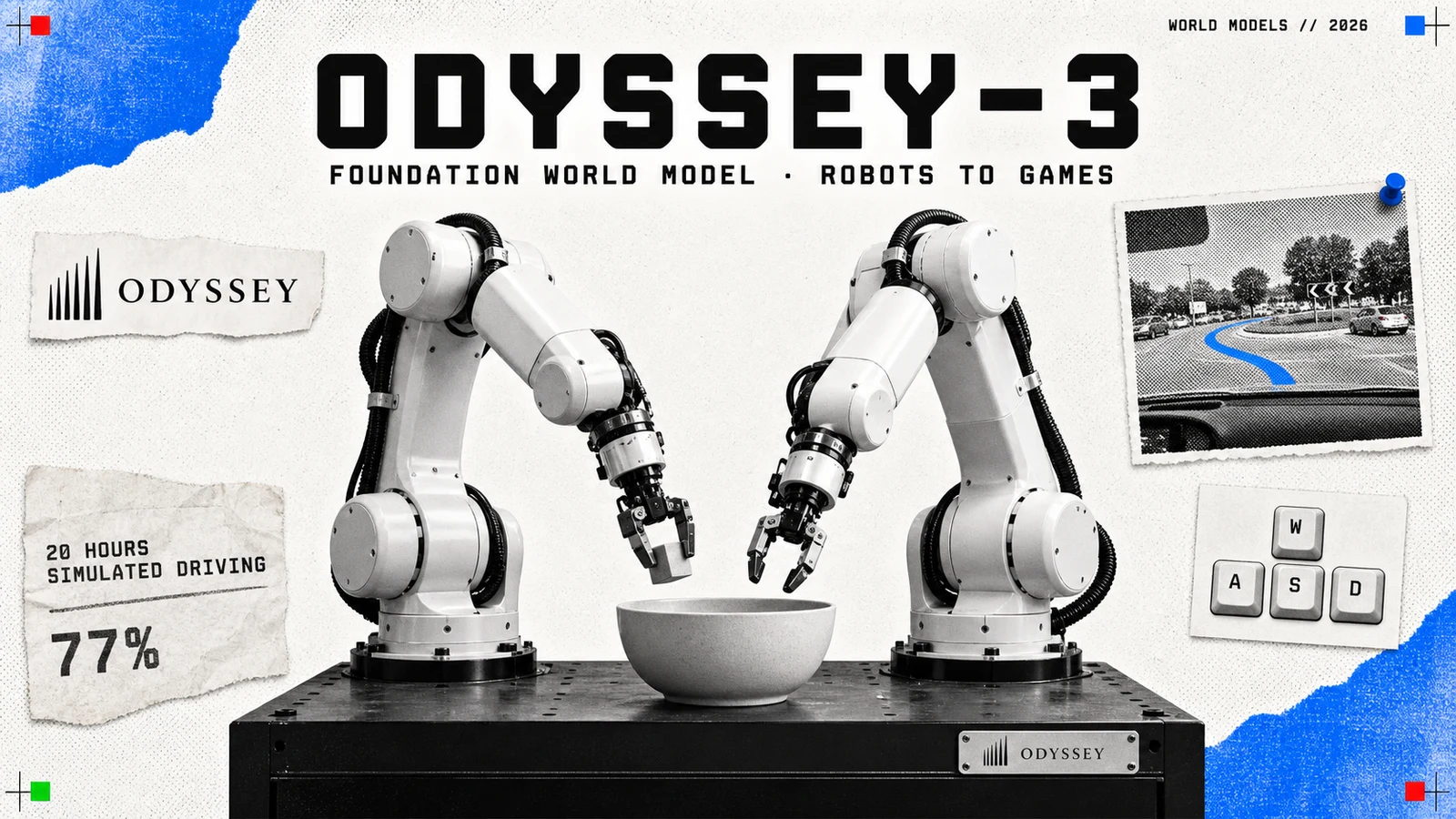
one pretrained world model behind robots, cars, drones and games
Key facts
- 15 Sept 2026public release pending
- Announced
- AR diffusiontransformer backbone
- Architecture
- 20 hourssimulated, closed loop
- Driving data
- 77%distance between interventions
- Sim against real
- ~2 hoursGTA footage reused in RDR2
- Game transfer
- $1.45bnJune 2026 Series B
- Lab valuation
A foundation world model announced by Odyssey on 15 September 2026 and written up by founders Oliver Cameron and Jeff Hawke. One pretrained backbone, held frozen, feeds small task policies that control robot arms, a Flexion humanoid, a car driving closed loop on Indian roads, an indoor drone and a character in Grand Theft Auto V. Odyssey reports tens of hours of task-specific data for the robot, humanoid and drone work and 20 hours for driving, and that a policy trained on roughly two hours of game footage carried over to a different game with no further training.
What it is
Odyssey published Odyssey-3 on 15 September 2026, in a post written by its two founders, chief executive Oliver Cameron and chief technology officer Jeff Hawke. The company describes it as “a foundation world model that can power robots, drive cars, train AIs, pilot drones, and even play video games”.
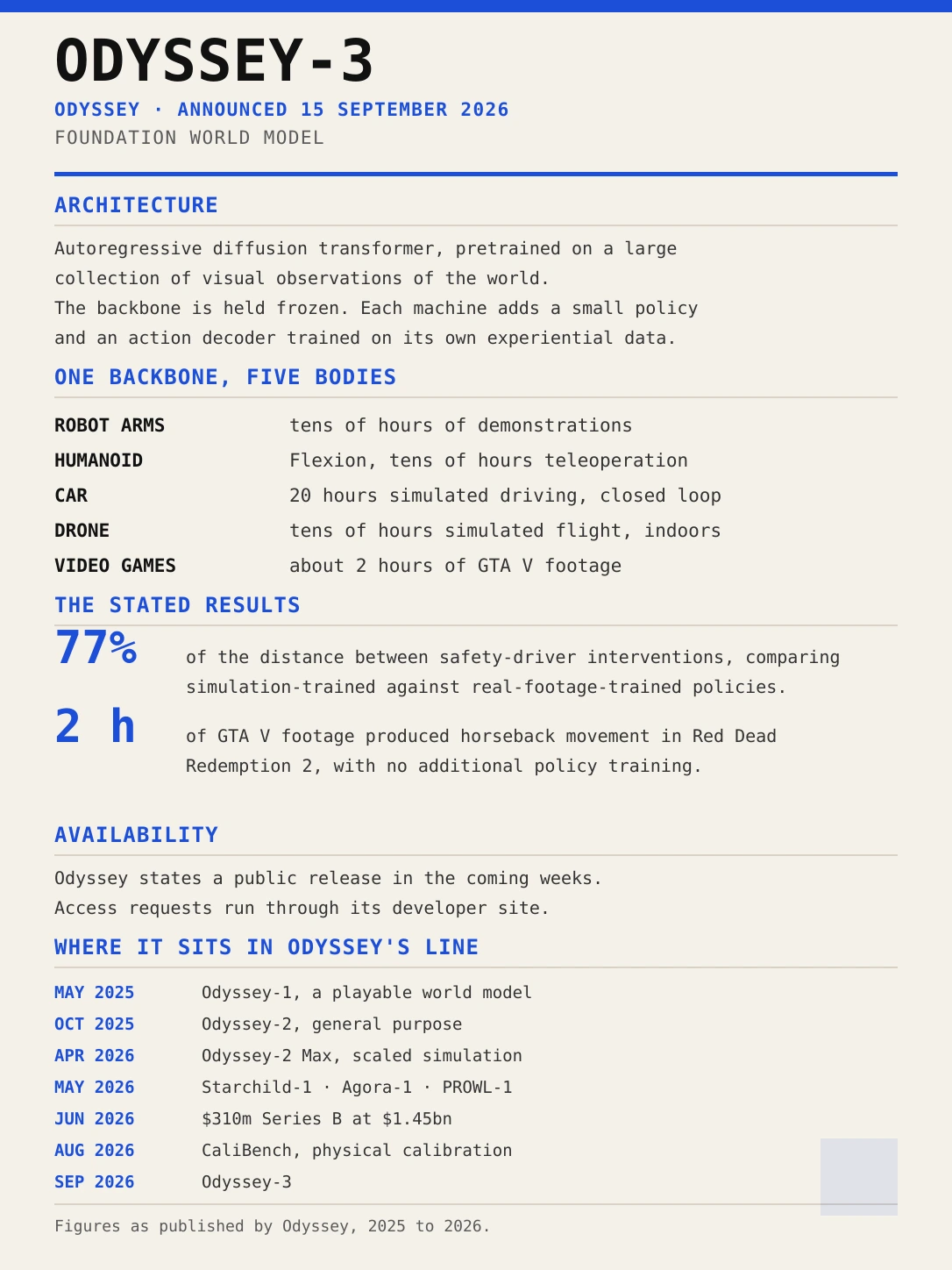
The claim underneath that sentence is about reuse. One model is pretrained once on visual observations of the world, and the same pretrained weights then sit behind five different machines: a pair of robot arms on a bench, a humanoid in a cluttered office, a car on public roads in India, a drone indoors, and a character in a video game. What changes between them is a small component bolted on top, trained on a few hours of data from that particular body.
Odyssey frames the result as “physical agents”, a term it uses for systems that interface with physical and virtual machines directly rather than through language. The lab was founded in 2023 by Cameron and Hawke, who both came from autonomous driving, and it raised a $310 million Series B in June 2026 at a $1.45 billion valuation.
How one model reaches five different machines
A world model learns how an environment behaves and generates what happens next in response to an action. Where a video model produces a fixed clip, a world model reacts to input and keeps the result consistent. YFarmX keeps a wider world models hub covering the rest of the field, and Genie 3 remains the reference point for interactive generation.
Odyssey-3 is described as an autoregressive diffusion transformer “trained to simulate highly diverse scenarios”. Its pretraining runs on a large collection of visual observations, from which the company says the model acquires physics, dynamics, cause and effect, and human behaviours.
Getting from that to a moving machine takes one extra piece. Odyssey attaches what it calls an action decoder, a learned output component trained on experiential data that pairs a machine’s observations with the actions taken to perform a task. The decoder translates the world model’s internal representations into whatever control signals that particular body needs. In the driving and drone work the pretrained backbone stays frozen throughout, and a comparatively small policy reads its visual representations and predicts waypoints.
The saving Odyssey is claiming sits in how much task-specific data each body then needs. Because the general knowledge already exists in the backbone, the company reports it is working from tens of hours of demonstrations per machine rather than the far larger task-specific collections that narrow systems are usually trained on.
What it does in each body
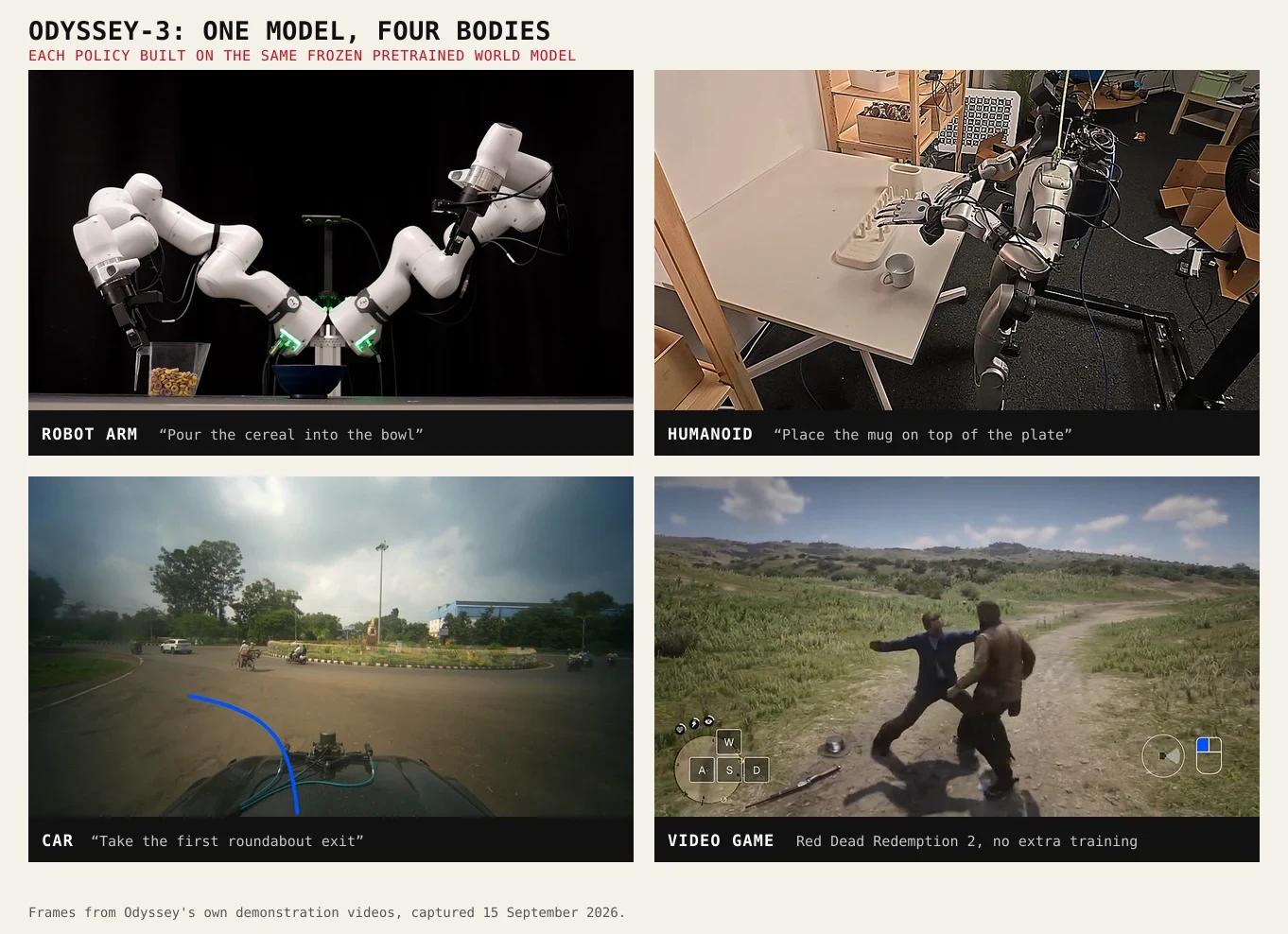
Robot arms. With tens of hours of demonstrations, Odyssey-3 drives a variety of robot arms through tasks such as pouring cereal into a bowl, cleaning a plate with a wipe and closing a screwbox. The detail the company highlights is recovery: in its experiments the arms reorient a gripper after a missed grasp and retrieve an object dropped in an unusual position, behaviours it says are absent from the training demonstrations. To test how far that holds across different hardware, Odyssey has announced a collaboration with Poke & Wiggle, a Munich robot-data company, to evaluate the model across different bodies, viewpoints and controls.
Humanoids. Odyssey announced a research collaboration with Flexion, the Zurich lab building general-purpose robot intelligence, whose co-founder and chief executive Nikita Rudin was a research scientist at NVIDIA before co-founding the company. Flexion built humanoid control policies on top of Odyssey-3 as a base model, using tens of hours of teleoperation data, and the resulting system performs tasks in real time. Odyssey reports that these policies held up better than the vision-language-action baselines it tested when lighting changed. Rudin’s own framing: “What excites us about Odyssey-3 is the opportunity to build on physical knowledge acquired far beyond a robot’s own demonstrations.”
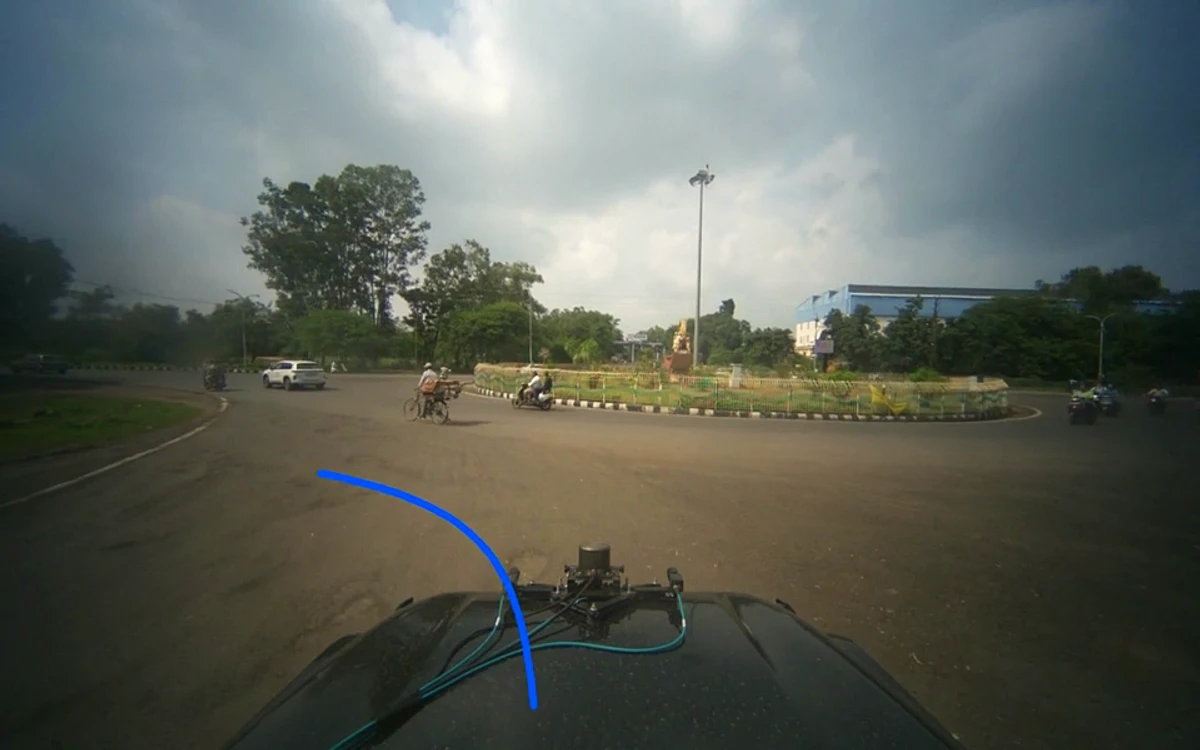
Cars. This is where the strongest number sits. Using 20 hours of simulated driving data, Odyssey-3 drives a car in closed loop on public streets in India, generating trajectories in real time. Odyssey then ran the comparison that gives the figure its weight: policies trained entirely in simulation against policies trained on real driving footage, both evaluated on busy roads. On real roads the simulation-only policies covered about 77% of the distance between safety-driver interventions that the real-footage policies managed.
Drones. The same recipe produces an aerial navigation policy that reads recent camera frames, the drone’s motion state and a high-level prompt, then generates flight waypoints. Trained on tens of hours of simulated drone data, it held stable flight while avoiding obstacles in a simulated indoor setting.
Video games. Policies are trained on gameplay recordings paired with keyboard and mouse inputs, with the world model again frozen. Odyssey reports extended sessions in Rockstar Games’ Grand Theft Auto V, covering driving, shooting and hand-to-hand combat. The transfer result is the interesting one: a mobility policy trained on roughly two hours of GTA footage produced horseback movement in Red Dead Redemption 2, applying controls learned in one game to a different character, mount and environment, with no additional policy training. Movement also carried over to Square Enix’s Sleeping Dogs.
How far the evidence goes
Every figure on this page is Odyssey’s own, published on its announcement page on the day of release. The demonstrations are the company’s recordings of its own systems, and the baselines in the humanoid comparison were selected by Odyssey.
The driving result is the most precisely stated: 77% of the distance between safety-driver interventions, a relative measure against the lab’s own real-footage policy rather than an absolute road-safety figure. The robotics, humanoid and drone results are given as “tens of hours” of data, which fixes the order of magnitude and leaves the exact totals open. The gameplay transfer carries a stated quantity, roughly two hours of GTA footage, and a described outcome rather than a scored benchmark.
Evaluation by a named outside party is the declared purpose of the Poke & Wiggle collaboration, which Odyssey says exists to establish where the model’s knowledge transfers across bodies, viewpoints and controls, and where it breaks down. It is a partnership Odyssey announced and is party to, rather than an arms-length audit. Odyssey published CaliBench, its own physical-calibration benchmark for world models, in August 2026, so the vocabulary for measuring this class of claim is one the lab has been building in public.
Where it sits in Odyssey’s line
Odyssey has shipped on a fast cadence. Odyssey-1, a playable world model, arrived in May 2025, followed by Odyssey-2 in October 2025 and Odyssey-2 Max in April 2026. Three research systems landed in the same period: Starchild-1, which the lab calls the first real-time multimodal world model; Agora-1, a multi-agent model letting several participants share one simulation; and PROWL-1, a reinforcement-learning framework in which an agent explores generated environments to improve the world model itself. Odyssey-3 is the first of the line the company presents as a general-purpose control backbone rather than a simulator to look at.
The June 2026 Series B was led by Natural Capital, with Amazon, GV, AMD Ventures, EQT and IQT participating, alongside existing backers including Jeff Dean, Elad Gil, Qasar Younis, Kyle Vogt and Garry Tan. Amazon Web Services was named the incoming preferred cloud provider in the same announcement, with Odyssey to work alongside Amazon’s Annapurna Labs on AWS Trainium.
How to get it
Odyssey states that it will release Odyssey-3 publicly “in the coming weeks”, with access running through its developer site. The founders close their post on the scaling argument: frontier world models, in their reading, remain “roughly two orders of magnitude behind language models”, which is the room they see ahead of this one.
More in World Models
All World Models →- Google DeepMindGenie 3the reference interactive world model
- WaymoWaymo World Modelthe first serious industrial deployment
- NVIDIANVIDIA Cosmosthe self-hostable one
- RunwayRunway GWM-1the most general commercial family
- World LabsMarble3D assets you can actually export
- TencentTencent HY-World 2.0the open Chinese entry