
Google DeepMind
Genie 4
explorable AI worlds you steer by typing, with their own sound
Key facts
- 27 Oct 2026Google DeepMind
- Announced
- Built inambient sound, music, dialogue
- Sound
- Gemini 3.8 Flashplans multi-step events
- Planner
- A few minutesof continuous interaction
- Session
- Trusted testersUltra and Gemini API next
- Access
- From $99.99a month in the US, Project Genie route
- Google AI Ultra
Genie 4 is an AI model from Google DeepMind that builds a world around you as you explore it. You walk with the keyboard, type what should happen next, and the scene changes in real time, complete with its own sound, music and voices. Google announced it on 27 October 2026 as a research preview for trusted testers, with Google AI Ultra subscribers and developers next.
Genie 4 is Google DeepMind’s newest interactive world model: describe a place and it generates one you can walk through with the keyboard, drawing each moment as you move. A world model is an AI that works out what happens next in response to what you do, so the scene reacts to you the way a game would. You can change it by typing while it runs, and every world comes with its own sound: wind, music and the voices of the people in it.
Google DeepMind announced Genie 4 on 27 October 2026, in a post by Raia Hadsell, Diego Rivas and Hang Qi. It is a research preview with trusted testers for now, and Google says it is “coming soon to Google AI Ultra subscribers in Project Genie and early access partners in the Gemini API and AI Studio”. It follows Genie 3, the August 2025 model behind Project Genie, and YFarmX tracks the rest of the field on the world models hub.
You steer the world by typing
Genie 4 takes keyboard controls for walking and turning the camera, and typed instructions for everything else. DeepMind’s examples include changing the weather, moving the camera and introducing a new person or object, all while the world keeps running.
Gemini reworks each instruction to fit what is on screen. DeepMind says Gemini “will contextually adapt your prompt to match the surrounding scene”, and between your inputs it also “monitors and steers the scene to keep the world progressing cohesively”.
Every world now comes with sound
Genie 4 generates audio together with the picture, and Google DeepMind calls it “our first real-time world model to generate audio natively”. Google’s own summary: “Every world also generates native audio on the fly, including ambient sounds, music, and interactive dialogue.”
Speech is the newest part. Characters in a Genie 4 world can talk, to each other and to you, and DeepMind says they “converse and react to your inputs or events in the world, all in real-time”. Its demo prompts ask for a saxophone playing over a misty lake, and for the wingbeats and roaring wind of a dragon race.
People and physics look more real
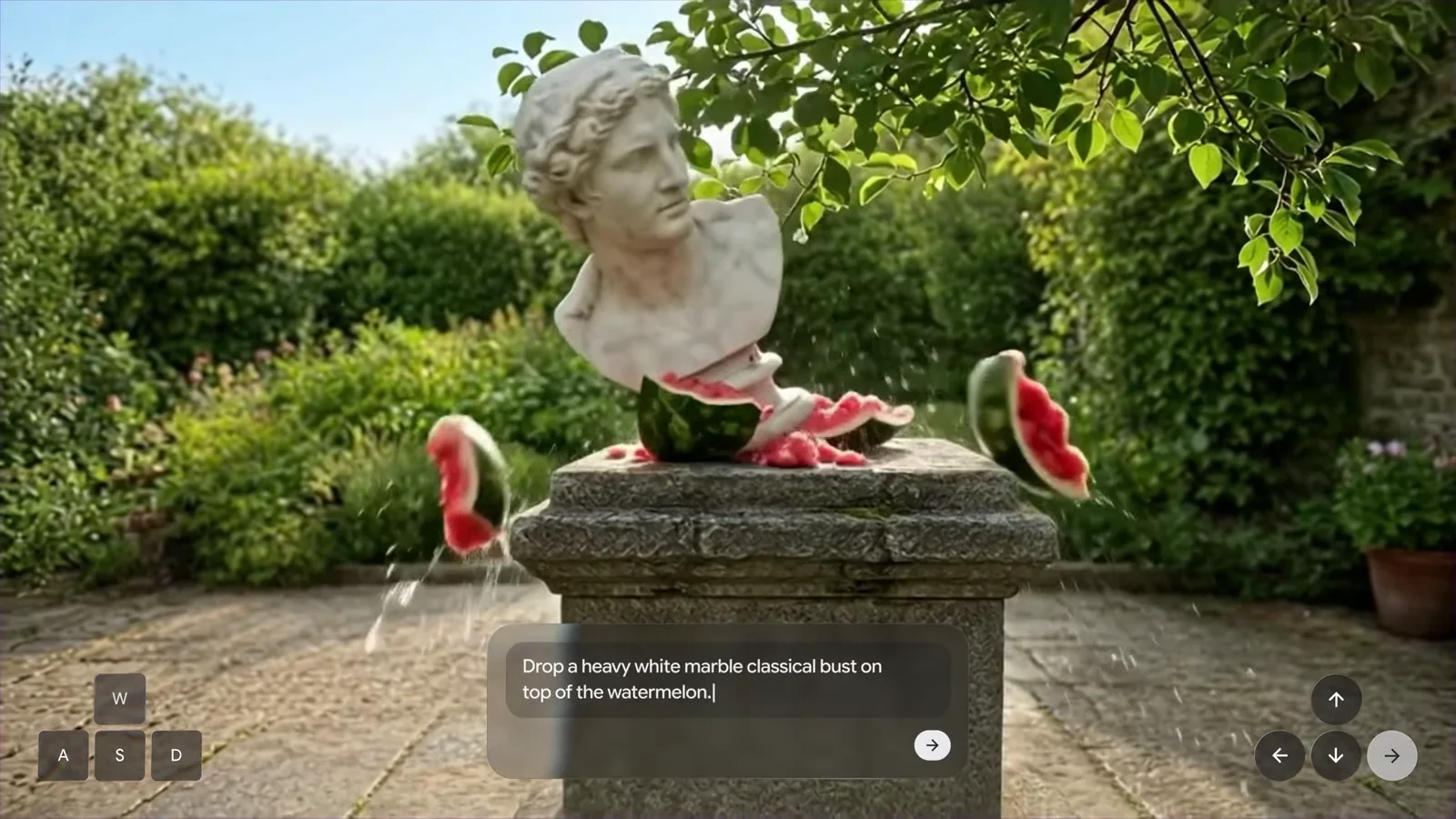
Google DeepMind says Genie 4 simulates physical events such as aerodynamics and collisions, and its demos show a maple seed falling from a tree into the grass and a watermelon bursting under a falling bust. The lab calls the way it simulates people “the most dramatic leap”: characters move naturally, react to what is around them and can be steered while the scene runs.
Gemini plans the scene while Genie draws it
Genie 4 can run with a Gemini model alongside it to play out events in several steps. DeepMind says Gemini 3.8 Flash “serves as a guiding agent in the loop”: as Genie 4 generates the world, Gemini watches the scene, breaks a goal into a sequence of steps and checks incoming frames to confirm each step worked. When the world shifts or the user steps in, it changes the plan on the spot.
Genie 4 also builds on the rest of the Gemini family. Google says Gemini Omni, its multimodal generation model, “anchors simulations in real-world appearance and behavior”, while other Gemini models supply the reasoning that keeps a simulation coherent. DeepMind describes the pairing as an early step towards hybrid world models, where language and code models map the structure and timeline of a scene and the pixel model renders how it looks, sounds and responds.
Google is trying it out on robots
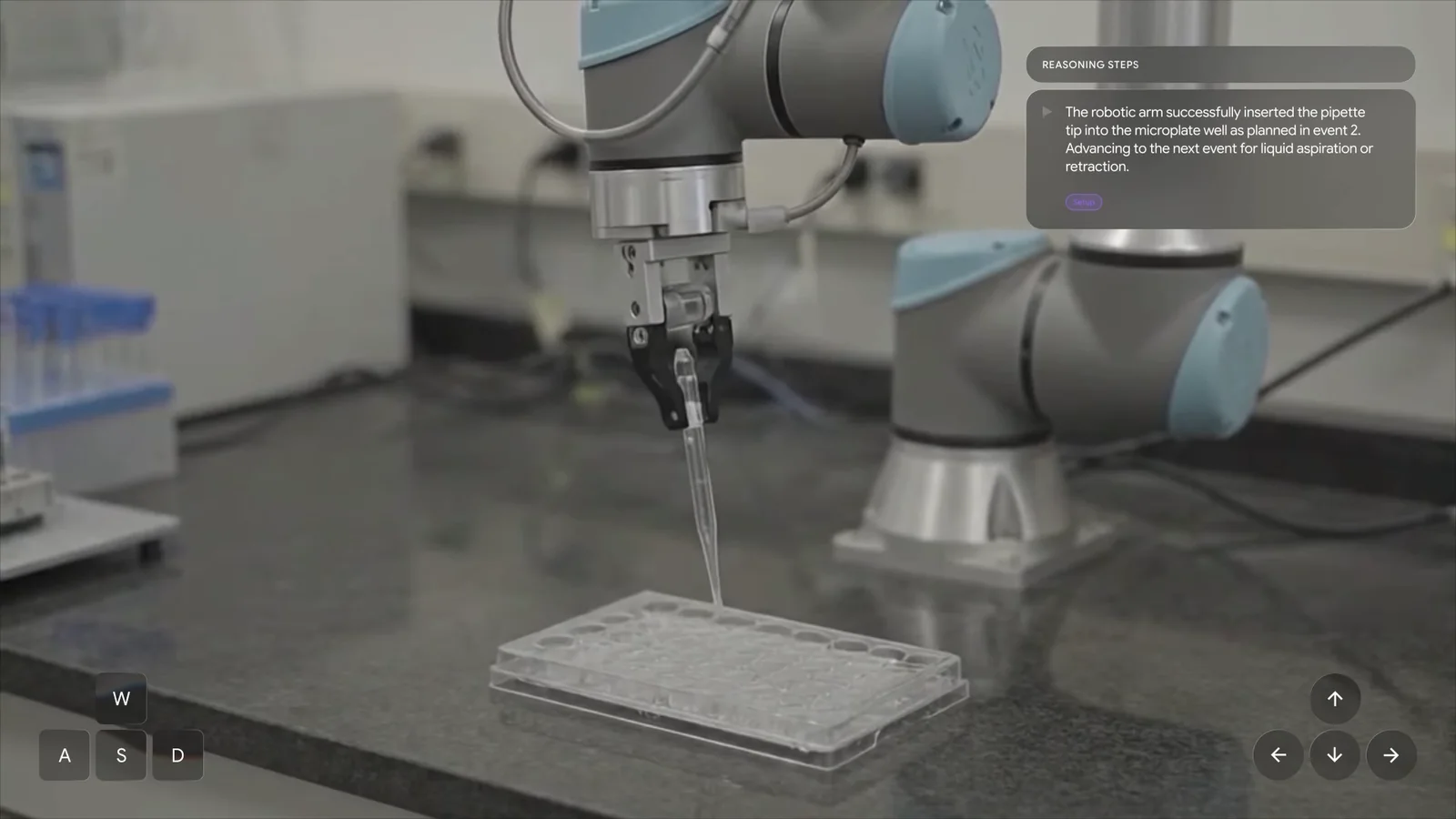
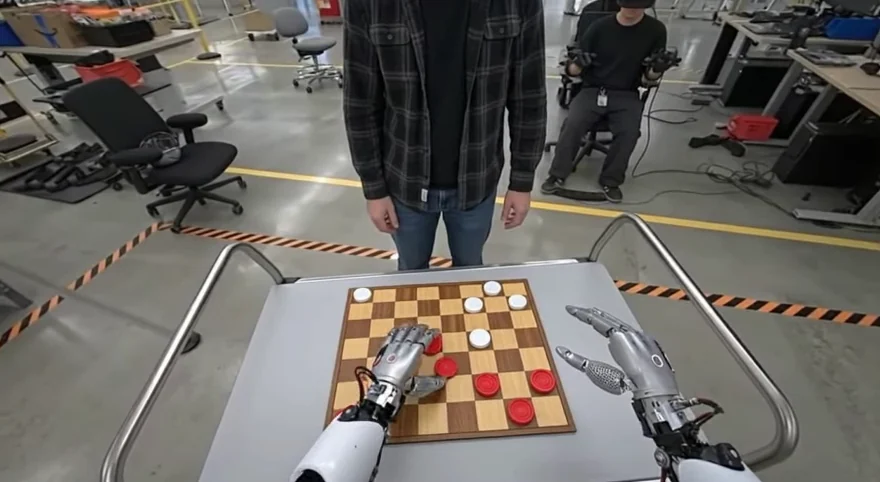
Google DeepMind paired Genie 4 with Gemini 4 Argon inside its Gemini Robotics research. In its example, Argon breaks a task given by a user into steps and feeds them to Genie 4 as text captions while the simulation renders, so the scene adapts as the task progresses.
The task shown is a game of checkers played by Apptronik’s Apollo, a humanoid robot. DeepMind calls this “a path for simulating a breadth of scenarios in imagined worlds”, and says pairing Gemini with Genie 4 lets it “test how AI systems navigate different environments before bringing them to the real world”.
How Genie 4 compares with Genie 3
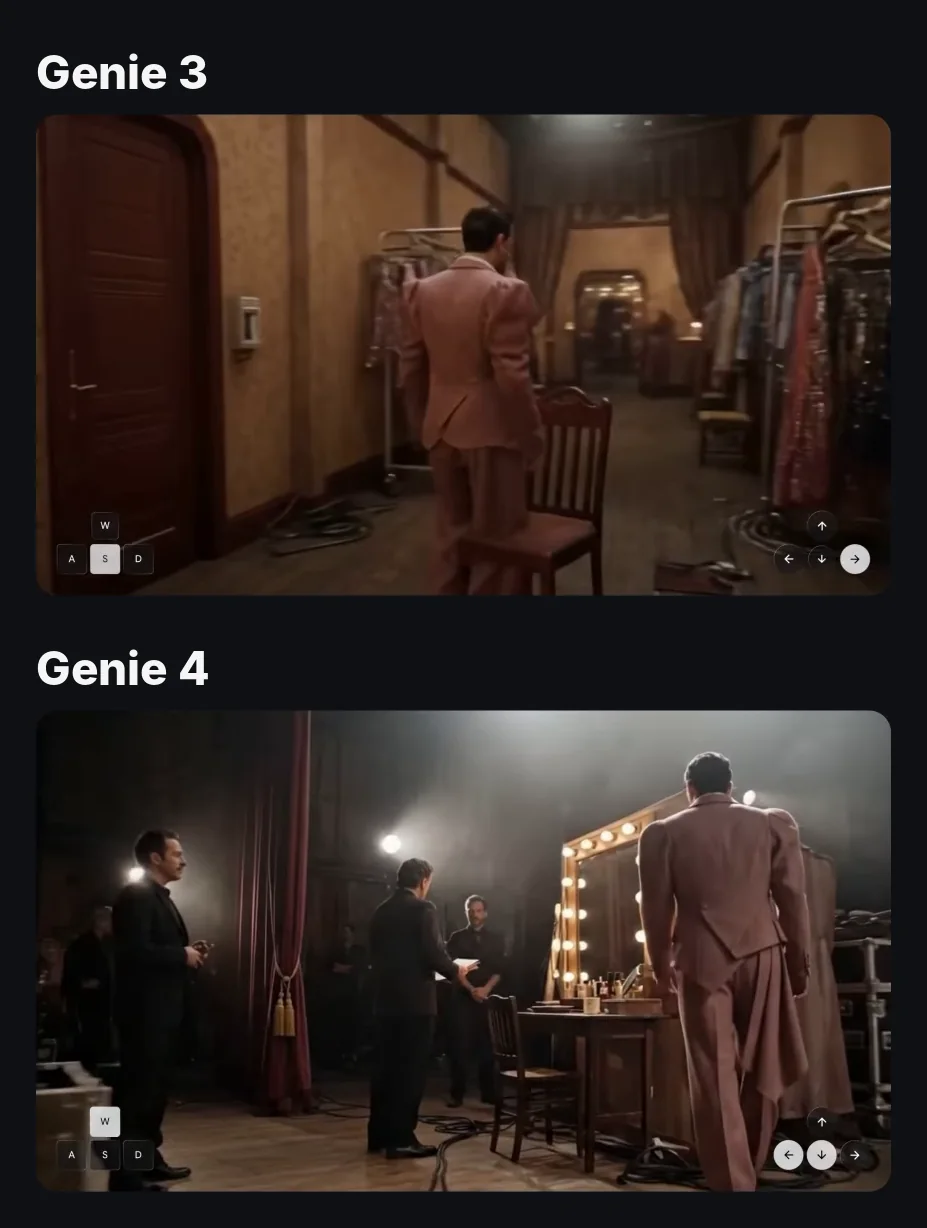
Genie 4 keeps Genie 3’s real-time, keyboard-driven exploration and adds sound, a Gemini planner and more realistic people.
| Genie 3 | Genie 4 | |
|---|---|---|
| Announced | 5 August 2025 | 27 October 2026 |
| What it generates | Video at 720p and 24 frames a second | Video with ambient sound, music and spoken dialogue |
| Typed changes | Weather, new objects and characters | The same, with Gemini fitting each prompt to the scene |
| Session length | A few minutes | A few minutes |
| Public route | Project Genie, Google AI Ultra | Trusted testers; Project Genie and Gemini API next |
What testers are using it for
Google DeepMind has tested Genie 4 with groups of trusted testers from creative industries, journalism, education, gaming and engineering. Creative teams are testing it as a “draft mode”: filmmakers can step into a live scene and run several takes, changing camera angles, lighting, dialogue and action. Photojournalists are exploring how one archival photograph can become a simulation of that place in seconds, and teams are testing it to visualise how a flash flood or a wildfire unfolds.
Game developers are testing it to go from an idea to an explorable prototype in seconds, trying out visual styles and mechanics through typed prompts before writing engine code. Enterprise partners are evaluating it as a fast way to generate a new scenario from scratch. Bloomberg’s report on the launch, by Davey Alba, said Genie 4 advances “a technology that has rattled investors in video game companies”.
Sessions last a few minutes
Genie 4 supports a few minutes of continuous interaction, according to Google DeepMind’s model page. Over that time, visual details and object permanence can shift, and DeepMind says the drift grows as a session runs longer, after several complex prompt edits, or while moving around the scene.
DeepMind names the other areas still under research: complex physical interactions, interactions between users, several independent agents and a shared environment, exact reproduction of real places, legible text (often generated only when it is written into the world description), spatial accuracy and real-time audio. Every clip DeepMind published records a real-time session, under the note “Results for illustrative purposes. Sequences shortened.”
How to get Genie 4
Genie 4 is in a research preview with trusted testers. Google says it is coming next to Google AI Ultra subscribers in Project Genie and to early access partners in the Gemini API and Google AI Studio. Google AI Ultra starts at $99.99 a month in the US with five times AI Pro’s usage limits, or $199.99 a month for 20 times, on Google’s plan page, which says Project Genie is available in more than 140 countries. DeepMind runs a waitlist for Genie 4 in Project Genie.
Google says all video and audio Genie 4 generates will carry SynthID, its imperceptible watermark for identifying AI-generated video and audio. DeepMind says it ran internal safety evaluations before the preview and gave the model to trusted testers first to gather feedback before a wider release.
Questions people ask
- What is Genie 4?
- Genie 4 is Google DeepMind's interactive world model, announced on 27 October 2026. It generates a world in real time as you move through it with the keyboard, lets you change the scene by typing, and produces the sound, music and dialogue along with the picture.
- How is Genie 4 different from Genie 3?
- Genie 4 adds sound generated with the world, more realistic people and physics, and Gemini models that adapt typed prompts to the scene and plan multi-step events. Genie 3, announced in August 2025, generated worlds at 720p and 24 frames a second.
- Can I use Genie 4 now?
- Genie 4 is with trusted testers as a research preview. Google says it is coming soon to Google AI Ultra subscribers in Project Genie and to early access partners in the Gemini API and Google AI Studio, and DeepMind runs a waitlist.
- How long does a Genie 4 session last?
- Google DeepMind says the model supports a few minutes of continuous interaction. Details and object permanence can drift as a session runs longer or after several complex prompt edits.
More in World Models
All World Models →- Google DeepMindGenie 3the reference interactive world model
- OdysseyOdyssey-3one pretrained world model behind robots, cars, drones and games
- WaymoWaymo World Modelthe first serious industrial deployment
- World LabsMarble3D assets you can actually export
- RunwayRunway GWM-1the most general commercial family
- RekaReka inverse dynamics modelestimating camera movement from video