OpenAI
GPT Image 2
the leading line
Key facts
- 13833rd on T2I, read 27 Sep 2026
- Arena Elo
- 14613rd on image edit, read 27 Sep 2026
- Edit Elo
- 4Kmax output
- Resolution
- ChatGPT + APIOpenAI
- Access
The leading line. GPT Image 2 sits third on both arena.ai boards read on 27 September 2026, at 1383 on text-to-image and 1461 on image edit, behind OpenAI's own GPT Image 2.5 Sunburst and Flare: the company holds the top three seats on both.
What it is
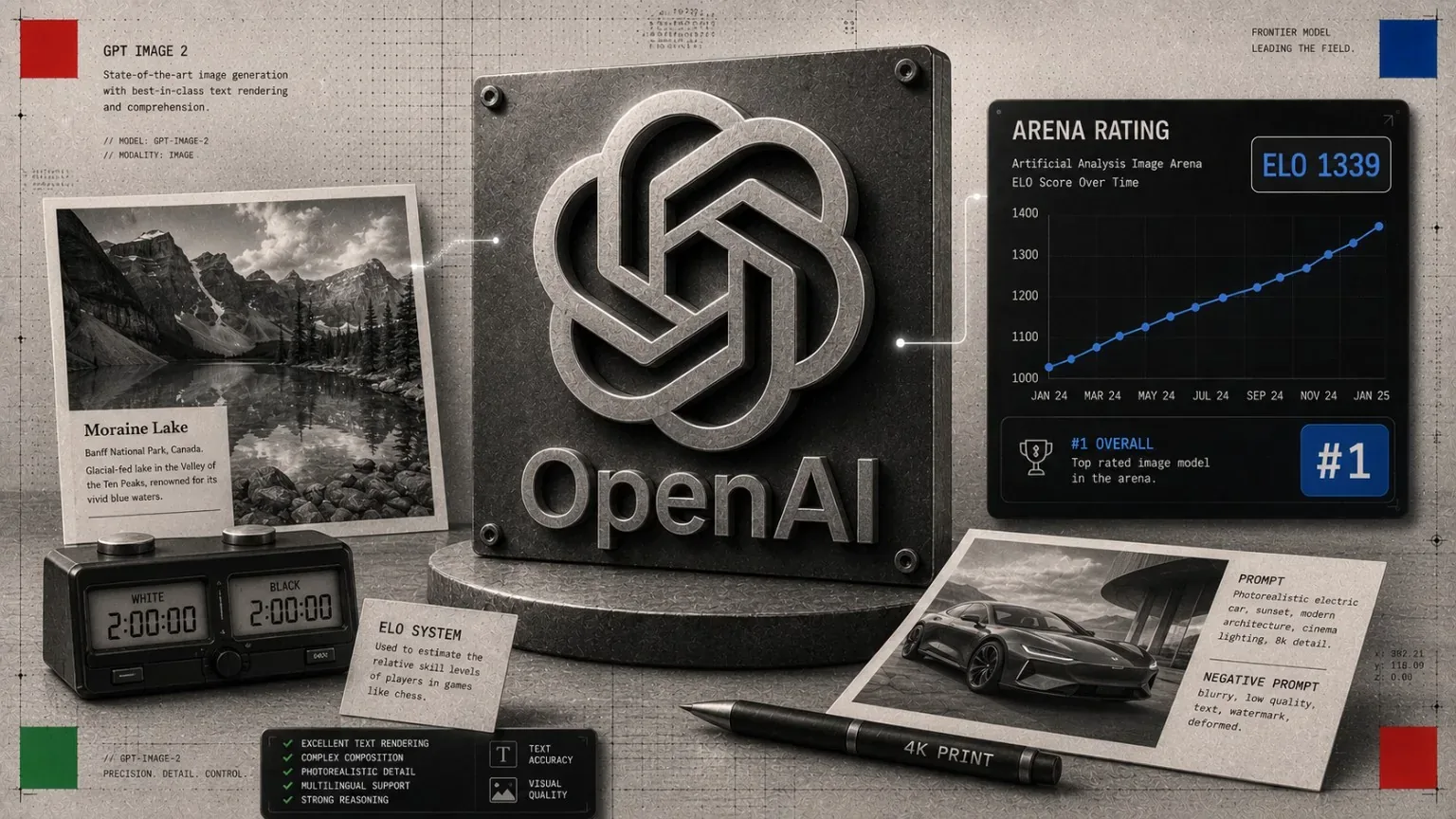
GPT Image 2 is the anchor of OpenAI’s image line. It launched in April 2026 to the top of the public leaderboards and stayed there through the summer, holding first on the arena.ai reading as late as 29 August 2026 and on the Artificial Analysis image arena on the 6 August reading. On the arena.ai boards read on 27 September 2026 (text-to-image dated 24 September, image edit dated 21 September; arena.ai is the address the old lmarena.ai now redirects to), it sits third on both, and the two models above it are OpenAI’s own. On text-to-image it records an Elo of 1383, behind GPT Image 2.5 Sunburst on 1424 and GPT Image 2.5 Flare on 1401, both marked preliminary; on image edit it records 1461, behind Sunburst on 1526 and Flare on 1482. OpenAI’s line holds the top three seats on both boards at once. The boards re-score continuously, so read those positions as dated readings rather than as today’s. These arenas rank models by pitting their outputs against one another in blind human comparisons and converting the results into an Elo score, the same rating method used in chess, so a top three occupied by a single line reflects a durable preference among the people casting votes rather than a single favourable benchmark.
The 2.5 pair
OpenAI released GPT Image 2.5 Sunburst and GPT Image 2.5 Flare on 8 September 2026, recorded in the company’s API changelog as a pair for image generation and editing. Sunburst is the variant OpenAI points at workflows where editing precision comes first; Flare is the one it describes as built for “fast, high-quality everyday image generation”. Both are billed at “GPT Image 2 token rates”, so the step up in score carries no change in price. The pair has headed both arena.ai boards since its first week. On the boards read on 27 September 2026, Sunburst is first on text-to-image at 1424 and on image edit at 1526, and Flare second at 1401 and 1482, with all four scores still marked preliminary while votes accumulate. GPT Image 2 sits directly beneath them on both boards.
Where it is strong
The strengths behind that score fall into three areas. GPT Image 2 is strong on prompt adherence, which means it renders what an instruction actually asks for rather than a loose approximation of it. It is strong on text rendering, the long-standing weak point of image generation, where earlier systems tended to produce garbled or invented lettering inside signs, labels and captions. And it is strong on photorealism, producing pictures that read as photographs rather than illustrations. The model also supports flexible output resolutions up to 4K, high enough for print and large-format work without a separate upscaling pass.
Those three qualities tend to travel together in practice. A model that follows the prompt precisely and renders clean text is far easier to direct, because it takes fewer attempts to reach a usable result, and fewer attempts means a lower cost per finished image. For editorial, marketing and product teams, that dependability is often worth more than a marginal gain in raw fidelity, and it goes a long way towards explaining why the model held first place on the public boards from its launch until OpenAI’s own 2.5 pair arrived above it.
How to access it
For distribution, the model is bundled into ChatGPT subscription plans and billed separately through the API, either per image or per token depending on how a team chooses to integrate it. That arrangement makes GPT Image 2 the path of least resistance for anyone already working inside the OpenAI stack. There is no new supplier to approve, and the same credentials and billing relationship that cover the company’s language models extend to image generation. For a development team weighing its options, that convenience often settles the question before quality is even discussed. Readers comparing systems can start at our image models hub, which sets each one against the others.
The lineage
The lineage is worth setting out, because a good deal of search traffic still arrives under the older names. GPT Image 2 follows GPT Image 1 and GPT Image 1.5, both of which are still cited in older comparison roundups, and the 2.5 pair now extends the line above it. Anyone looking for those earlier releases is almost always after the current generation, and tracing the progression from one release to the next explains how the line came to hold the top three seats it occupies today.
What to watch
The position is easy to describe and hard to unseat. The public arenas have become the closest thing the industry has to an agreed scoreboard, and on the boards read on 27 September 2026 OpenAI holds the top three seats on both at once. Beneath them on text-to-image, Microsoft’s MAI-Image-2.6 is fourth on 1335, with Reve 2.1 fifth on 1302 and Grok Imagine Image 2.0 sixth on 1301; on image edit, Grok Imagine Image 2.0 and MAI-Image-2.6 sit fourth and fifth on 1430 and 1429. The same company also leads much of the market in large language models, so a team that adopts GPT Image 2 is often consolidating text and image work with a single provider. What to watch is whether the preliminary Sunburst and Flare scores settle where they started as votes accumulate, and whether any rival breaks into the top three as the next wave of models arrives.
More in Image Generation
All Image →- Black Forest LabsFLUX 3 ImageFLUX 3 Image creates and edits pictures with up to ten reference images
- TencentHY Image 3.5 PreviewTencent’s image generation and editing preview
- IdeogramIdeogram 4.5image generation and precise editing
- AlibabaQwen-Image-2.1-TurboAn eight-step image generator with downloadable weights
- Google DeepMindNano Banana 2.1Image generation, reference pictures and conversational edits
- OpenAIGPT Image 2.5two variants, one price, the top two seats