
Meta
Muse Image
from a consumer feature to a $0.01 API
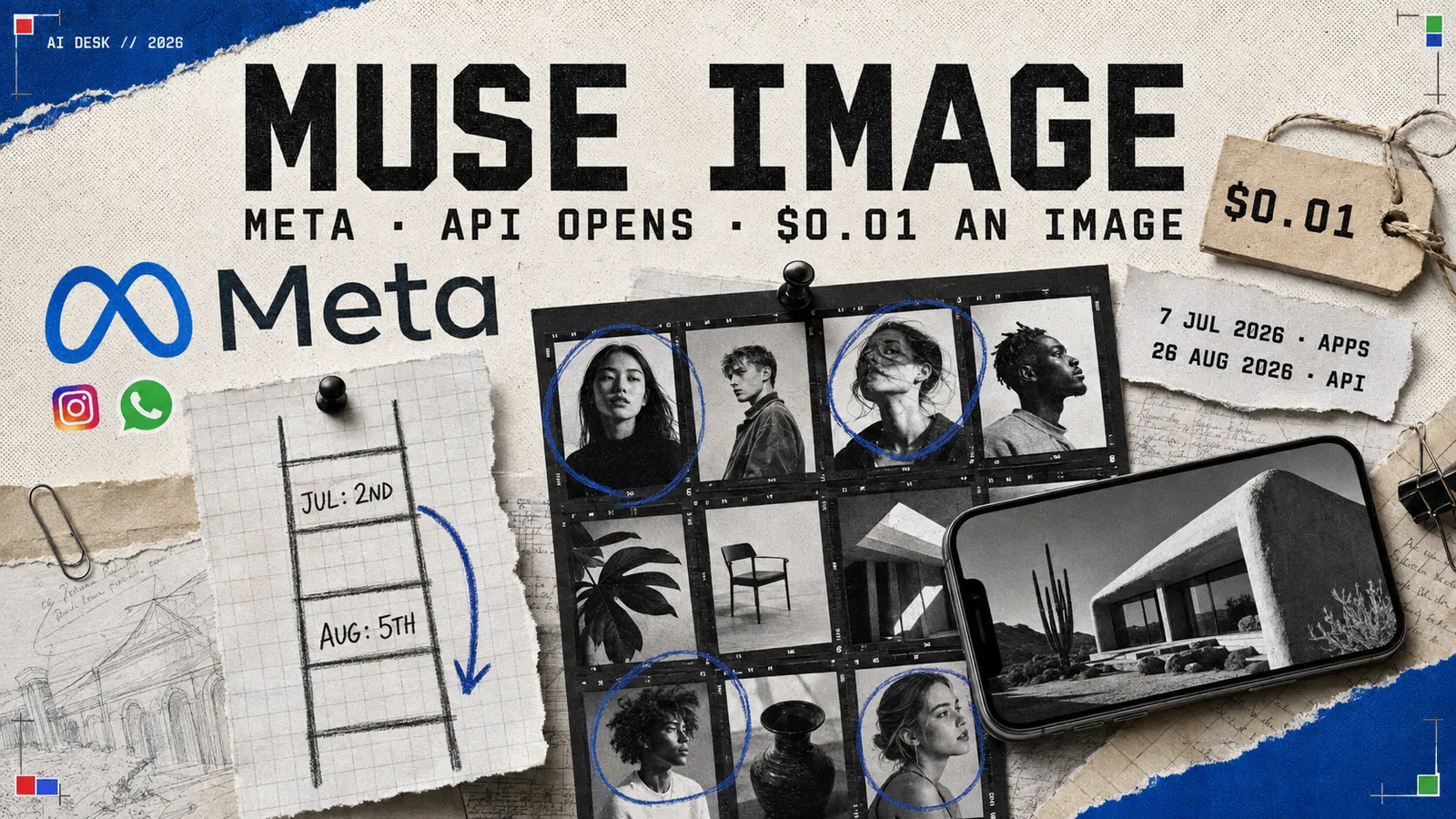
Key facts
- 7 Jul 2026consumer apps only
- Announced
- 26 Aug 2026Meta Model API
- Developer API
- $0.01per image, Meta's own table
- Price
- 7th1276 Elo, read 27 Sep 2026
- Arena text-to-image
- 6th1402 Elo, read 27 Sep 2026
- Arena image editing
- Noneclosed, hosted only
- Weights
Meta Superintelligence Labs' first image model. It launched on 7 July 2026 inside the Meta AI app, meta.ai, Instagram Stories and WhatsApp with no developer route at all, and only reached Meta's own API on 26 August 2026 at a cent an image. Meta's launch post claimed the number two spot on Arena for text-to-image and for both editing boards; on the boards read on 27 September 2026 it sits seventh on text-to-image and sixth on editing.
What it is
Muse Image is Meta’s first image model, built by Meta Superintelligence Labs and announced on 7 July 2026 alongside a preview of a companion video model, Muse Video. It generates images from text, edits an existing image, and composes from several reference images at once.
For its first seven weeks it was a feature rather than a product. Meta’s launch post sets out where it ran: “available today across the Meta AI app and on meta.ai, Instagram Stories in the US, and WhatsApp in limited countries, and is coming soon to Facebook.” There was no endpoint, no model id and no price. Anyone who wanted to put it in a pipeline had nowhere to send a request.
What changed on 26 August
On 26 August 2026 the model reached a developer API. Meta’s own developer site now lists Muse Image under Models with a dedicated pricing table of a single row: Muse Image, $0.01 an image. That table sits separately from Meta’s token-priced listings, where muse-spark-1.2-contributor is $0.10 in and $0.20 out per million tokens and muse-spark-1.2 and muse-spark-1.1 are both $1.25 in, $0.15 cached and $4.25 out. An image model billed by the picture rather than by the token is the ordinary arrangement in this category, and it is the first time Meta has offered one.
OpenRouter listed the model the same day, at 17:15 UTC, under the slug meta/muse-image, printing “$0.01/image”, a 66K context and a release date of 26 August 2026. Its machine record gives the context window as 65,536 tokens with a maximum completion of 58,982, the modality as text and image in and image out, and full tool-choice support alongside max_tokens, temperature, top_p, top_k and repetition_penalty.
One detail is worth printing and worth not over-reading. OpenRouter’s provider record names the deployment meta/muse-image-1.0-eval-20260824, which reads as an evaluation build dated 24 August. Meta has published nothing about what separates an evaluation build from a general one, so treat the name as a label rather than as a statement about stability.
The reasoning claim
The description Meta supplies with the OpenRouter listing makes a claim that appears nowhere in the July announcement. Its words: “Unlike single-pass image models, it reasons before it renders, breaking down multi-part prompts and refining its output within the chain of thought, and invokes web search for factual accuracy on knowledge-intensive prompts.”
Two things there separate it from a conventional diffusion model. The first is the chain-of-thought pass, which is Meta describing an agentic loop around image generation rather than a single denoising run. The second is the web search call, which means a prompt that turns on a fact can be answered against a live lookup instead of against whatever the training data held. Meta has published no evaluation of either behaviour, so both stand on the company’s own description.
The same listing sets out the capability surface: text-to-image, targeted image editing, multi-image composition, reference-image conditioning for style and subject consistency across a series, and text rendering inside the generated image. Iterative editing works by passing the previous output back with a new instruction, which is the pattern anyone who has used GPT Image 2 or Imagine Image 2.0 will recognise.
Where it stands on the boards
Meta’s launch-day claim was specific. In its own words, Muse Image held “the No. 2 spot on Arena for text-to-image, single-image editing, and multi-image editing as measured by human preference Elo rankings at the time of writing”, and Muse Video “ranks No. 3 in human-preference Elo for text-to-video”.
Arena’s own text-to-image board, read on 27 September 2026 and dated 24 September, has it seventh.
| Arena text-to-image, read 27 Sep 2026 | Elo |
|---|---|
| GPT Image 2.5 Sunburst | 1424 |
| GPT Image 2.5 Flare | 1401 |
| GPT Image 2 (medium) | 1383 |
| MAI-Image-2.6 | 1335 |
| Reve 2.1 | 1302 |
| Grok Imagine Image 2.0 (low) | 1301 |
| Muse Image | 1276 |
That is rank 7 on 35,422 votes. On image editing, on the board read the same day and dated 21 September, the position is better: rank 6 on an Elo of 1402 across 106,325 votes, behind GPT Image 2.5 Sunburst on 1526, GPT Image 2.5 Flare on 1482, GPT Image 2 (medium) on 1461, Grok Imagine Image 2.0 (low) on 1430 and MAI-Image-2.6 on 1429.
Both boards re-score continuously, and a launch-day reading taken before a model has accumulated votes is a different measurement from one taken after 35,422 of them. Read Meta’s July claim and the September standing as two dated readings rather than as a contradiction. What the pair does show is the shape of this category: between 7 July and 27 September, Muse Image went from the second place Meta claimed on both counts to seventh on text-to-image and sixth on editing. The last two places it lost on each board went to OpenAI’s GPT Image 2.5 Sunburst and Flare, released on 8 September, which entered above it.
Muse Video has moved further. Meta’s July claim was third on text-to-video; on the Arena text-to-video board read on 27 September 2026 it sits ninth, on 1456 Elo across 2,188 votes. It is also still not on Meta’s developer site, so the video model announced in the same post as Muse Image remains a preview with no way in.
Price and access
A cent an image puts Muse Image at the cheap end of the hosted field, and Meta charges the same rate whether the request is a generation or an edit. There are two routes: Meta’s own developer API, and OpenRouter, which resells the same model under meta/muse-image. The model does not appear in OpenRouter’s general model listing because it returns an image rather than text, which is worth knowing if you are enumerating the catalogue programmatically.
The consumer surfaces from July are unchanged: the Meta AI app, meta.ai, Instagram Stories in the United States, and WhatsApp in a limited set of countries, with Facebook stated as coming.
What has not been published
Meta has published no parameter count for Muse Image, no architecture paper, no training-data description and no licence, because there are no weights to license: the model is closed and hosted, and there is no local path. Nor has Meta published a benchmark table of its own beyond the Arena placings quoted above, so the reasoning and web-search behaviours are asserted rather than measured.
What to watch
Whether the editing rank holds. Sixth on 106,325 votes is a much firmer number than seventh on 35,422, and editing is where Meta’s multi-reference and consistency claims would show up if they are real.
Whether the evaluation build becomes a general one. A deployment string dated 24 August, exposed publicly on 26 August, is the sort of thing that gets replaced without an announcement. Anyone pinning behaviour should expect the name to change.
Whether Muse Video ships an API at all. The July post presented the two models together. Only one of them is buyable, and the video model has slid six places on Arena since.
Whether a cent an image is the real price. It is Meta’s launch rate on a first-generation model, published on a table with nothing else on it. The rest of the image field sits in the image models hub, and the video side of Meta’s announcement is covered in the rest of the field.
Related pages
All Image →- OpenAIGPT Image 2the leading line
- GoogleNano Banana Pro and Nano Banana 2the 4K value leader
- xAIImagine Image 2.0the one that gets the text right
- Reve 2.1, Z-Image Turbo and the Imagen sunset
- The rest of the fieldMuse Video, Pika 2.5, Grok Imagine and Marey
- Black Forest LabsFLUX 3 ImageFLUX 3 Image creates and edits pictures with up to ten reference images