
Reve 2.1, Z-Image Turbo and the Imagen sunset
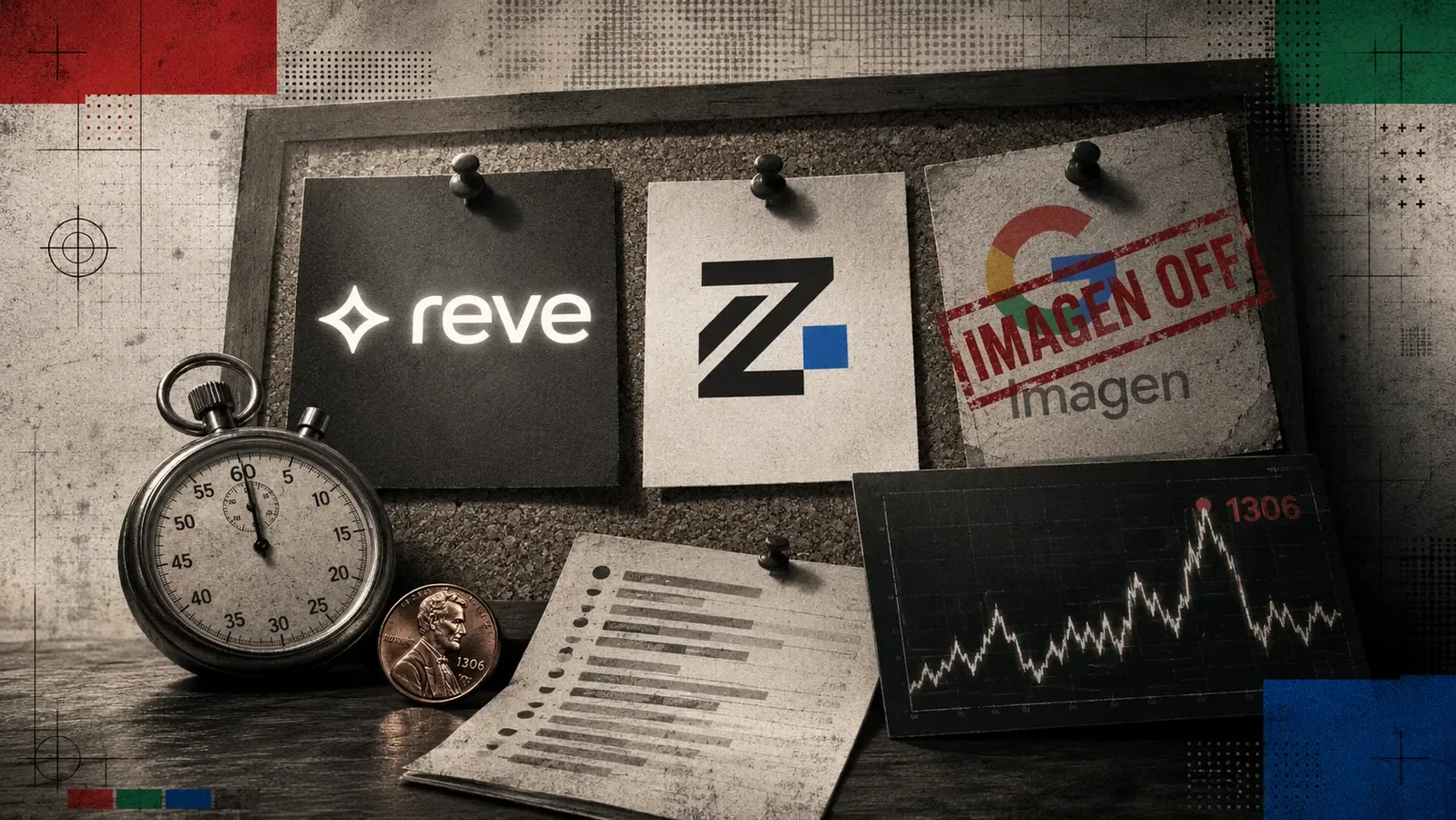
Key facts
- 27 Sep 2026downloads until 31 Oct
- Reve closed
- 9 Jul 2026Reve 2.1
- Launched
- $0.01per image
- Draft price
- ~1 secZ-Image Turbo
- Draft speed
- 17 Aug 2026Imagen 4 sunset
- Imagen off
Reve 2.1 launched 9 July 2026 and reclaimed second place on the Arena text-to-image board. Reve stopped image generation on 27 September 2026, and users have until 31 October to download their work.
Reve stopped making images on 27 September
Reve closed its image generator on 27 September 2026. The banner across Reve’s help centre reads: “Reve is sunsetting. You have until Sept 27th to create, and October 31st to download your work.” Anyone with images in a Reve account has until 31 October 2026 to save them. The closure came two months after Reve announced, on 27 July, a new investment from OpenAI under which “members of our AI Research team will join OpenAI to help lead its multimodal research efforts”, in the words of Reve’s own blog.
Reve 2.1 reached second place in July
Reve 2.1 is the clearest recent illustration of how quickly positions in image generation change hands. Launched on 9 July 2026, it scored 1306 on the Arena text-to-image leaderboard, reclaiming second place overall behind OpenAI’s GPT Image 2 and making Reve the strongest independent lab on the board. On the arena.ai text-to-image board dated 24 September 2026, three days before the shutdown, Reve 2.1 stood fifth on 1302, behind OpenAI’s GPT Image 2.5 Sunburst on 1424, GPT Image 2.5 Flare on 1401 and GPT Image 2 on 1383, and Microsoft’s MAI-Image-2.6 on 1335. The model still shows on that board because its votes predate the closure. Positions near the top of that table traded hands within days all summer, which tells you most of what you need to know about how perishable these rankings have become.
Why the ranking is perishable
That perishability is the real lesson here, more than the score itself. The Arena leaderboard measures human preference between anonymised outputs, and in the text-to-image category the gaps between the leading models are now small enough that each new release can reorder the table within hours. A first-place ranking is a snapshot, not a settled verdict, and anyone choosing a model on the strength of a leaderboard position should treat it as this month’s reading rather than a durable fact. Reve 2.1 went from second place in July to a closed service in September; the recent history of the board suggests no position on it stays uncontested for long.
The collapsing cost of a draft
Cost is the other axis on which this part of the market is moving, and Z-Image Turbo is the example to note. It generates an image in about one second at $0.01 per image, which makes it the cheapest draft option currently available. That price and speed change what image generation is for: at a penny an image and a one-second wait, a model becomes a tool for rapid iteration and disposable drafts rather than a considered, costed request. A designer can fire off dozens of variations to find a direction and think nothing of the bill, then reserve a slower, more expensive model for the final render. Peak fidelity is no longer the only measure of the frontier; how cheaply and quickly a usable draft can be produced counts for more each quarter, and Z-Image Turbo is pushing hard at that end of the spectrum.
The Imagen shutdown
The counterpoint to all this launching is a shutdown, and it carries a lesson of its own about depending on any single provider. Google shut down Imagen 4, Imagen 4 Ultra and Imagen 4 Fast on 17 August 2026, the date its deprecation table had announced. Its named replacement for all three is Gemini 3.1 Flash Image, the model it markets as Nano Banana 2, so anyone who still had requests routed to Imagen now needs to test against that model and migrate, rather than discover a broken pipeline the morning after. The change is documented in Google’s own developer changelog, which is the source to trust over second-hand accounts.
What it all points to
Taken together, these three developments sketch the state of the AI image market in mid-2026. New models arrive and top the leaderboard within days, as Reve 2.1 did, and a lab can close its product within three months of that peak, as Reve did on 27 September; the cost of a draft is collapsing towards a penny, as Z-Image Turbo shows; and even a large provider’s models are retired on a fixed schedule, as Imagen’s closure demonstrates. The practical takeaway for anyone building on these tools is to hold model choices loosely. A current leaderboard leader is worth trying, but it is not worth hard-wiring into a system that cannot swap it out, because the next challenger is rarely more than a few weeks away, and the model you depend on today may be deprecated tomorrow. For the wider picture, our AI hub tracks how the rest of the field is moving from one week to the next.
More in Image Generation
All Image →- Black Forest LabsFLUX 3 ImageFLUX 3 Image creates and edits pictures with up to ten reference images
- Google DeepMindNano Banana 2.1Image generation, reference pictures and conversational edits
- OpenAIGPT Image 2.5two variants, one price, the top two seats
- OpenAIGPT Image 2the leading line
- AlibabaQwen-Image-2.1one small model for making pictures and editing them
- GoogleNano Banana Pro and Nano Banana 2the 4K value leader