
Alibaba
Qwen-Image
the free self-hosted option
Key facts
- Open weightdownloadable
- Licence
- Freeself-hosted
- Price
- CN + ENin-image text
- Text rendering
- Qwen + WanLLM and video
- Ecosystem
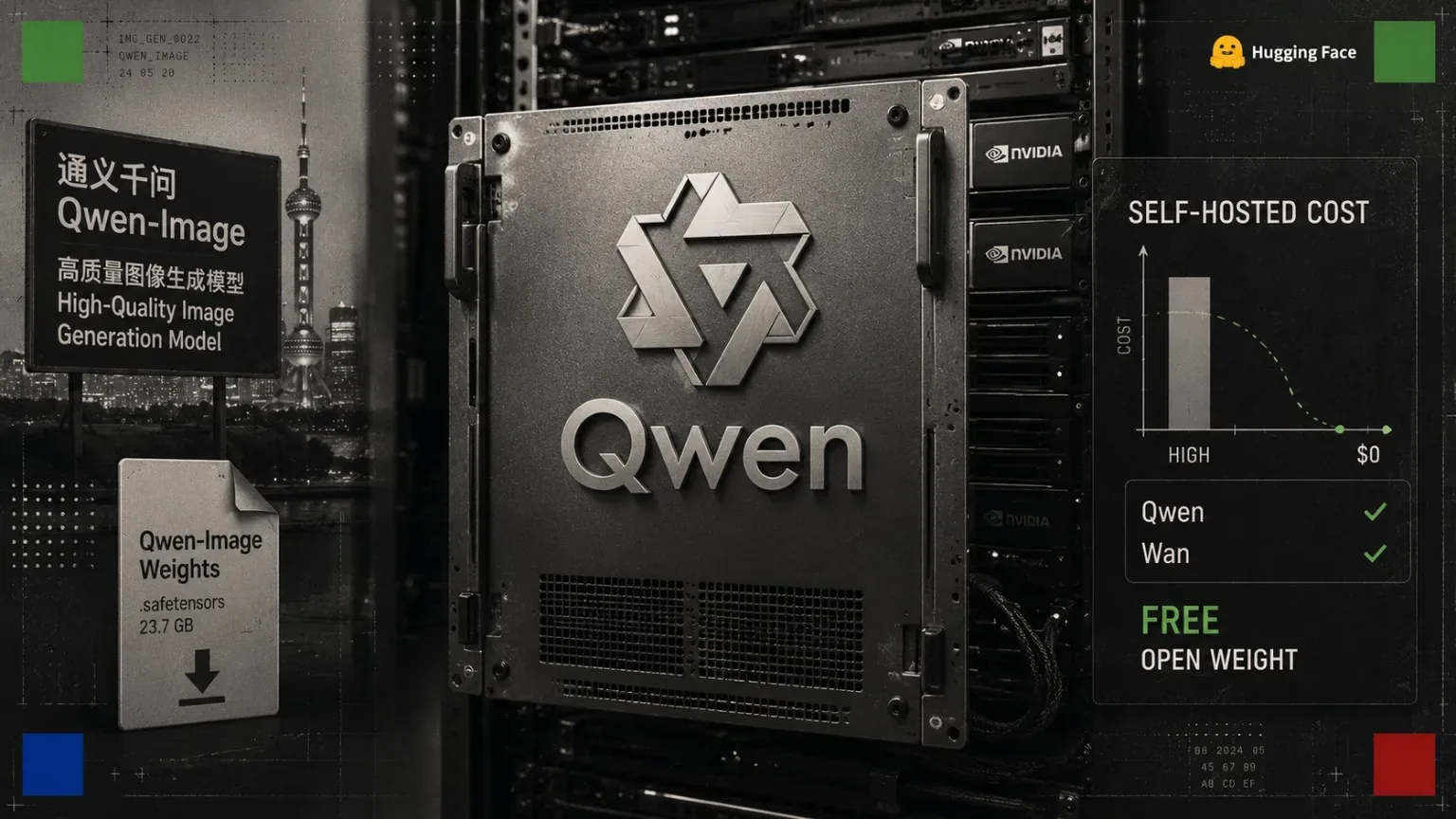
The free self-hosted option. Open weights, effectively free if you self-host and already own the hardware.
What it is
Qwen Image is Alibaba’s open-weights image generator, and its pitch is refreshingly blunt: it is effectively free if you self-host and already own the hardware. The release to download is Qwen-Image-2512, the open-weights version shipped on 31 December 2025 and rated the strongest open image model on the public boards. There is no per-image fee and no metered API in that arrangement, only the electricity and the graphics cards you have already paid for. For anyone generating pictures at volume, or anyone who needs the model to run inside their own infrastructure rather than a vendor’s, that economics is the entire reason to look.
Open weights is the load-bearing phrase. Because Alibaba publishes the model’s parameters rather than hiding them behind a service, the model can be downloaded, inspected, fine-tuned and run on machines you control. That turns the cost structure from a rental into a one-off: the marginal cost of the next image is close to zero once the hardware is in place, which is a very different proposition from a hosted generator that bills per call. It also means the tool keeps working regardless of a provider’s pricing changes or outages, which is worth a great deal to teams that cannot depend on someone else’s uptime.
The text-rendering edge
The standout capability is text rendering. Qwen Image handles both Chinese and English text inside images well, which most open models do poorly. Legible characters, signage, captions and logos are among the hardest things for an image generator to get right, and failures there are immediately obvious to a reader. Competence in Chinese as well as English is not incidental for Alibaba’s home market, where a generator that garbles the local script is of limited use. For designers who need words to sit correctly inside a picture, this is often the deciding feature.
Part of a bigger stack
The model does not stand alone. Qwen Image pairs with the Qwen family of large language models and the Wan family of video models, which together make Alibaba the most complete open-weights publisher outside Tencent. That breadth counts for teams that would rather assemble a stack from a single lab’s releases than stitch together components from several. A shared lineage tends to mean shared tooling and more predictable behaviour across text, image and video, and it lets a developer commit to one publisher’s ecosystem with reasonable confidence that the pieces will keep arriving. (For the text side, see our large language models hub.)
The self-hosting trade-off
The trade-off is the one every self-hosted option carries. “Effectively free” assumes you already own capable hardware and the skills to run it; the graphics cards, the configuration and the maintenance are real costs that a hosted service simply folds into its price. A suitable graphics card is not a trivial purchase, and keeping a self-hosted setup patched, updated and running is work that never fully stops. For a solo user making the occasional image, a paid API is almost always cheaper and simpler than standing up local infrastructure. Qwen Image earns its keep at scale, or wherever control, privacy and independence from a vendor outweigh the convenience of letting someone else run the machine.
Where it sits
The placement is clear enough. The open-weights corner of the AI image market is where cost, control and data governance win out over the last few points of fidelity, and Qwen Image is one of the stronger options in it, with the text-rendering advantage as its distinguishing feature. The thing to watch is whether Alibaba keeps publishing weights as openly as it has, because the newer line is drifting closed: Qwen-Image-2.0, announced in February 2026 with native 2K output and stronger typography, and Qwen-Image-3.0, announced on 21 July 2026, have not shipped open weights. The value of the model to self-hosting teams rests entirely on that continued openness. As long as the releases keep coming, Alibaba holds one of the most coherent open stacks in the business, and the image piece of it is in good shape.
More in Image Generation
All Image →- Black Forest LabsFLUX 3 ImageFLUX 3 Image creates and edits pictures with up to ten reference images
- Google DeepMindNano Banana 2.1Image generation, reference pictures and conversational edits
- OpenAIGPT Image 2.5two variants, one price, the top two seats
- OpenAIGPT Image 2the leading line
- AlibabaQwen-Image-2.1one small model for making pictures and editing them
- GoogleNano Banana Pro and Nano Banana 2the 4K value leader