Bitcoin AI stocks correlation: crypto's new problem is Nvidia's mood
The Bitcoin AI stocks correlation has become the defining market dynamic of July 2026, and this week supplied its cleanest demonstration yet.
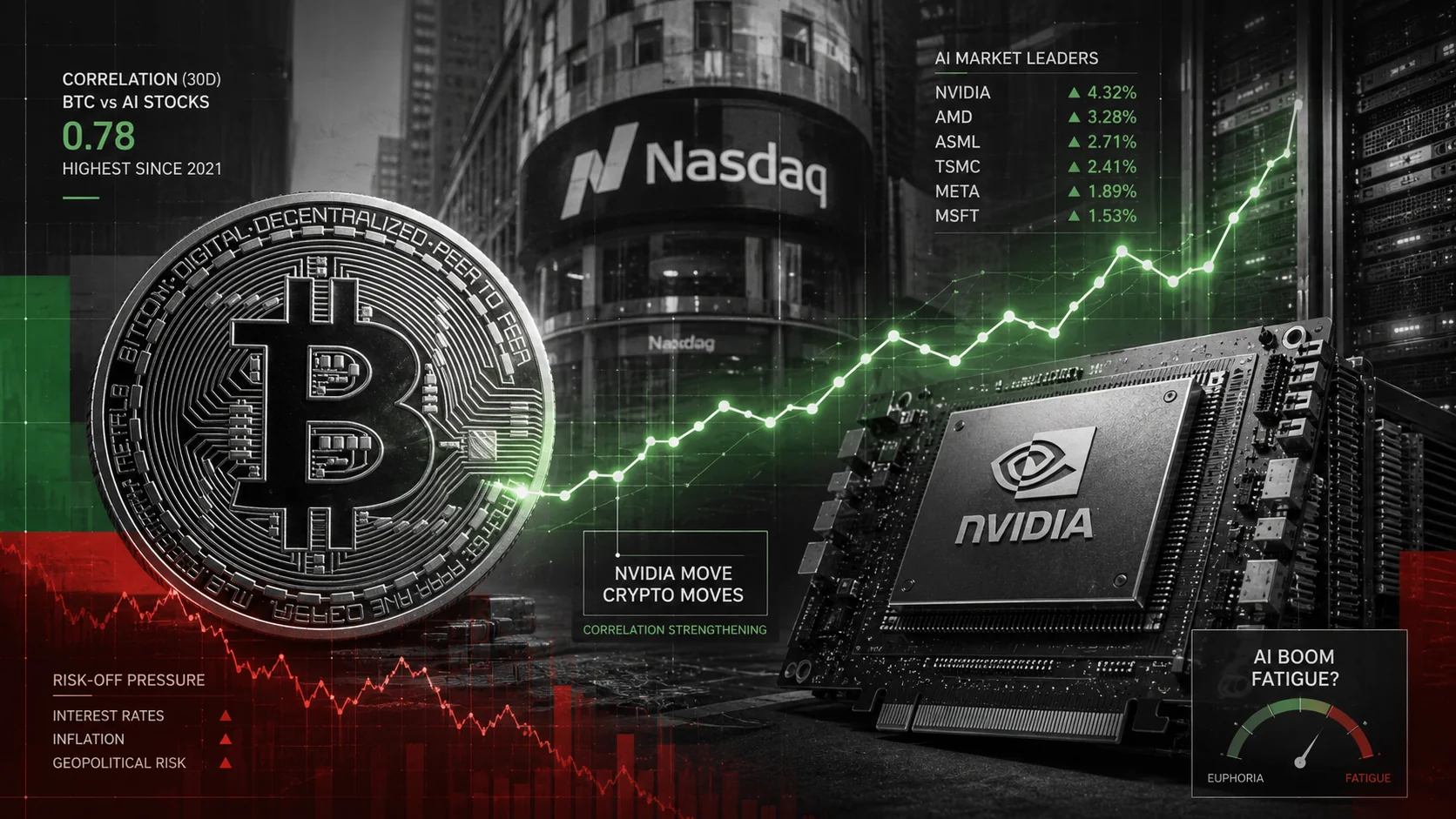
The Bitcoin AI stocks correlation has become the defining market dynamic of July 2026, and this week supplied its cleanest demonstration yet. A deepening global selloff in chipmakers dragged risk assets lower on Friday, pulling bitcoin back from the 65,000 dollar level it had reclaimed on a soft inflation print, down through 63,000 as the Nasdaq shed 1.4 per cent. The proximate trigger, remarkably, was a coding benchmark: Moonshot AI’s Kimi K3 model took the top spot in frontend coding rankings from the American incumbents, and it is free. Semiconductor stocks fell on the implication for AI capital spending, and crypto fell with them. Bitcoin is now taking orders from leaderboards it has never heard of.
The relationship has been building all year. Analysts blamed June’s slide to a 21-month low partly on capital rotating out of crypto and into AI-related assets; now the rotation runs in reverse, with AI fatigue spreading to everything that trades on the same risk appetite. One market note this week captured the strangeness of the moment: the AI frenzy losing steam has left bitcoin less volatile than South Korean equities, a sentence that would have been unprintable in any previous cycle. When the most notorious volatility machine in finance becomes the comparatively steady asset, the volatility has not vanished; it has simply moved to Silicon Valley’s income statements.
Why should the Bitcoin AI stocks correlation exist at all? The honest answer is plumbing and psychology. The same institutional pools that bought AI equities bought bitcoin ETFs, and when risk budgets shrink, everything bought with the same money gets sold on the same afternoon. The miners deepened the physical link: listed bitcoin miners have spent two years converting themselves into AI data-centre landlords, so chip sentiment now flows directly through crypto equity indices. And the marginal crypto buyer of 2025 was frequently making the same bet in both venues: that an abundance of intelligence and an abundance of programmable money were the twin trades of the decade.
The correlation cuts both ways, which is the part the bears skip. If AI capital spending disappoints and semiconductors fall further, bitcoin lacks the decoupling credentials to stand aside, and this week proved it. But the same linkage means any stabilisation in tech, or any dovish surprise from the Federal Reserve on 29 July, transmits upward just as efficiently. A technical measure flagged by market analysts already hints at oversold conditions heading into the weekend, and US-Iran tensions pushing oil above 80 dollars a barrel arguably weigh on the Nasdaq and bitcoin equally now, one undifferentiated blob of risk.
The uncomfortable conclusion for maximalists is that the diversification pitch has died. Bitcoin in 2026 is not a hedge against the technology economy; it is a leveraged expression of it, with a Washington subplot attached. That is not necessarily bearish, since the technology economy has been the only game in town, but it means the asset’s next act depends on earnings calls in Santa Clara and benchmark tables from Beijing as much as anything on-chain. Exchange data is public at venues like the Nasdaq; the days when crypto could ignore it are gone.
The Bitcoin AI stocks correlation will loosen eventually; correlations always do, usually right after everyone has repositioned around them. Until then, the most useful crypto analyst may be the one covering semiconductors.
The mining industry illustrates how literal the entanglement has become. Listed miners have spent two years converting halls of ASICs into AI compute tenancy, and the migration continues down the size curve: one Nasdaq-listed firm sold its Chinese auto business, bought mining rigs, then pivoted again to distributed AI inference, wiring up the small operators the hyperscalers ignore. Boardroom fights at mining firms now revolve around data-centre strategy rather than hash rate. When a sector’s largest companies earn tomorrow’s revenue from the very trend whose wobbles sink its underlying asset today, disentangling the two trades stops being analysis and becomes archaeology.
Sources
- Nasdaqnasdaq.com