Ethereum Glamsterdam upgrade slips to Q3, but the 200 million gas target is the real story
The Ethereum Glamsterdam upgrade will not arrive on its original June schedule.
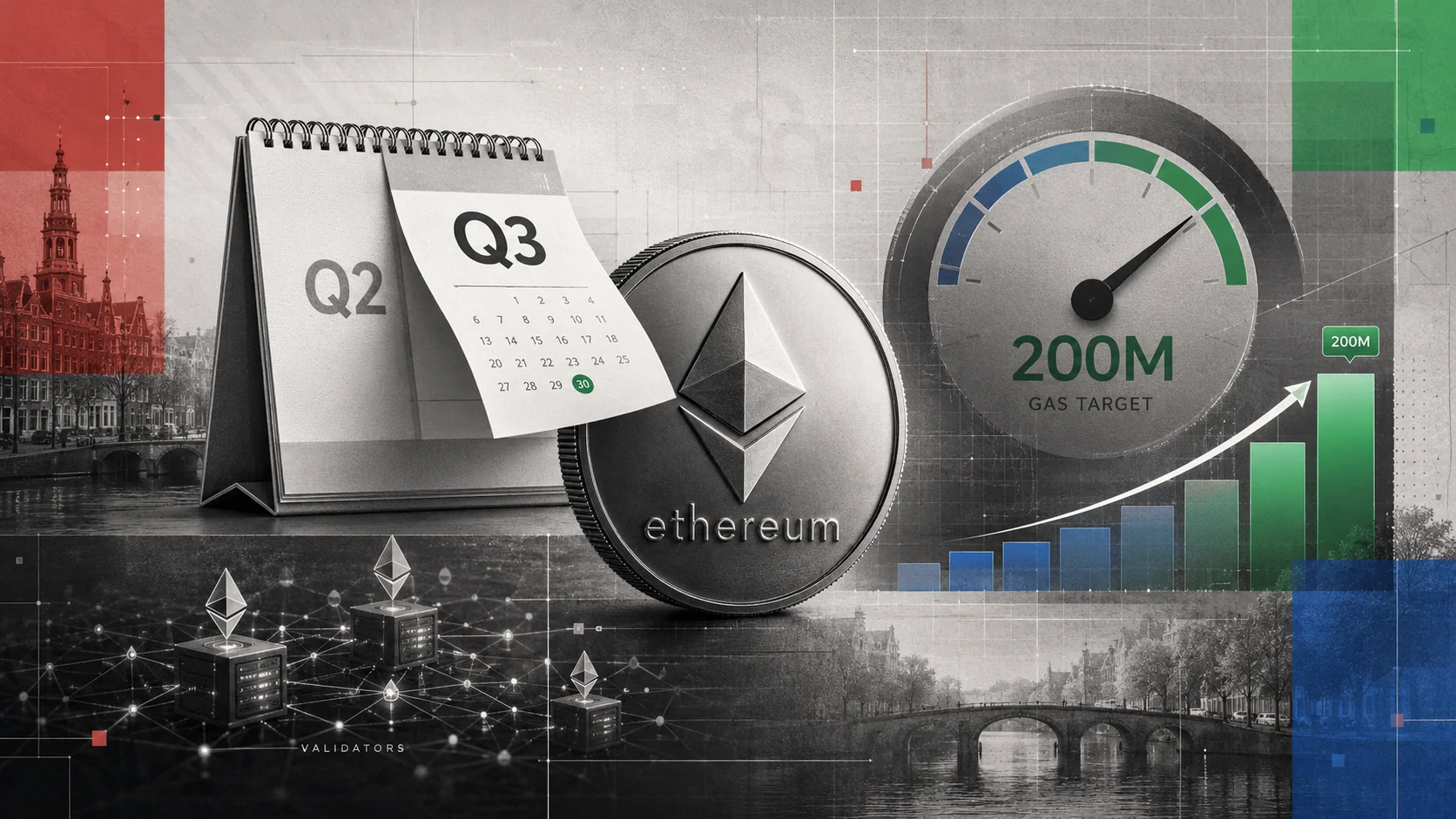
The Ethereum Glamsterdam upgrade will not arrive on its original June schedule. The Ethereum Foundation confirmed in a blog post this month that the hard fork is now expected in the third quarter of 2026, and buried the more interesting news in the same update: a post-upgrade gas limit floor of 200 million, up from roughly 60 million today. Delays are routine in Ethereum’s world. Committing to more than triple base-layer capacity is not.
Glamsterdam is the most ambitious change to Ethereum’s core since The Merge in 2022, and the direct successor to Fusaka, which shipped in December 2025 and scaled rollup data availability through PeerDAS. The name follows the network’s convention of pairing a star with a Devconnect host city: Gloas covers the consensus layer changes, Amsterdam the execution layer, bundled and shipped as one upgrade.
Two proposals headline the package. EIP-7732 introduces enshrined proposer-builder separation, moving block building into the protocol itself rather than leaving it to the off-chain marketplace that grew up around MEV. EIP-7928 adds block-level access lists, the groundwork for parallel transaction execution. Around them sits a supporting cluster: EIP-7708 restructures ether transfer logs, EIP-7954 raises the smart contract size limit from 24 to 64 kibibytes, and a longer tail of gas repricing and state management changes rounds out the set. Devnets are live, and the Foundation says ePBS has stabilised in testing, with public testnets to follow.
The strategic subtext of the Ethereum Glamsterdam upgrade is a course correction. For years the roadmap pushed activity to rollups while the base layer stayed deliberately constrained. Earlier in 2026, Vitalik Buterin publicly questioned the pace of that rollup-centric approach, and Glamsterdam is the answer: scale layer one directly, restore fee revenue and economic weight to the chain that actually secures everything, and make the base layer hospitable to the stablecoin and tokenised asset flows that institutions keep promising to bring.
The timing is either terrible or perfect. Ether trades around 1,760 to 1,840 dollars, down roughly 45 per cent over the year and about 64 per cent from its all-time high, having just closed three consecutive red quarters for the first time in its history. A network tripling its capacity into a bear market invites the obvious jibe about building motorways nobody is driving on. The counterargument is that capacity built in downturns is precisely what gets used in recoveries, and Ethereum still leads on-chain real-world assets and holds DeFi’s deepest liquidity.
There are open questions worth watching. No mainnet date is locked, only the quarter. Client teams must co-ordinate flawlessly across both layers simultaneously, historically the riskiest kind of fork. And a bigger gas limit raises hardware demands on solo stakers, a constituency Ethereum’s culture has always been reluctant to squeeze.
Still, the destination is clear enough. If the Ethereum Glamsterdam upgrade lands in Q3 as now planned, with parallel execution and protocol-level block building, the network heads into 2027 with an order-of-magnitude scaling story on its own base layer for the first time. Specifications and timelines are published by the Ethereum Foundation, with technical detail at ethereum.org.
Glamsterdam is also not the end of the queue. The Hegota upgrade pencilled in behind it concentrates on state management, with Verkle tree research aimed at shrinking what node operators must store, and the published long-term roadmap through 2029 speaks of ten to twenty second finality, quantum-resistant cryptography and native privacy features. Meanwhile the validator base the upgrade must carry has never been larger: roughly 37 million ether, around 30 per cent of supply, sat staked by early 2026 with millions more queued. Scaling a live network with that much economic weight bolted to it is the engineering equivalent of refitting an aircraft mid-flight, which explains both the caution and the delays.
Sources
- Ethereum Foundationblog.ethereum.org
- ethereum.orgethereum.org