Metaplanet Bitcoin holdings reach 43,000 BTC as the Tokyo treasury doubles down
Metaplanet Bitcoin holdings crossed a threshold on 2 July that would have read as satire two years ago: the Tokyo-listed firm bought another 2,823 BTC for roughly 170 million dollars, lifting its stack to a round 43,000 BTC and cementing its place as the world's third-largest publicly traded bitcoin
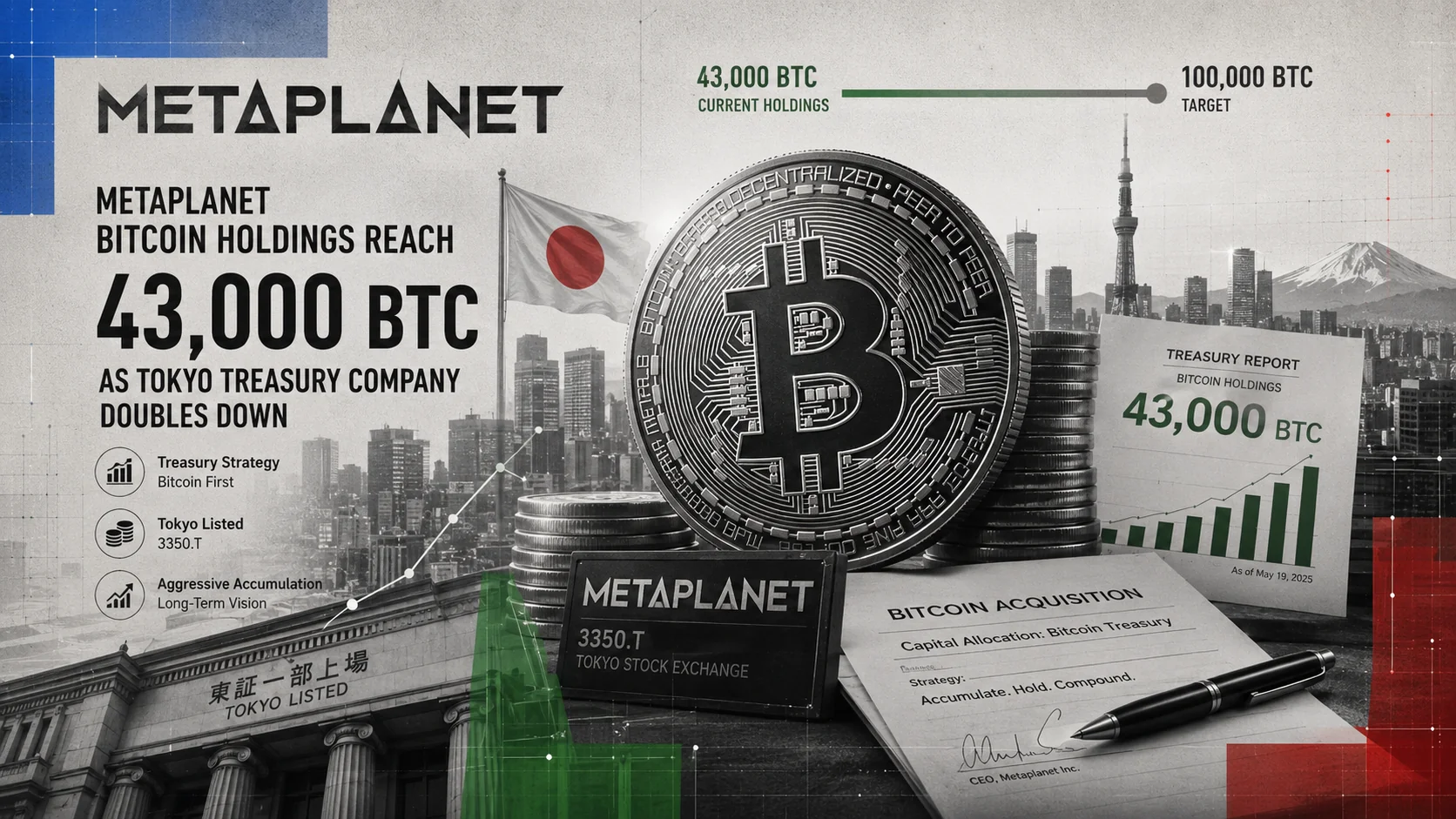
Metaplanet Bitcoin holdings crossed a threshold on 2 July that would have read as satire two years ago: the Tokyo-listed firm bought another 2,823 BTC for roughly 170 million dollars, lifting its stack to a round 43,000 BTC and cementing its place as the world’s third-largest publicly traded bitcoin holder. Only Strategy, at 762,099 BTC, and Twenty One Capital, at 43,514, sit above it, and the gap to second place has narrowed to a few hundred coins. Not bad for a company that entered 2024 as a small hotel operator with fewer than 100 bitcoin.
The purchase came with the machinery that has defined the firm’s model. Metaplanet’s Bitcoin Income Generation business, which writes options against the existing stack and collects premium without selling the underlying coins, produced approximately 10.85 million dollars of revenue in the second quarter. That income is credited against acquisitions, pulling the effective cost of the latest coins toward 77,000 dollars each. The company has since announced a further 137 million dollar capital raise through a third-party share allotment, extending a financing conveyor belt that has already run through premium-priced placements, moving-strike warrants with a net-asset-value guardrail, and repeated zero-coupon bond issues to its anchor backer EVO FUND.
The ambition remains immoderate. The firm’s 555 Million Plan targets 100,000 BTC by the end of 2026 and 210,000 by the end of 2027, the latter representing roughly one per cent of bitcoin’s fixed supply. With six months left in the year, reaching the first milestone requires adding about 9,500 coins a month, a pace demanding multiple further raises in a market that has spent the summer punishing risk. Chief executive Simon Gerovich has so far threaded the dilution needle: debt and preferred stock stand near 23 per cent of the firm’s net bitcoin asset value, conservative by the standards of the treasury genre.
The awkward arithmetic sits in plain view. Metaplanet Bitcoin holdings carry an average cost basis above 100,000 dollars as of the first quarter, against a spot price around 64,000, and the company has already flagged a near 680 million dollar non-cash impairment for 2025. Buying aggressively through a drawdown is either how one per cent of bitcoin gets accumulated or how shareholders discover the difference between conviction and concentration risk. Management’s own metric, BTC yield per diluted share, is designed to argue the former: it measures how much bitcoin each share represents over time, regardless of price, and rose 2.8 per cent in the first quarter alone.
The wider signal is what makes the story more than a curiosity. While US spot ETFs endured their worst outflow month on record in June, the corporate treasury cohort kept buying: Metaplanet in Tokyo, Capital B in Paris, SharpLink and BitMine on the ether side. The marginal seller of 2026 has been the fund investor; the marginal buyer has been the balance sheet with a mandate and a capital markets desk. Whether that swap looks brilliant or reckless in two years depends entirely on a price nobody controls. Disclosures, dashboards and the running tally are published at metaplanet.jp.
The tests ahead are usefully falsifiable. If quarterly BTC yield sinks well below one per cent, or the firm cannot close meaningful raises before year-end, the flywheel narrative stalls on its own arithmetic; a sustained bitcoin price below the roughly 77,000 dollar effective cost of the latest tranche would strain the options income model that subsidises the buying. Japan’s wider crypto scene is meanwhile consolidating around such balance-sheet strategies even as others retreat, with SBI shutting its bitcoin mining pool at the end of July and pushing miners elsewhere. Accumulating coins, it seems, has aged better locally than minting them.
Sources
- Metaplanetmetaplanet.jp