Ostium hack: a 24 million dollar oracle exploit where the code worked perfectly
The Ostium hack of 15 July is the most instructive DeFi exploit of the summer precisely because nothing malfunctioned.
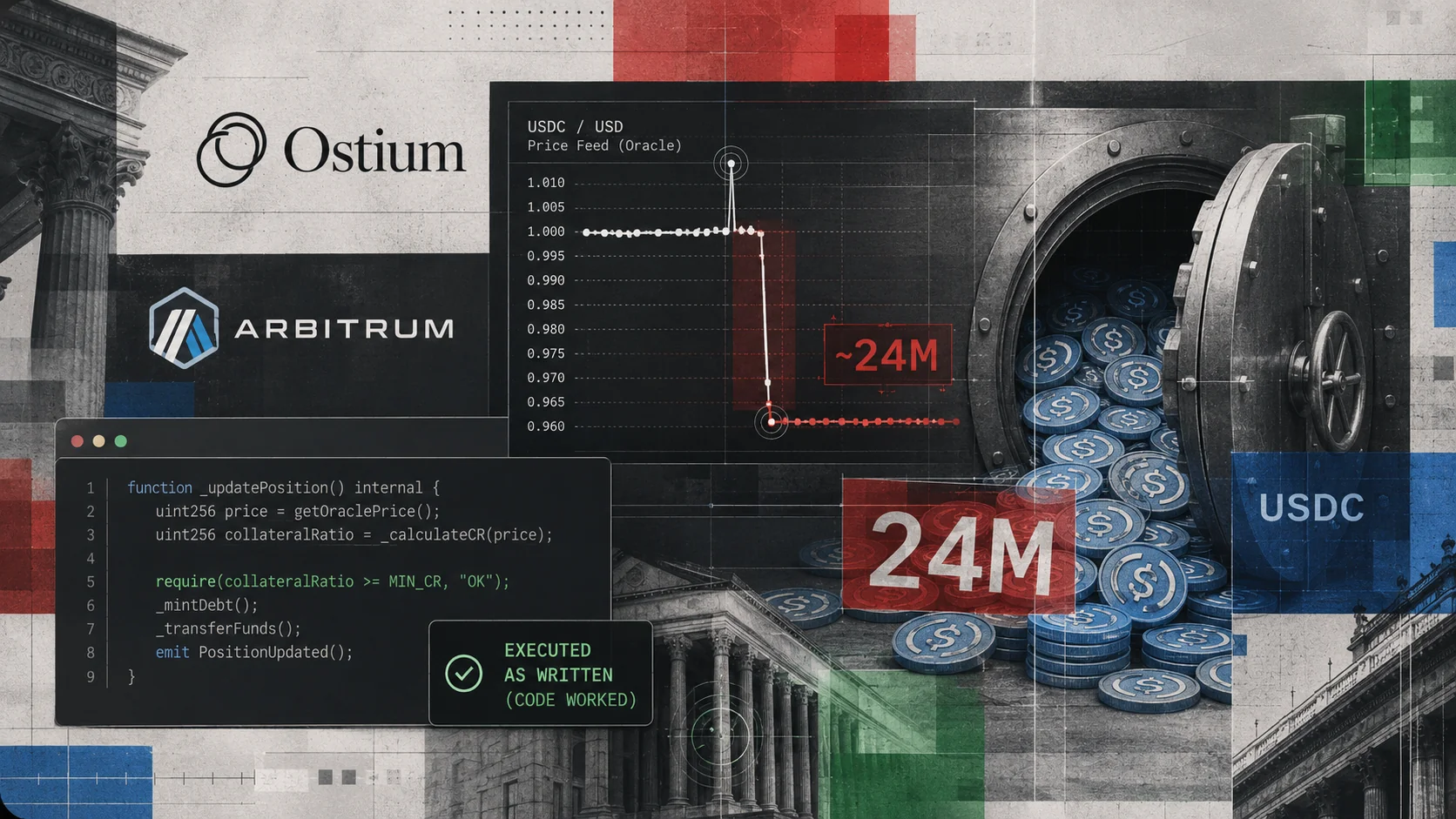
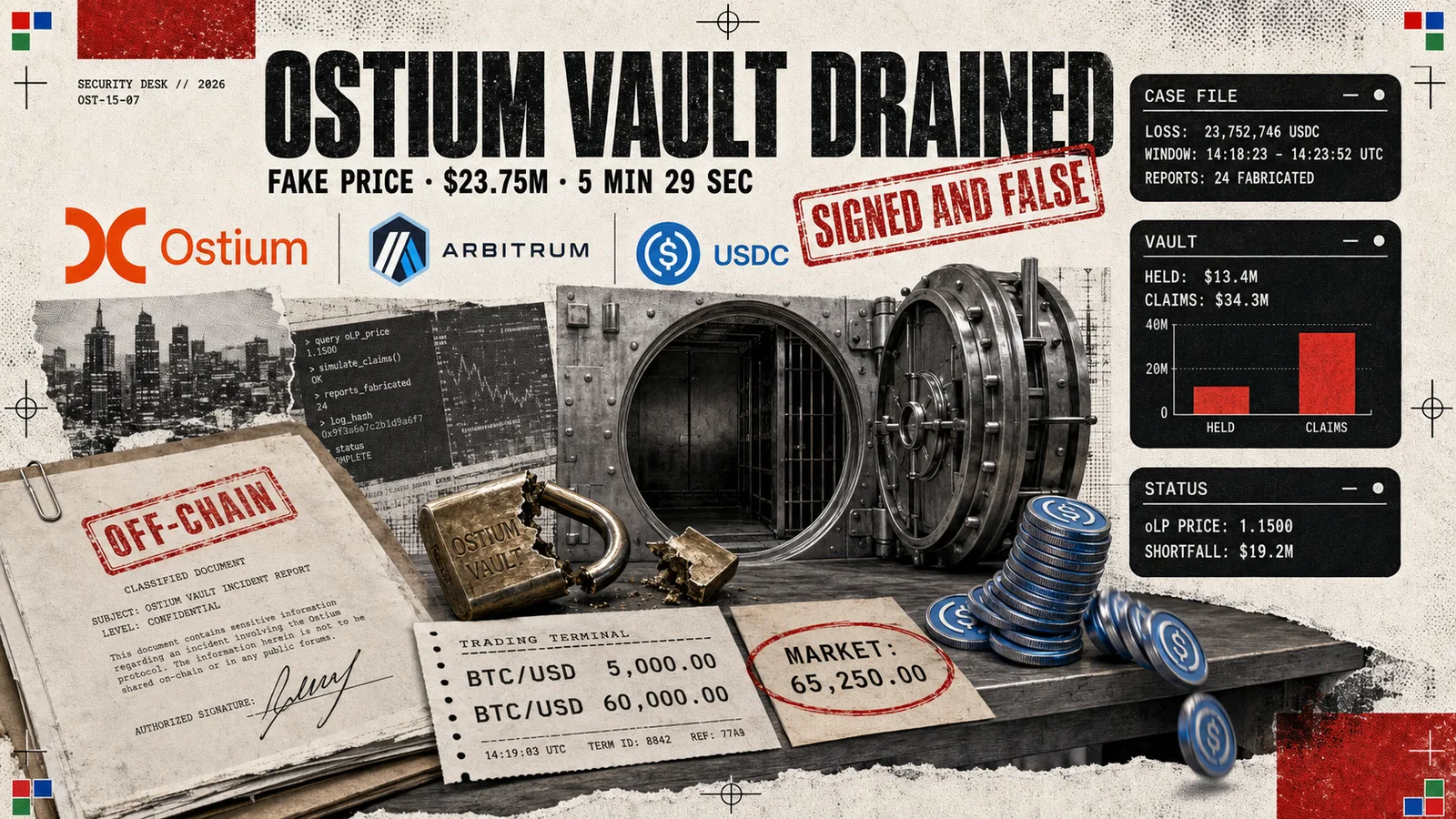
The Ostium hack of 15 July is the most instructive DeFi exploit of the summer precisely because nothing malfunctioned. Ostium, a real-world-asset perpetuals protocol built on Arbitrum, watched an attacker walk out with what security firm Blockaid initially flagged as roughly 18 million dollars in USDC from its public liquidity vault. Once PeckShield’s monitoring traced the full flow of funds, the figure settled closer to 24 million. Every contract executed exactly as written, which is rather the problem.
The mechanics reward attention. The attacker submitted price reports through Ostium’s PrivatePriceUpKeep contract and used them to fabricate trading profits. All 24 reports named BTC/USD at exactly $5,000.000000000000000000 or exactly $60,000.000000000000000000, while Bitcoin traded near $65,250 that minute. The protocol, believing the manufactured prices, paid out from its OLP vault, the pooled capital that ordinary depositors supply to take the other side of traders’ positions. Oracle manipulation is one of DeFi’s oldest recurring patterns, distinct from a contract bug because the logic performs precisely as designed; it is the inputs that lie.
The laundering was brisk and conventional. The stolen USDC was converted into roughly 12,080 ether, of which about 10,540 ETH was routed into the mixing service Tornado Cash, according to on-chain trackers. Investigators noted one procedural clue: the exploiter’s address was seeded with one ether apiece from ChangeNOW and Bybit before the attack, the kind of operational fingerprint that occasionally proves more useful to attribution than the theft itself.
Context makes the Ostium hack sting more. Real-world-asset perpetuals are one of 2026’s fashionable categories, offering leveraged exposure to equities, commodities and currencies through DeFi rails, and the pitch depends entirely on price feeds behaving. An oracle whose signing keys can be used by someone else undermines the category’s core promise. For depositors in public vaults, the episode is a reminder that supplying liquidity to a perpetuals protocol means underwriting not just trader profits but the integrity of every oracle in the stack.
The incident also fits the year’s larger pattern with uncomfortable neatness. Security researchers have spent months pointing out that 2026’s losses concentrate in infrastructure, keys and inputs rather than contract code, and the Ostium hack extends that thesis to price feeds: another attack surface adjacent to the audited logic, another exploit that a conventional code review would never have caught. Insurance funds, circuit breakers on outsized payouts and delayed settlement for anomalous profits are the standard mitigations, all of which trade a little capital efficiency for a lot of survivability. It is a trade more protocols will now be re-examining.
For Arbitrum, where much of the RWA perpetuals experimentation lives, the reputational damage is limited but real; the network itself, documented at arbitrum.io, functioned flawlessly, though that distinction is lost on anyone whose deposits left in the exploiter’s wallet. Recovery prospects look slim once funds enter a mixer, and history offers little comfort: of this year’s major exploits, only a single project has fully clawed back its assets.
The Ostium hack will not make the year’s top-five table by size. It may still prove the half’s most quoted case study, a clean demonstration that in decentralised finance, trusting the code is table stakes and trusting the data is the actual wager. Protocols that cannot tell the difference tend to find out at 24 million dollars a lesson.
The remediation conversation is already under way across the category. The standard prescriptions after an incident of this shape include redundant oracle sources with deviation checks, hard caps on single-transaction payouts, and settlement delays for statistically improbable profits, each a small tax on capital efficiency in exchange for survivability. Expect vault depositors to start pricing those controls the way bond investors price covenants. There is also a wider credibility test in play: real-world-asset protocols are courting exactly the institutional users that the GENIUS and CLARITY frameworks are meant to reassure, and a market that can be robbed with a correctly signed report from the future is not yet ready for that clientele.
Sources
- Ostium, first account of the incident (15 July 2026)x.com
- Ostium, "An update on where things stand" (19 July 2026)x.com
- Ostium documentation, how the consensus oracle publishes pricesdocs.ostium.com
- Arbiscan, the largest exploit transaction (block 484,137,113)arbiscan.io
- Arbiscan, the Ostium Vault contractarbiscan.io
- Coinbase Exchange, BTC-USD one-minute candles for 15 July 2026api.exchange.coinbase.com