
Perps & onchain derivatives
the contract at the centre of crypto trading
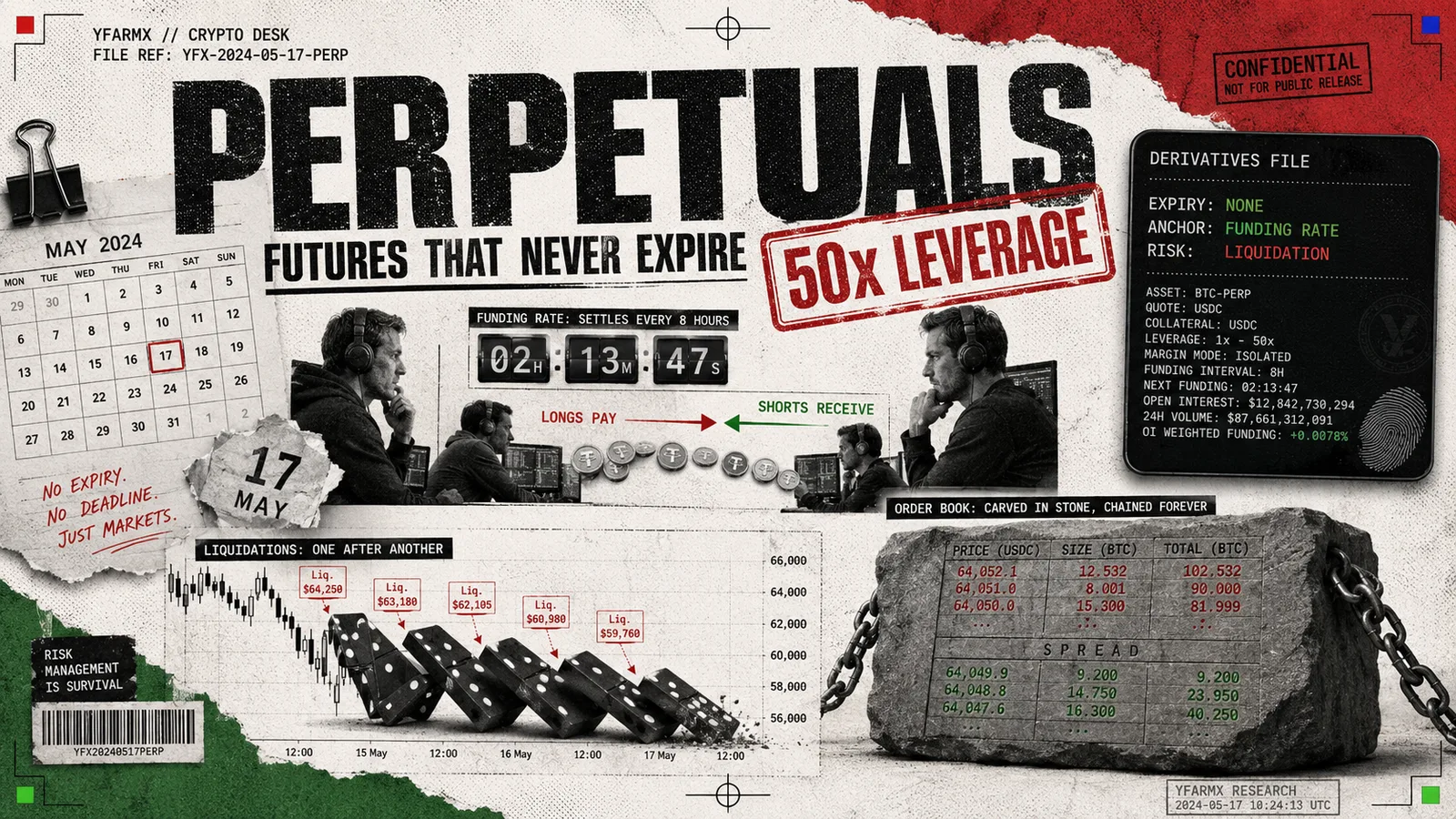
Key facts
- Nonehold indefinitely
- Expiry
- Funding ratepaid between traders
- Anchor
- Often 50x+and liquidation with it
- Leverage
- Hyperliquidand other onchain venues
- Onchain leaders
Futures that never expire, up to fifty times leverage, and a funding fee that ticks every few hours to keep the price honest. This is where crypto's leverage lives, and when it unwinds, the liquidation cascades follow.
Most people picture crypto trading as buying coins. A great deal of it is something else entirely: the perpetual future, a leveraged bet on price with no expiry date, and the venues offering it onchain have become some of the largest businesses in decentralised finance.
What a perpetual future is
A traditional futures contract is an agreement to settle at a set price on a set date, and the date is the awkward part: traders who want continuous exposure must keep rolling into the next contract. A perpetual future removes the expiry entirely. You open a position and hold it as long as you can fund it.
That creates a problem. With no settlement date forcing convergence, nothing stops the contract price drifting away from the actual market price of the asset. The fix is the funding rate: a small payment made every few hours directly between traders. When the contract trades above spot, holders of long positions pay short positions, which makes being long more expensive and pulls the price back down. When it trades below, shorts pay longs. The mechanism is elegant, self-correcting, and requires no intervention.
Leverage and liquidation
Perps are traded with leverage, often twenty to fifty times and sometimes more. Deposit collateral, control a much larger position, and both gains and losses are multiplied against the collateral rather than the position size. At fifty times leverage, a 2% move against you wipes out your deposit entirely.
To protect the exchange from unpayable losses, positions are liquidated automatically when collateral falls below a maintenance threshold. In fast markets this cascades: liquidations force selling, selling moves the price, the move triggers more liquidations. Most violent short-term crypto price movements are liquidation cascades rather than opinion changing.
Why onchain versions are different
Perps ran on centralised exchanges for years, which meant trusting a company with your collateral, a trust repeatedly betrayed. Onchain perpetual exchanges settle on a blockchain instead, so positions and collateral are verifiable and users keep custody.
The engineering is genuinely hard, because a serious derivatives venue needs an order book updating many times a second, and general-purpose blockchains are too slow. The response has been purpose-built infrastructure: Hyperliquid runs its own chain designed around the order book rather than deploying onto someone else’s, which is why it grew from an exchange into a network.
Where it stands
Onchain perps have taken meaningful share from centralised venues, and the leading protocols now generate substantial fee revenue, much of it returned to token holders through buybacks and burns. The open questions are regulatory rather than technical: high-leverage derivatives sold to retail traders attract supervisory attention everywhere, and most of these venues operate without the licences a traditional derivatives exchange would need.
More Crypto
All Crypto →
Binance Together Initiative offers $400M to traders
Binance Together Initiative injects $400M to aid traders post-liquidation. Discover the impact and future prospects.