
Liquid staking & restaking
the yield layer holding up DeFi
Key facts
- Stakelock coins, earn rewards
- Base idea
- A receipttradeable while staked
- Liquid staking
- Reusesame stake, more services
- Restaking
- Stackedslashing across layers
- Risk
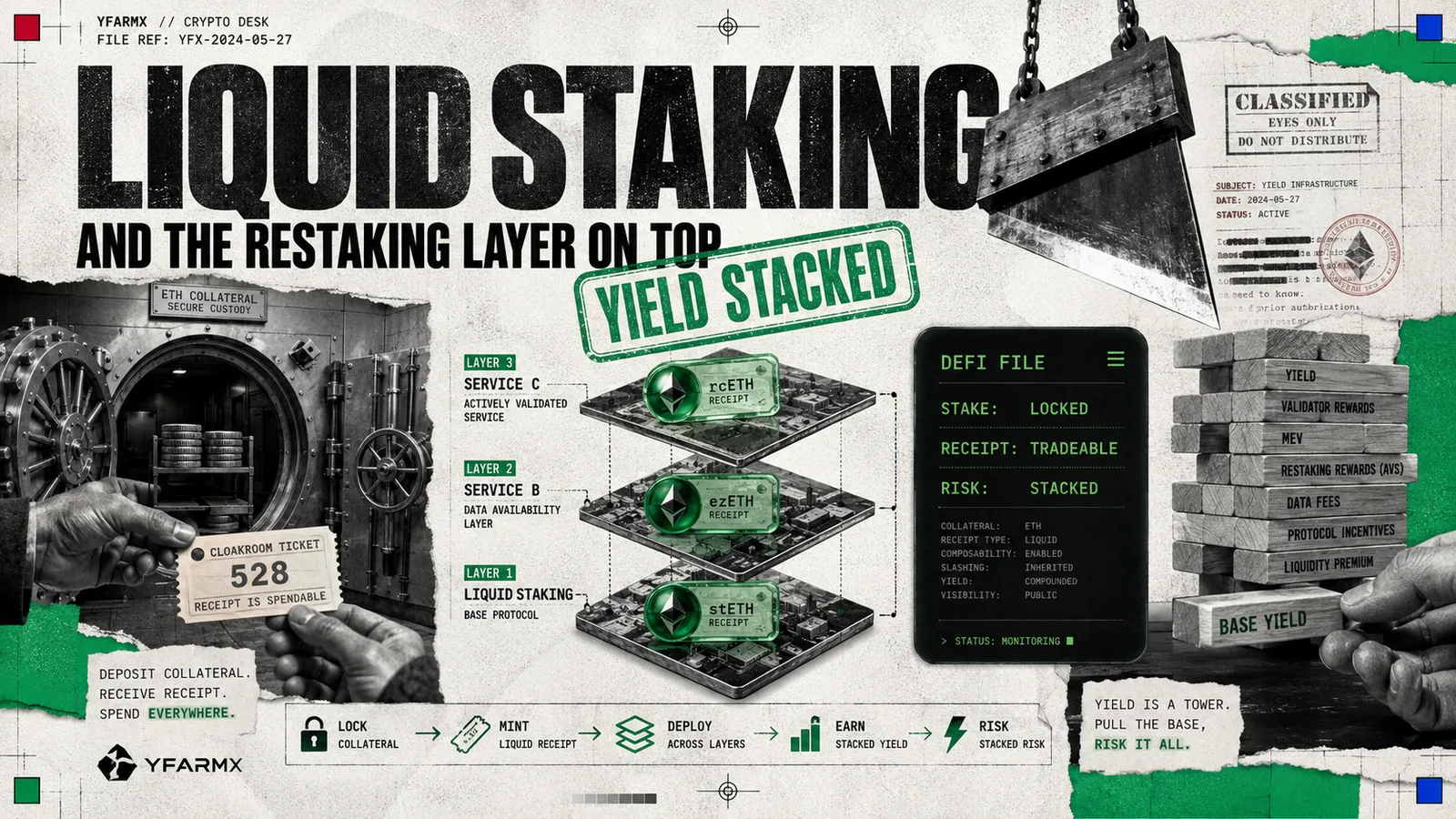
Staking locks your coins up to help secure a network. Liquid staking hands you a receipt you can spend while they are locked, and restaking lends the same collateral out again. Each layer adds return, and each adds a way to lose everything.
Proof-of-stake networks pay you to help secure them. You lock up coins as collateral, your stake backs the honesty of the validation you perform, and the network pays a reward. If you cheat or go offline badly enough, part of your stake is destroyed, a penalty called slashing. Liquid staking and restaking are the two financial layers built on top of that simple arrangement, and together they hold up a large share of decentralised finance.
Liquid staking
Ordinary staking has an obvious drawback: the money is locked. Stake it and you cannot lend it, trade it or use it as collateral. Liquid staking solves that with a receipt. You deposit coins with a staking protocol, it stakes them on your behalf, and it issues you a token representing your claim, which continues to accrue the staking reward while remaining freely tradeable.
That token can then be used anywhere in DeFi. You earn the network’s staking yield and, at the same time, use the same capital as collateral for a loan or supply it to a liquidity pool. The efficiency is real, and so is the fragility: the receipt is only worth the underlying stake if the protocol is solvent and honest, and receipts have traded below the value of what they represent during periods of stress.
There is also a concentration problem. If most staked coins flow through a handful of liquid staking providers, those providers collectively control a large share of the network’s validation, which is uncomfortable for a system whose selling point is that nobody is in charge.
Restaking
Restaking takes the idea one step further. The same staked collateral, already securing the base network, is committed a second time to secure additional services: oracles, bridges, data availability layers, other chains. Those services get economic security without having to bootstrap their own validator set, and the staker earns extra reward for taking on extra slashing conditions.
The appeal to a new protocol is obvious, because recruiting billions in fresh collateral is the hardest part of launching. The risk is that one pool of collateral now underwrites many independent systems, and a failure in any of them can slash the same stake. Correlated failure is the concern: several services depending on the same collateral, all suffering at once, in exactly the market conditions where that collateral is least liquid.
Where it stands
Liquid staking is now mainstream infrastructure rather than an experiment, and restaking has moved from novelty to a substantial part of the market. The unresolved question is whether the layered risk is properly priced. Each layer is individually reasonable; the concern is what happens when the bottom one fails while all the layers above are counting on it.
More Crypto
All Crypto →
SEC staff clear token buybacks on blockchains that already work
The SEC's Division of Corporation Finance published nine staff answers on crypto on 25 September 2026. On a working network, announcing a buyback or paying for upgrades sits outside the managerial effort the Howey test looks for; before launch, a buyback sold as a return could count.