
Glamsterdam
the next hard fork and the parallel execution bet
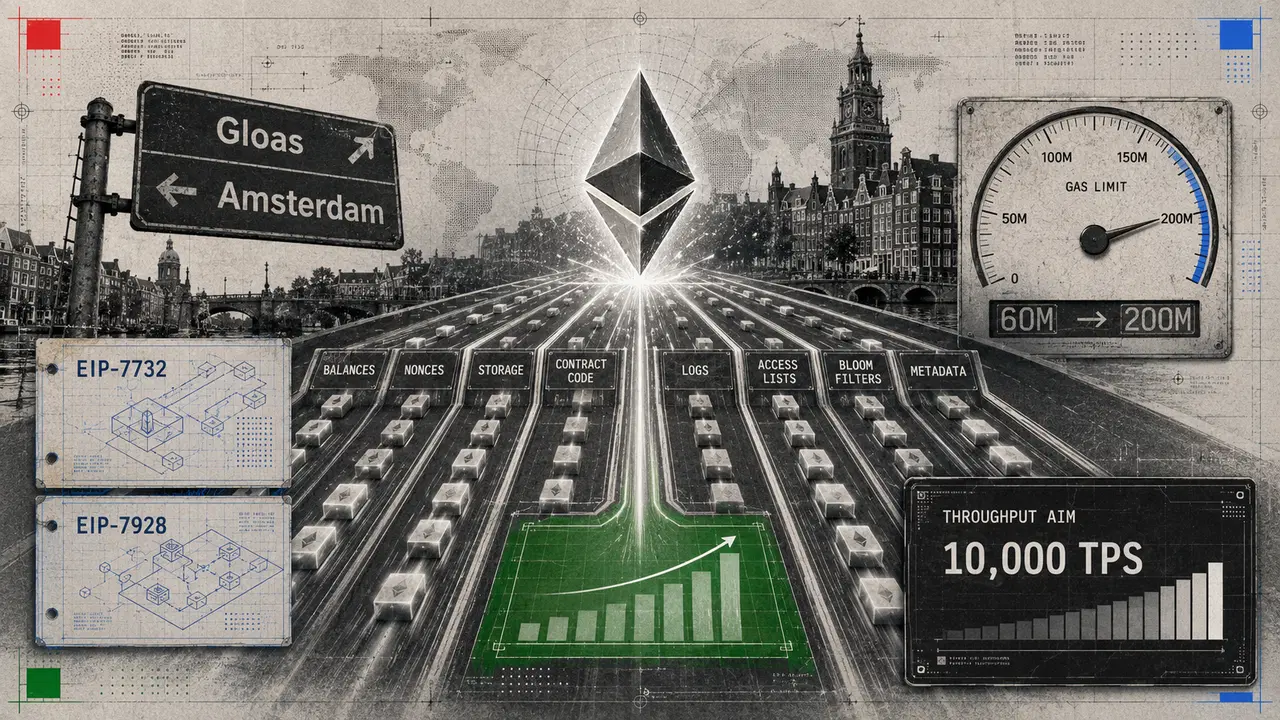
Key facts
- 6 Oct 202613:53:36 UTC, epoch 353,024
- Sepolia fork
- Q4 2026expected, date to be confirmed
- Mainnet
- 200Mpath from 60M
- Gas limit
- 200Mtestnet · 6 October
- Sepolia limit
- 10,000 TPScited aim
- Throughput
- 7732 / 7928ePBS and BALs
- Core EIPs
The next hard fork and the parallel execution bet. Named from Gloas (consensus layer) and Amsterdam (execution layer).
What Glamsterdam is
The Glamsterdam upgrade is the next scheduled hard fork on Ethereum’s roadmap, and it carries the network’s biggest bet yet on parallel execution. The name is a portmanteau, drawn from Gloas on the consensus layer and Amsterdam on the execution layer, the two halves of the network that every upgrade has to coordinate. After a run of short-lived devnets, the Ethereum Foundation announced the Platåberget public testnet on 17 August 2026, a network intended to run for a few months, with the Glamsterdam fork on that testnet scheduled for 20 August. Alchemy reports that Glamsterdam activated on Sepolia at 13:53:36 UTC on 6 October 2026. This matches epoch 353,024 and slot 11,296,768 in the Ethereum Foundation’s testnet announcement. Hoodi and mainnet dates remain to be confirmed; ethereum.org gives the fourth quarter of 2026 as the mainnet target.
The two proposals
Two proposals define the release. The first is EIP-7732, Enshrined Proposer-Builder Separation, which writes into the protocol the division between the party that proposes a block and the party that builds its contents, and adds in-protocol commitments from builders. The second is EIP-7928, Block-Level Access Lists, which requires each block to declare in advance which parts of the network’s state its transactions will touch. Read together, the two enable parallel transaction execution: if the network knows ahead of time which transactions touch which data, it can process those that do not overlap at the same time rather than strictly one after another. That is the core of the Glamsterdam upgrade, and the reason it draws so much attention.
Parallel execution is the ambition behind both proposals. Most blockchains process transactions in a strict single file, one after another, because any two might touch the same data and conflict. Declaring in advance which data each transaction needs lets the network prove which ones are independent and run them together, which is how a general-purpose chain can raise throughput without simply asking every node for more raw power. It is a well-understood technique in conventional computing, and bringing it to a decentralised network safely is what makes the Glamsterdam upgrade difficult.
The capacity climb
Glamsterdam is intended to raise Ethereum’s block capacity. Alchemy’s 6 October update says Sepolia activated with a 200 million gas limit. That testnet setting supports work towards a higher mainnet limit. Developers are also testing state pricing: the cost assigned to operations that read or change stored data. Pricing expensive operations accurately helps protect the network as blocks grow. The cited ambition of up to 10,000 transactions per second remains a target, dependent on parallel execution working as designed.
What comes after
Hegotá is the upgrade after Glamsterdam. The Ethereum Foundation’s post of 7 September 2026 on Hegotá’s scope names two locked-in headliners. On the consensus layer, FOCIL (EIP-7805) gives any user a path to get an eligible transaction included without relying on centralised block builders. On the execution layer, Frame Transactions (EIP-8141) bring native account abstraction, which the foundation frames as a route to post-quantum signature schemes. Where Glamsterdam concentrates on doing more work per block, Hegotá concentrates on who can get a transaction into a block and how accounts sign, and the two are complementary parts of the same roadmap.
What to watch
The next milestones are the Hoodi testnet and a confirmed mainnet date. Sepolia activated on 6 October, according to Alchemy’s operational update. Testing will show how parallel execution and the new state-pricing rules behave under load before wider deployment. Our Ethereum guide places Glamsterdam within the longer roadmap.
More Crypto
All Crypto →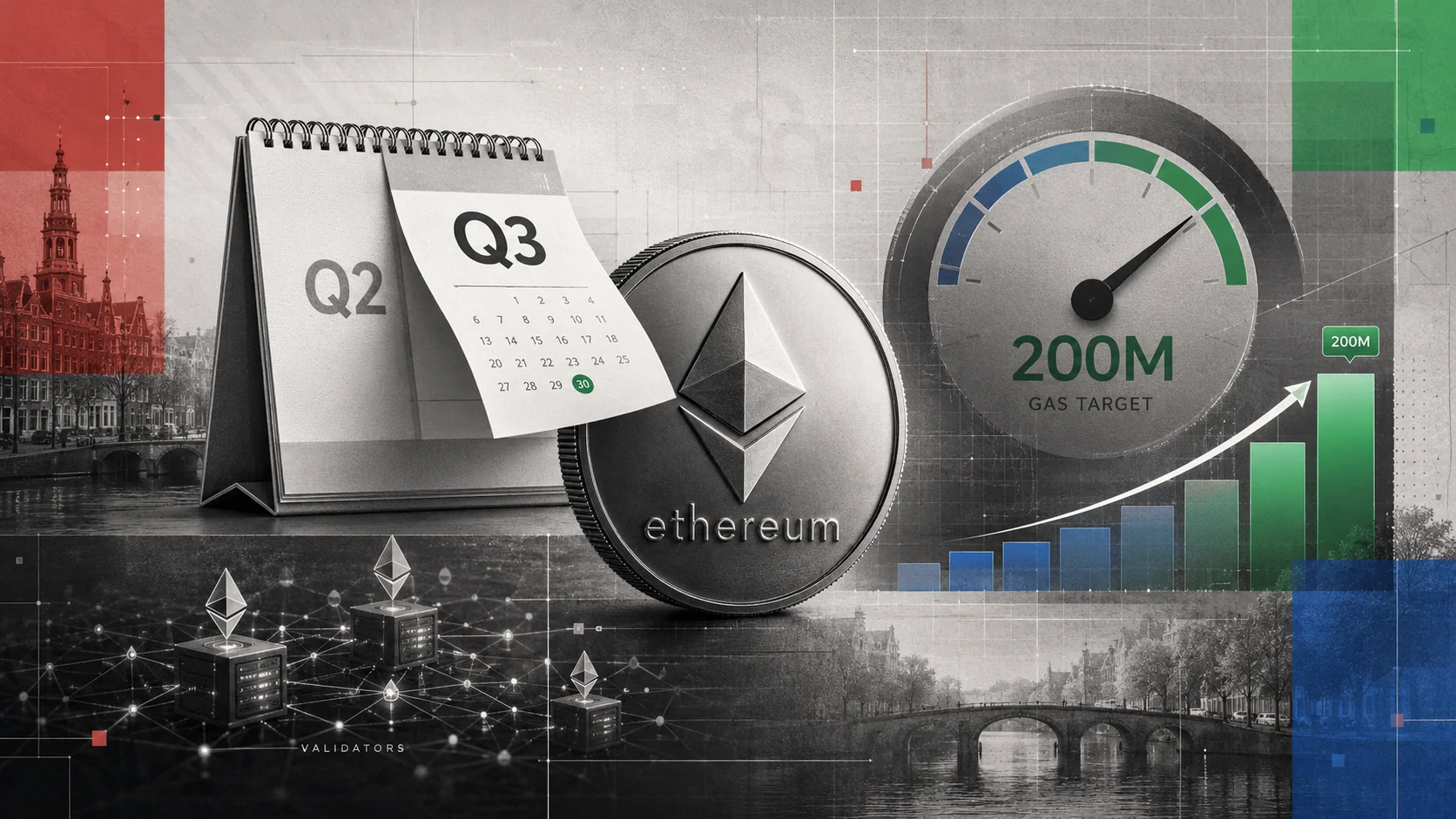
Ethereum Glamsterdam upgrade slips to Q3, but the 200 million gas target is the real story
The Ethereum Glamsterdam upgrade will not arrive on its original June schedule.