Europe's aviation regulator revises its satellite jamming warning again
EASA has issued the fourth revision of its safety bulletin on satellite navigation outages, covering jamming and spoofing that has grown steadily around conflict zones since February 2022.
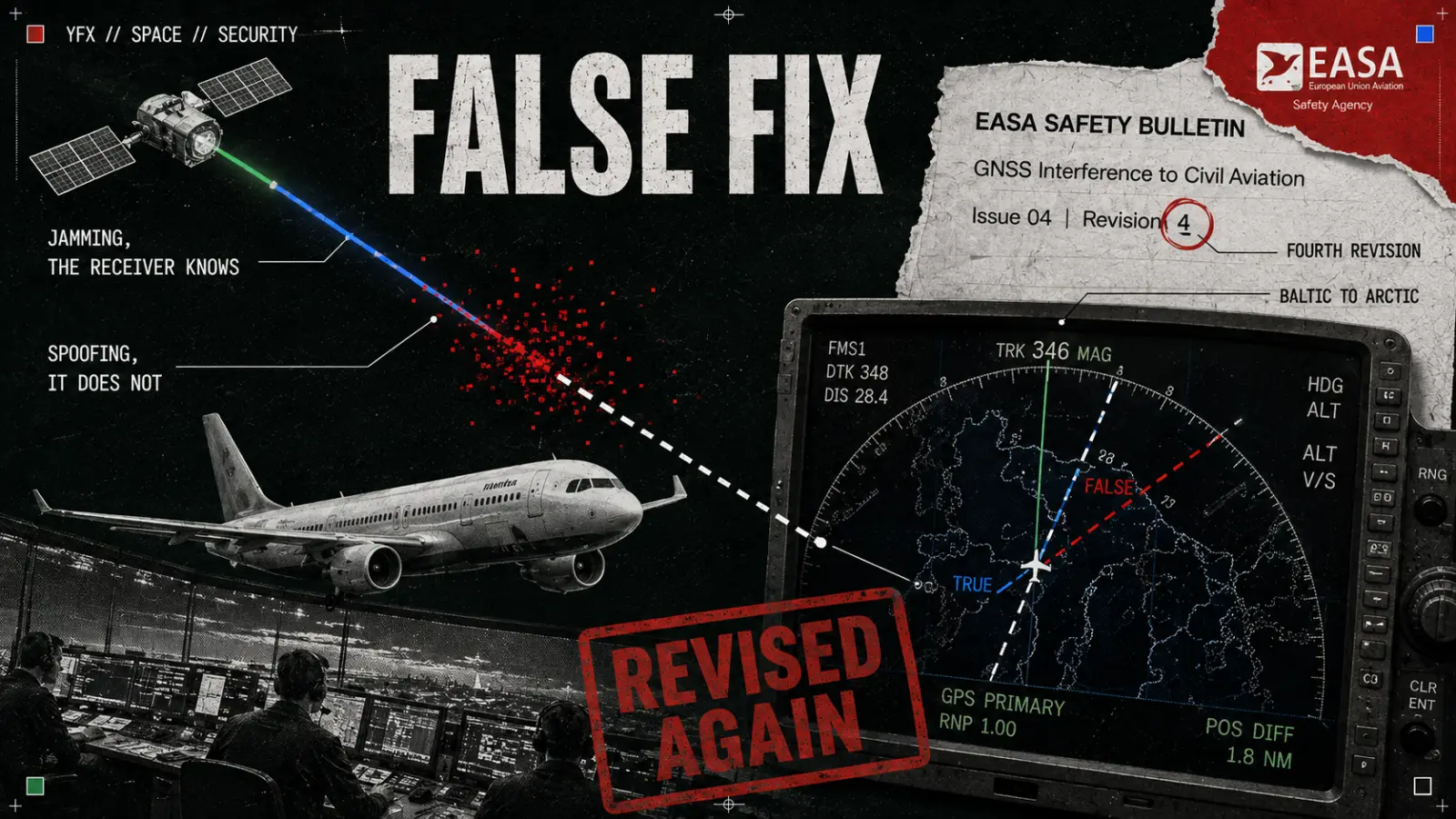
The European Union Aviation Safety Agency issued the fourth revision of Safety Information Bulletin 2022-02 on 3 July 2026. The subject is satellite navigation that stops working, or worse, keeps working and lies.
A bulletin reaching its fourth revision is the story. The original went out in 2022. Each revision since has widened the description of a problem that has not been solved, and the regulator is addressing it to competent authorities, air traffic management providers, air navigation service providers, air operators, and aircraft and equipment manufacturers. That distribution list is what a systemic issue looks like on paper.
Jamming and spoofing are not the same failure
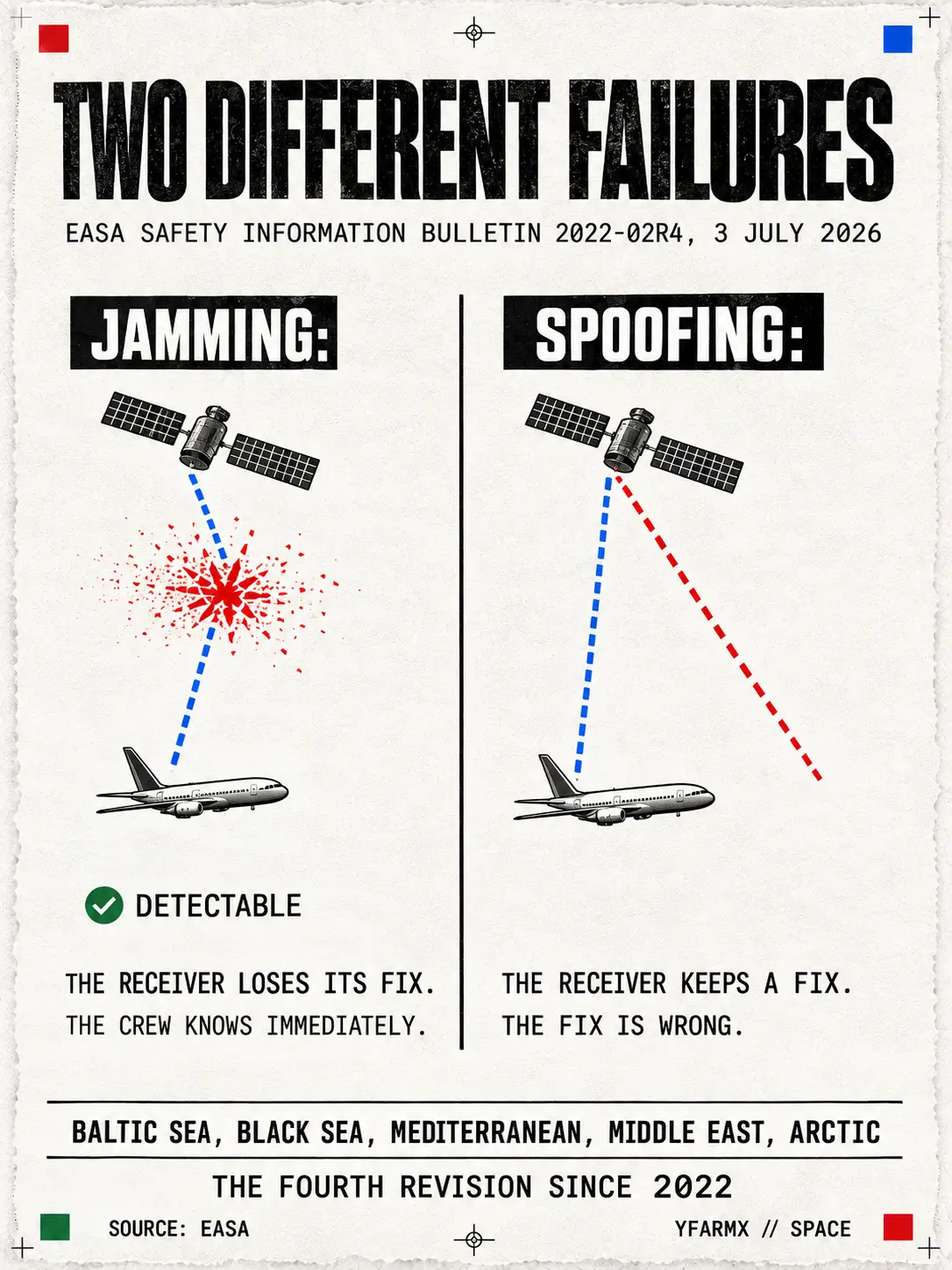
Jamming drowns the signal. A receiver loses its fix, the crew knows immediately, and the aircraft falls back on other means of navigation. It is disruptive and it is honest.
Spoofing substitutes a false signal. The receiver keeps a fix and the fix is wrong. Nothing announces itself, and the failure can propagate into systems that trust position without questioning it, including terrain warnings and timing.
EASA’s bulletins have tracked both, and the agency describes the incidents as growing in severity and sophistication.
Where it happens
Interference has risen notably since February 2022, concentrated around conflict zones and other sensitive areas: the Mediterranean, the Black Sea, the Middle East, the Baltic Sea and the Arctic.
That geography is the argument for treating this as space security rather than an avionics fault. The signals come from a constellation in medium Earth orbit that no airline owns, arriving at a power level a modest ground transmitter can overwhelm. The vulnerability is structural, and it sits in the gap between who operates the satellites and who depends on them.
The response is coordination, not a fix
Following a request from 13 EU member states and the European Commission, EASA and EUROCONTROL produced the first version of a European Aviation Action Plan for Ensuring Safe Operations during GNSS Interference. The two bodies have also convened more than 100 experts from across the sector to work on the operational response.
What that produces is procedure: reporting, awareness, crew training and fallback. It does not produce an uninterfered signal, because the regulator does not control the transmitters causing the problem.
What is not known
EASA does not attribute the interference to any state or actor in the bulletin, and this article does not either. The agency has not published a count of affected flights in the revision, and no timeline exists for when the interference might recede. Whether the action plan reduces incidents or only improves how they are handled is not yet measurable.