Japan launches mission to return samples from Mars’s moon
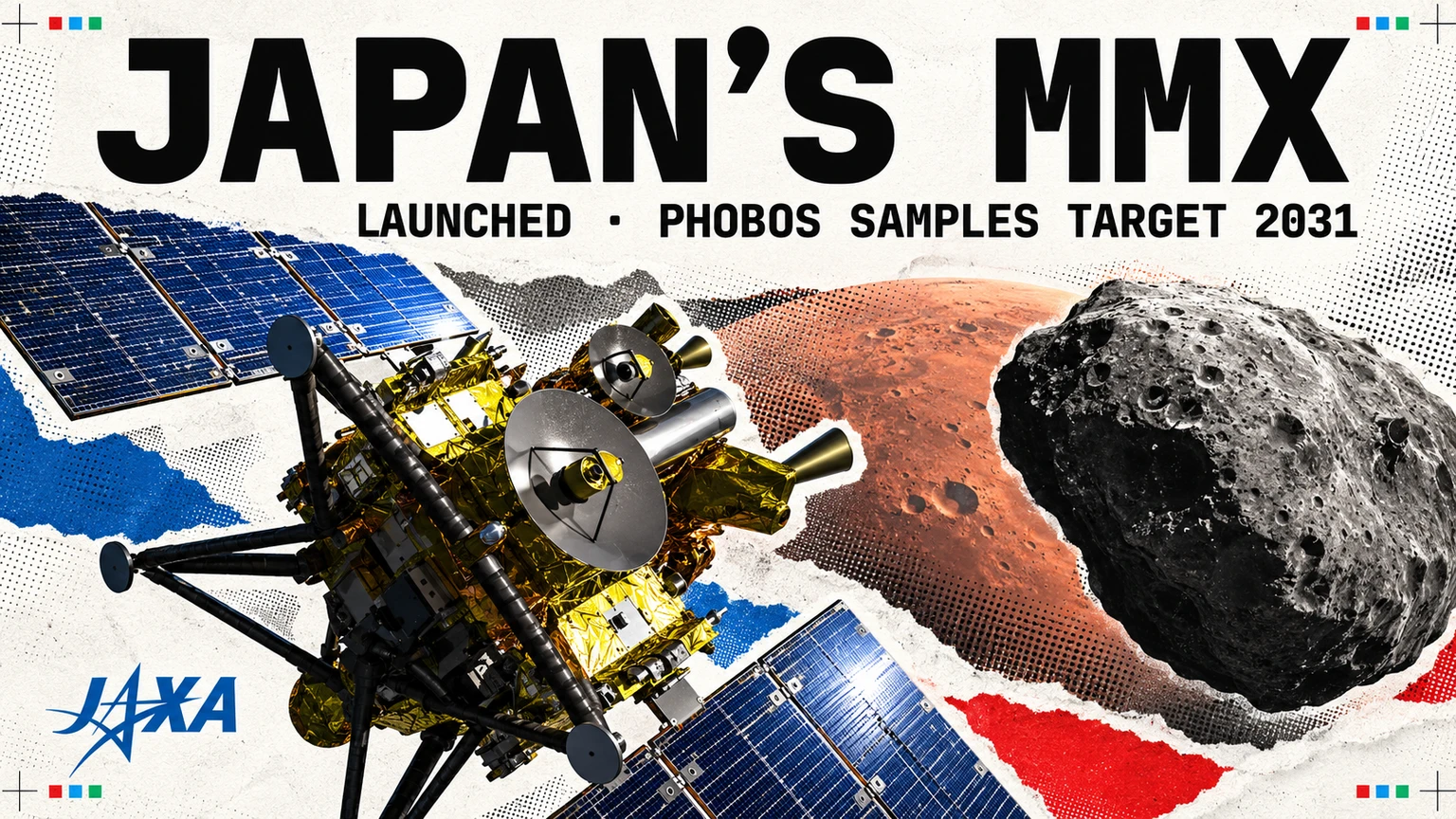
Japan’s MMX spacecraft launched aboard an H3 rocket toward Phobos. The mission plans a rover survey, surface sampling and an Earth return in 2031.
Listen to this articleListen
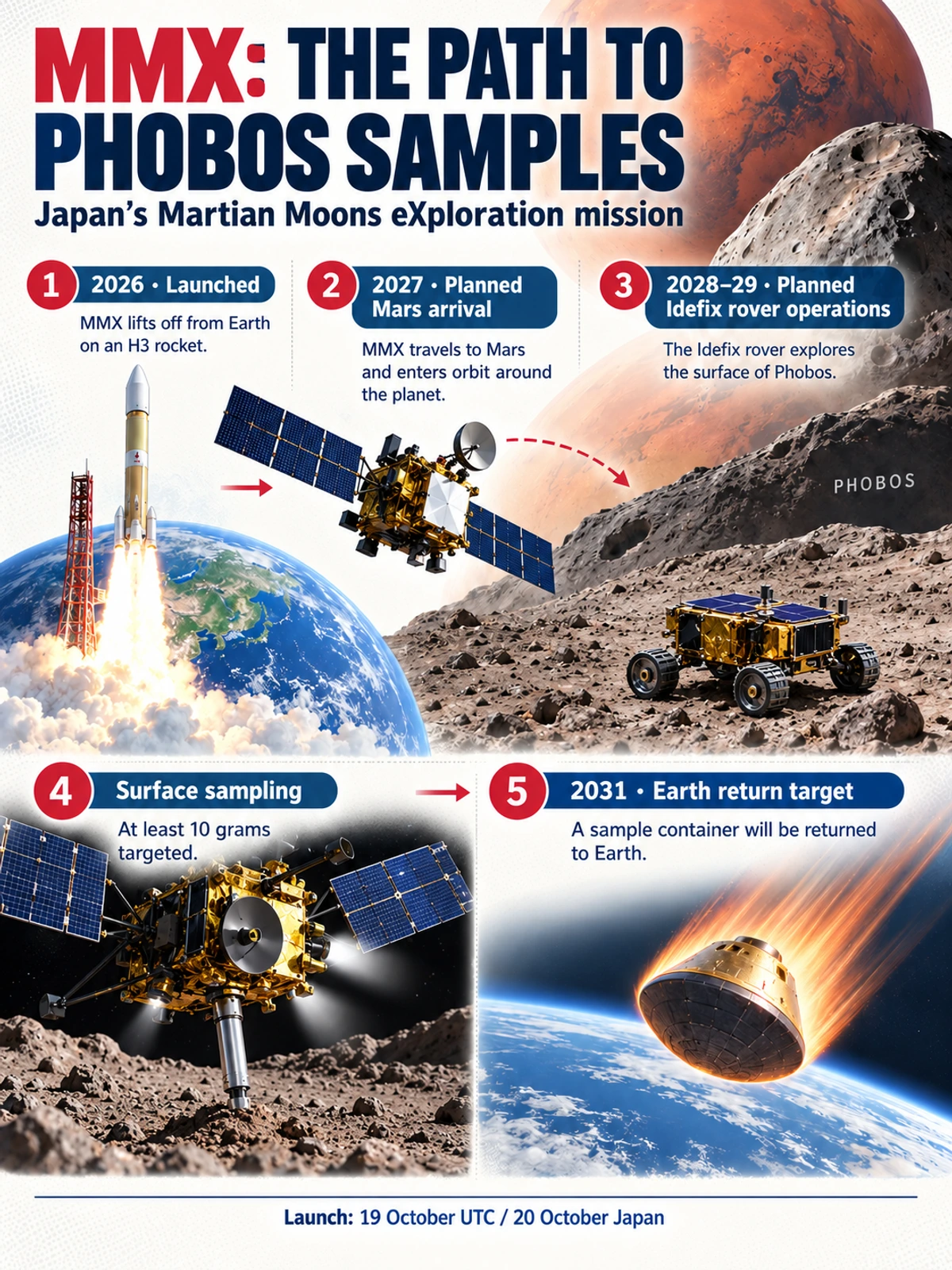
Japan’s MMX spacecraft has launched toward Mars on a mission to bring back samples from the moon Phobos. The H3 rocket lifted off from Tanegashima at 20:41 BST on 19 October 2026, corresponding to 04:41 in Japan on 20 October. JAXA confirmed that the spacecraft separated successfully about one hour and 11 minutes later.
MMX stands for Martian Moons eXploration. Its planned five-year journey combines observations of Phobos and Deimos, a rover survey on Phobos and a sample capsule targeted to return to Earth in 2031. The spacecraft’s next major destination is the Mars system in 2027.
Samples could explain how Mars acquired its moons
Phobos samples would let scientists test competing explanations for the origin of Mars’s two moons. One proposes that they are captured asteroids. Another proposes that they formed from debris thrown into orbit by a large impact on Mars.
Measurements in laboratories on Earth can examine composition and history in ways that complement spacecraft instruments. JAXA’s mission plan calls for collecting at least 10 grams from Phobos, the larger and closer of the two moons.
NASA explains that the findings could also illuminate the early movement of water and organic compounds through the inner Solar System. Answering how the moons formed would connect their small surfaces to a much larger history of planetary formation.
Idefix will survey the ground before sampling
The French-German Idefix rover is planned to explore Phobos around the turn of 2028 and 2029. DLR describes a release from roughly 40 to 100 metres above the surface, followed by a landing, possible bouncing and an autonomous manoeuvre to stand upright.
Its planned 100-day survey will examine the ground’s mechanical, thermal and mineral properties. Those measurements will help the team select a sampling location and prepare the larger spacecraft’s approach to the surface.
Phobos’s weak gravity makes driving and landing a distinctive engineering problem. Idefix must establish stable contact and move carefully while operating with long communication delays to Earth.
| Stage | Planned milestone |
|---|---|
| 19 October UK time | Launch completed; spacecraft separation confirmed |
| 2027 | Arrival at Mars and moon observations |
| From late 2028 | Rover deployment and surface-sampling phase |
| 2031 | Return of the sample capsule to Earth |
Two samplers will collect different kinds of material
MMX combines a core-sampling system with a pneumatic sampler designed to gather surface grains. NASA’s P-Sampler uses bursts of high-pressure nitrogen, complementing JAXA’s C-Sampler, which reaches a few inches beneath the surface.
NASA also contributes the MEGANE instrument, which measures gamma rays and neutrons to investigate surface chemistry, together with navigation and communications support. The agency plans to curate about 15% of the returned sample for researchers.
The launch has put that equipment on its way to Mars. The planned sequence now moves through cruise and arrival, detailed moon surveys, rover operations, sample collection and the return capsule’s journey to Earth. Each stage prepares the next part of the attempt to deliver Phobos samples to laboratories in 2031.