Perseverance reads 75 metres of Mars that nothing has recycled
NASA's Perseverance rover has found a 75-metre stack of rock on the rim of Jezero Crater built by repeated asteroid impacts more than 3.9 billion years ago, and has cached two samples of it.
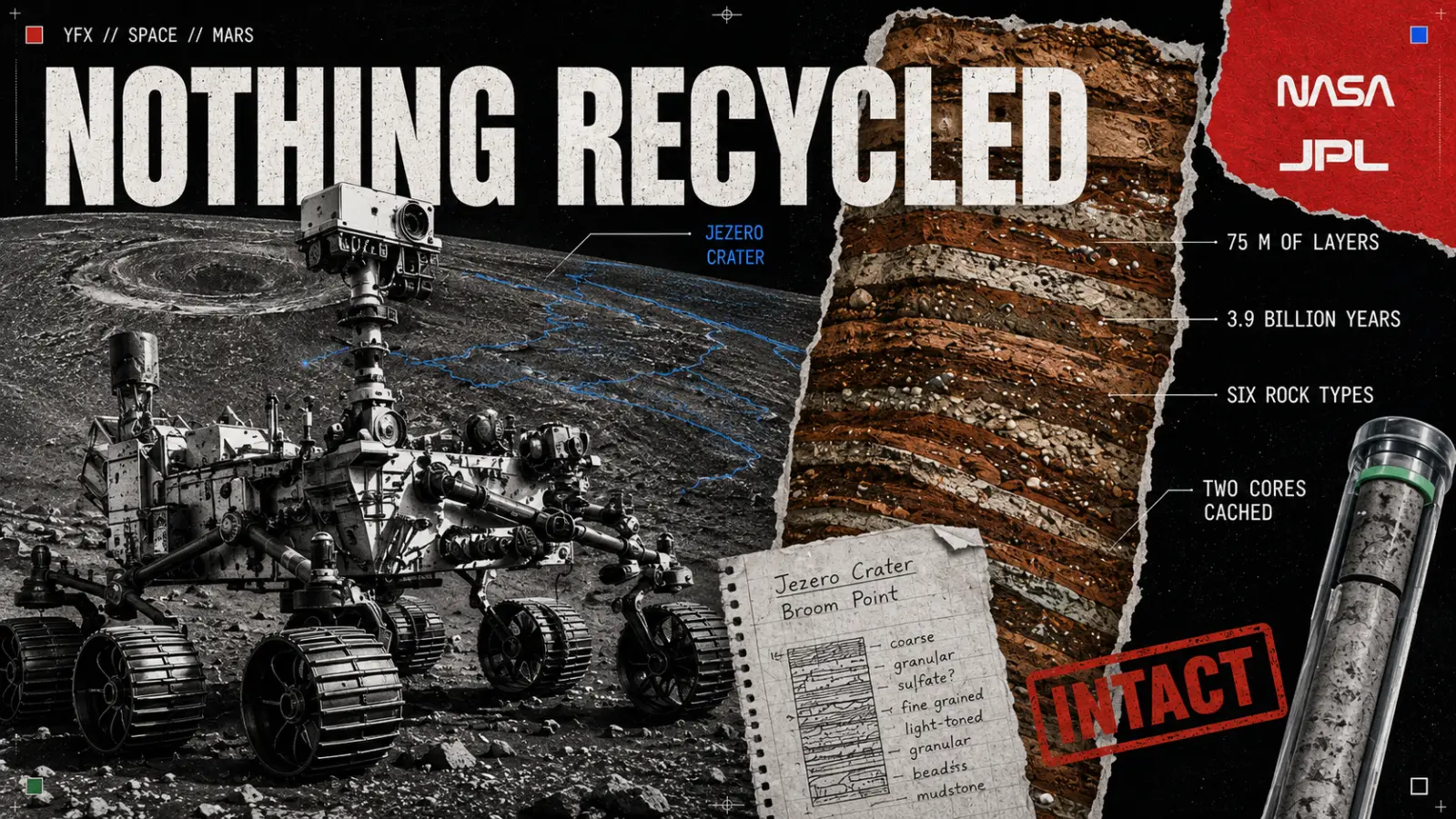
NASA’s Perseverance rover has worked out how a 75-metre stack of rock on the rim of Jezero Crater was built. The answer is asteroids, repeatedly, more than 3.9 billion years ago. The rover’s science team calls the sequence the Broom Point member, and it is among the oldest terrain any Mars rover has examined.
The structure is what carries the argument. Six distinct rock types alternate with layers of fine-grained pulverised material, and between them sit glassy beads and breccias. That is not one event. Each glassy layer records a separate high-energy impact, and the stacking says they happened again and again across the same region of early Mars.
Why the record still exists
Ken Farley, Perseverance deputy project scientist at Caltech, gave the reason in one sentence: “Because Mars lacks plate tectonics to recycle its crust, this ancient record remains intact.”
That is the whole value of the site. Earth ran through the same bombardment, and Earth destroyed the evidence. Crust is subducted, melted and returned, so the terrestrial record of the period is largely gone. Mars stopped resurfacing itself and kept the pages in order.
The one-two punch
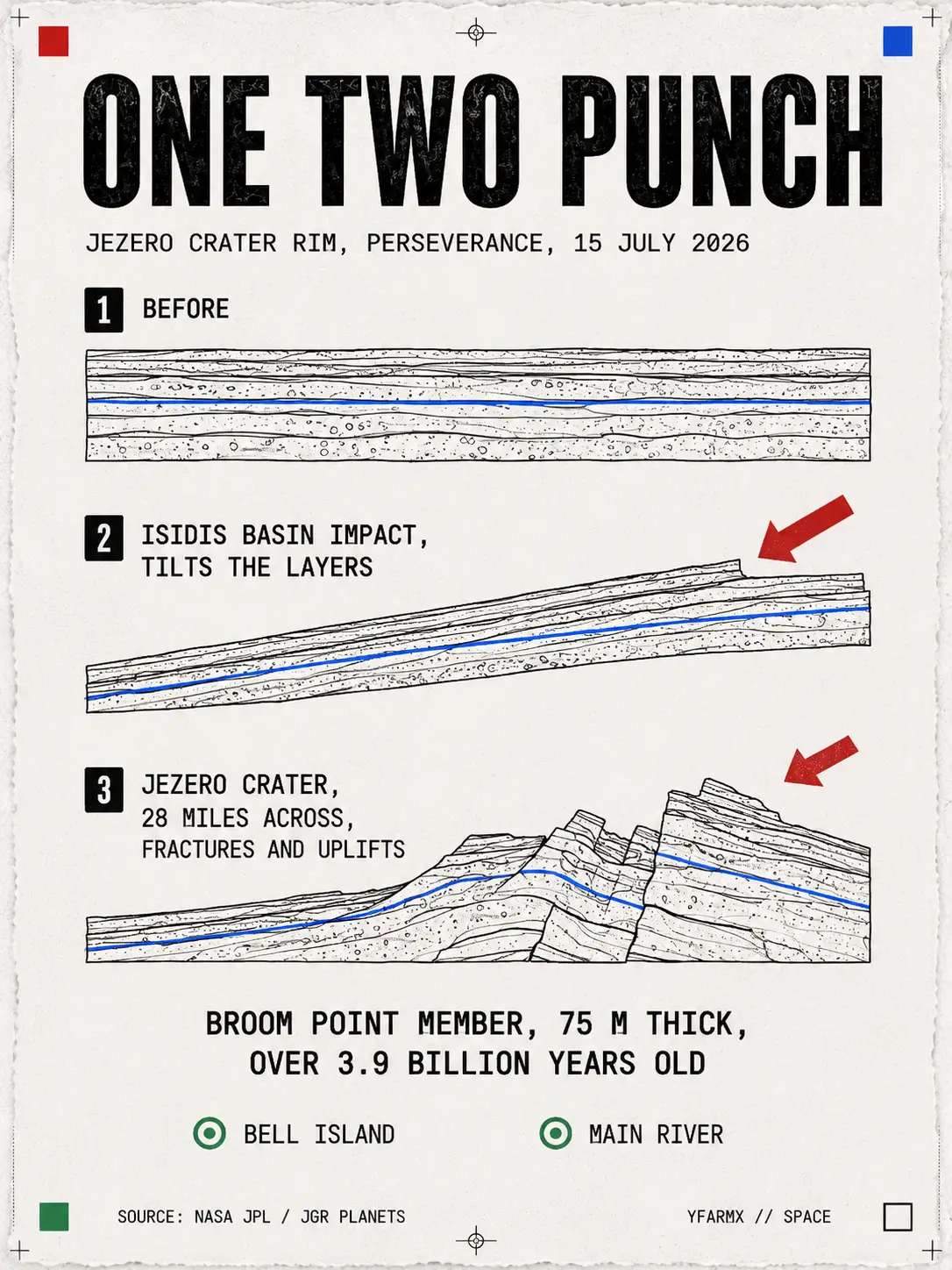
The team’s reading of the landscape involves two separate blows. The Isidis Basin impact came first and tilted the rock layers away from horizontal. Jezero Crater, 28 miles across, formed afterwards and fractured and uplifted rocks that were already tilted.
That sequence is why the rim is worth driving to. A flat, undisturbed plain shows you the top of the stack. A crater rim that has been tipped and lifted shows you the side of it, which is 75 metres of history exposed to a rover that can only reach what is at the surface.
Two samples now waiting
Perseverance drilled and cached two cores from the sequence, named Bell Island and Main River. Both are candidates for radiometric dating, which is the measurement that would convert “more than 3.9 billion years old” into a number with an error bar on it.
That measurement cannot be made on Mars. It needs laboratory instruments, which means it needs the samples on Earth.
What is not known
The absolute age of the Broom Point member is not established: 3.9 billion years is a lower bound derived from context, not a dated result. Which specific impacts produced which layers is not resolved, and neither is how much of the wider Jezero rim shares the same structure. The dating that would settle the first question depends on a sample return whose schedule and funding are not set.
The findings are published in the Journal of Geophysical Research: Planets.