NASA clears four astronauts for SpaceX's 1 October station launch

NASA and SpaceX cleared Crew-13 at its Flight Readiness Review at Kennedy Space Center on 25 September 2026. Four crew are due to launch to the International Space Station at 11:10 EDT (15:10 UTC) on Thursday 1 October.
Listen to this articleListen
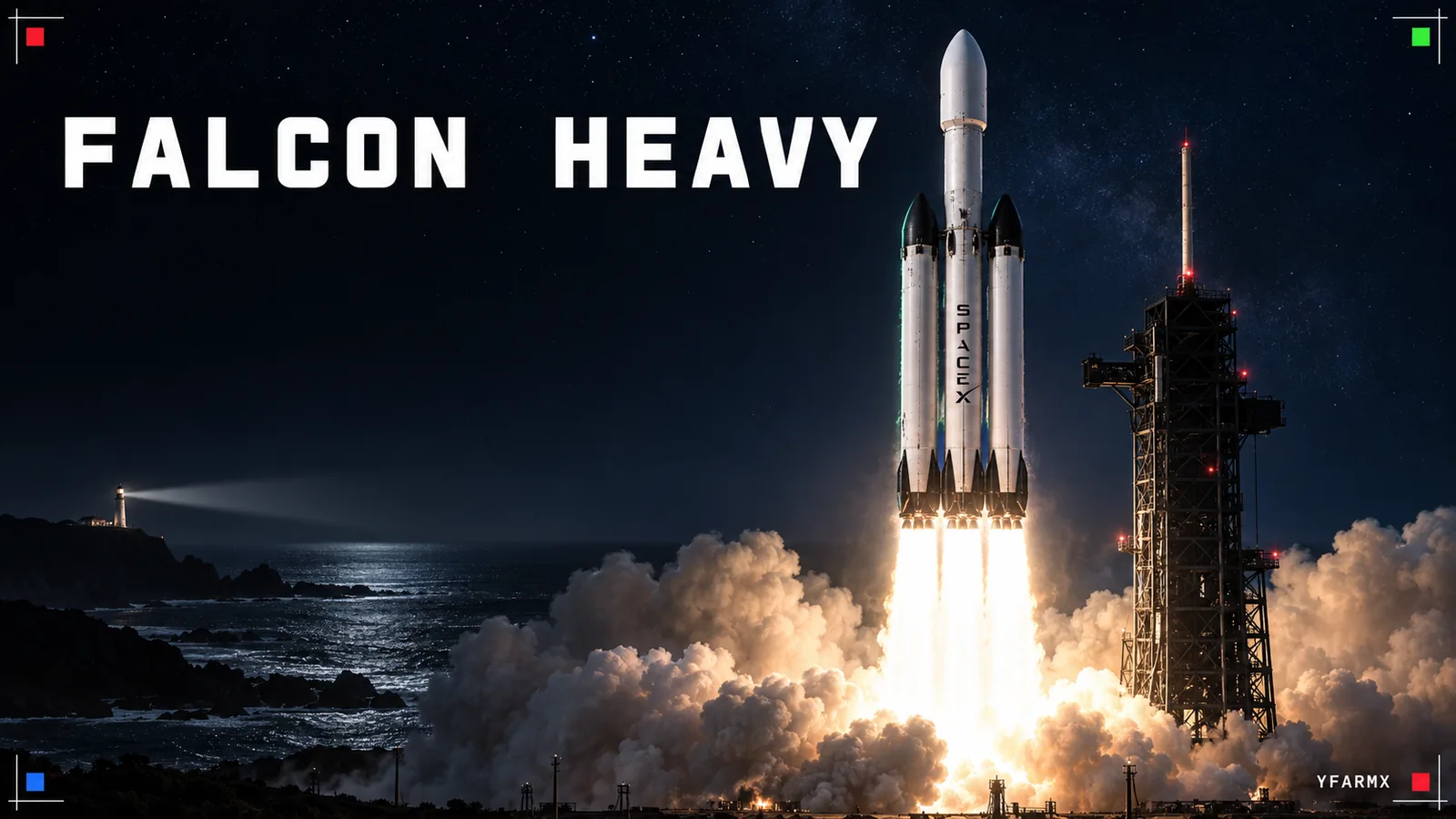
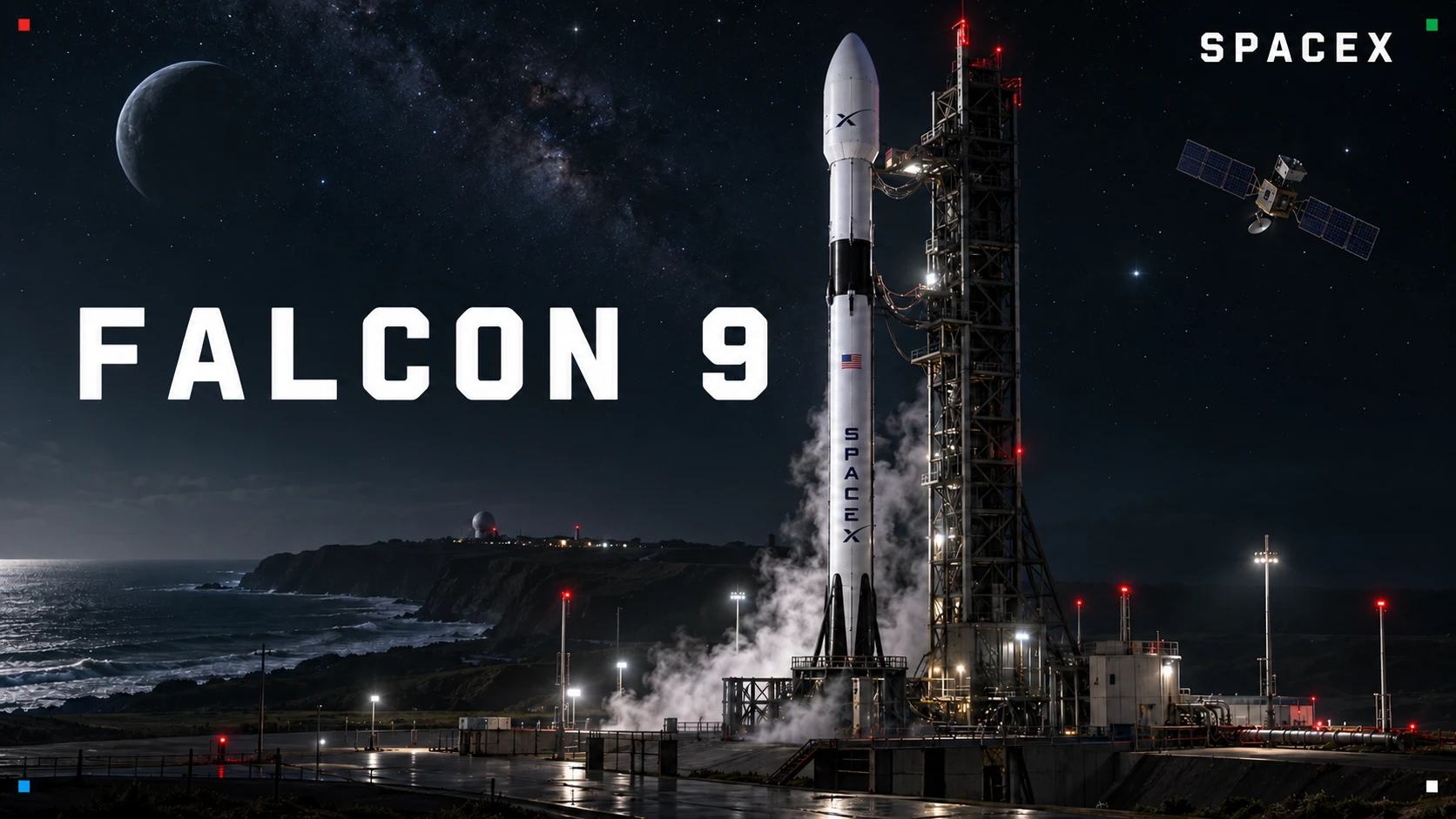
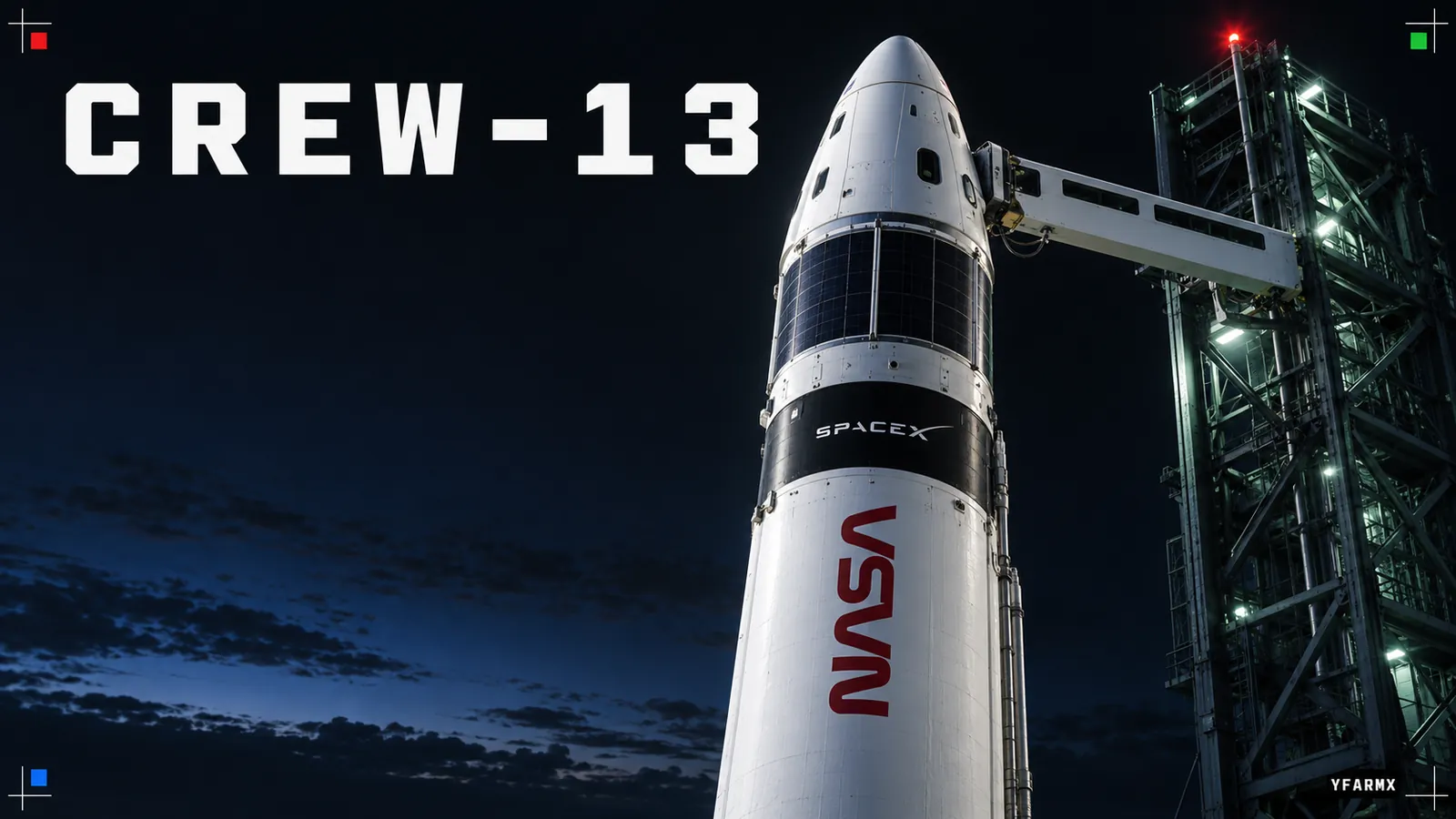
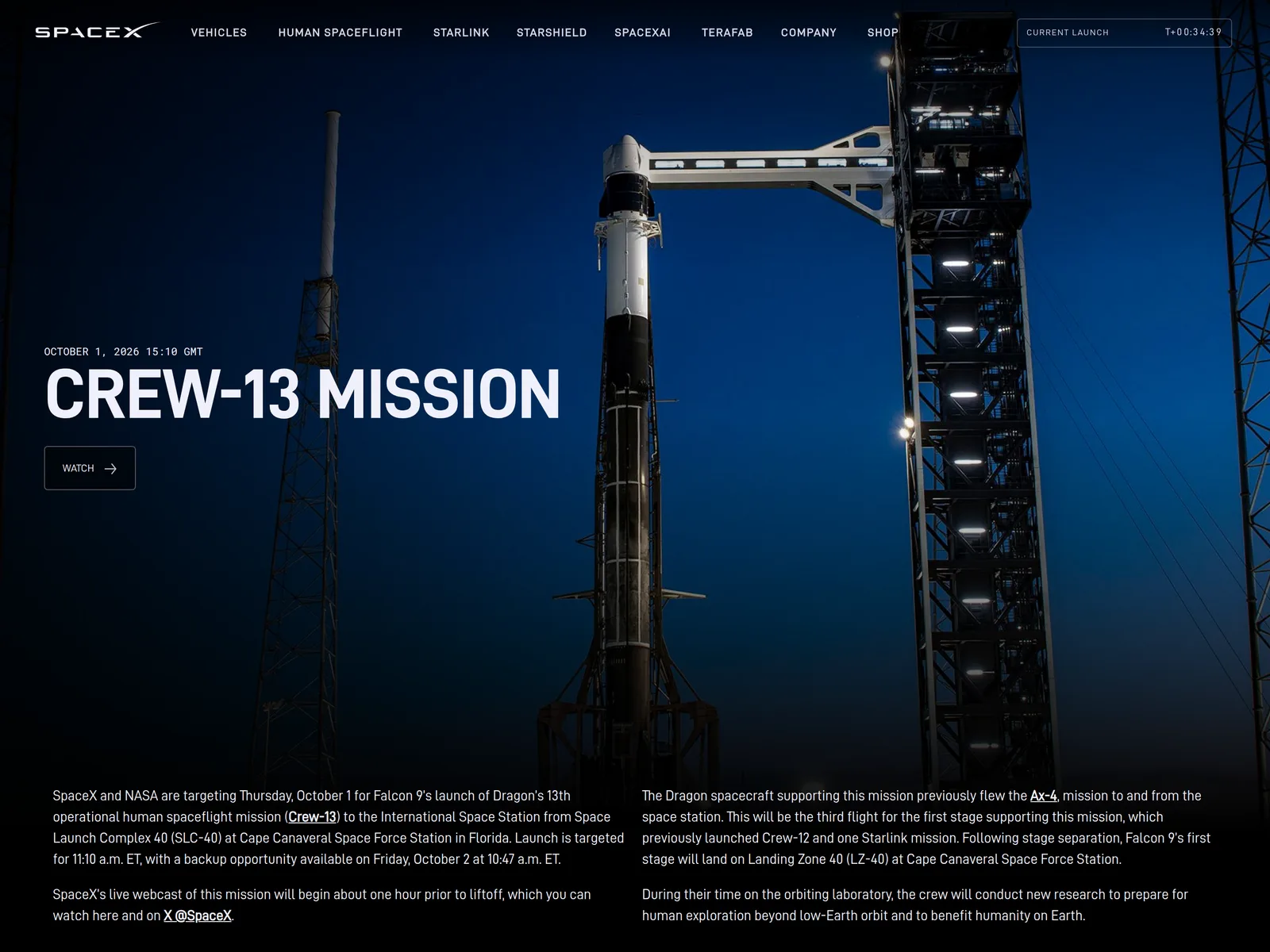
NASA, SpaceX and their international partners polled “go” for Crew-13 at the mission’s Flight Readiness Review at Kennedy Space Center in Florida on Friday 25 September 2026, NASA announced at 15:06 EDT (19:06 UTC). Four crew are targeted to launch to the International Space Station no earlier than 11:10 EDT (15:10 UTC) on Thursday 1 October, on a SpaceX Falcon 9 rocket and Dragon spacecraft from Space Launch Complex 40 at Cape Canaveral Space Force Station.
The review is NASA’s in-depth check of SpaceX’s transportation system, mission operations and support functions, and of the station’s readiness for the incoming crew. The four have been in quarantine at Johnson Space Center in Houston since 17 September, and were due to land at Kennedy at about 13:00 EDT (17:00 UTC) on Saturday 26 September for their final week of preparations.

Who is flying on Crew-13?
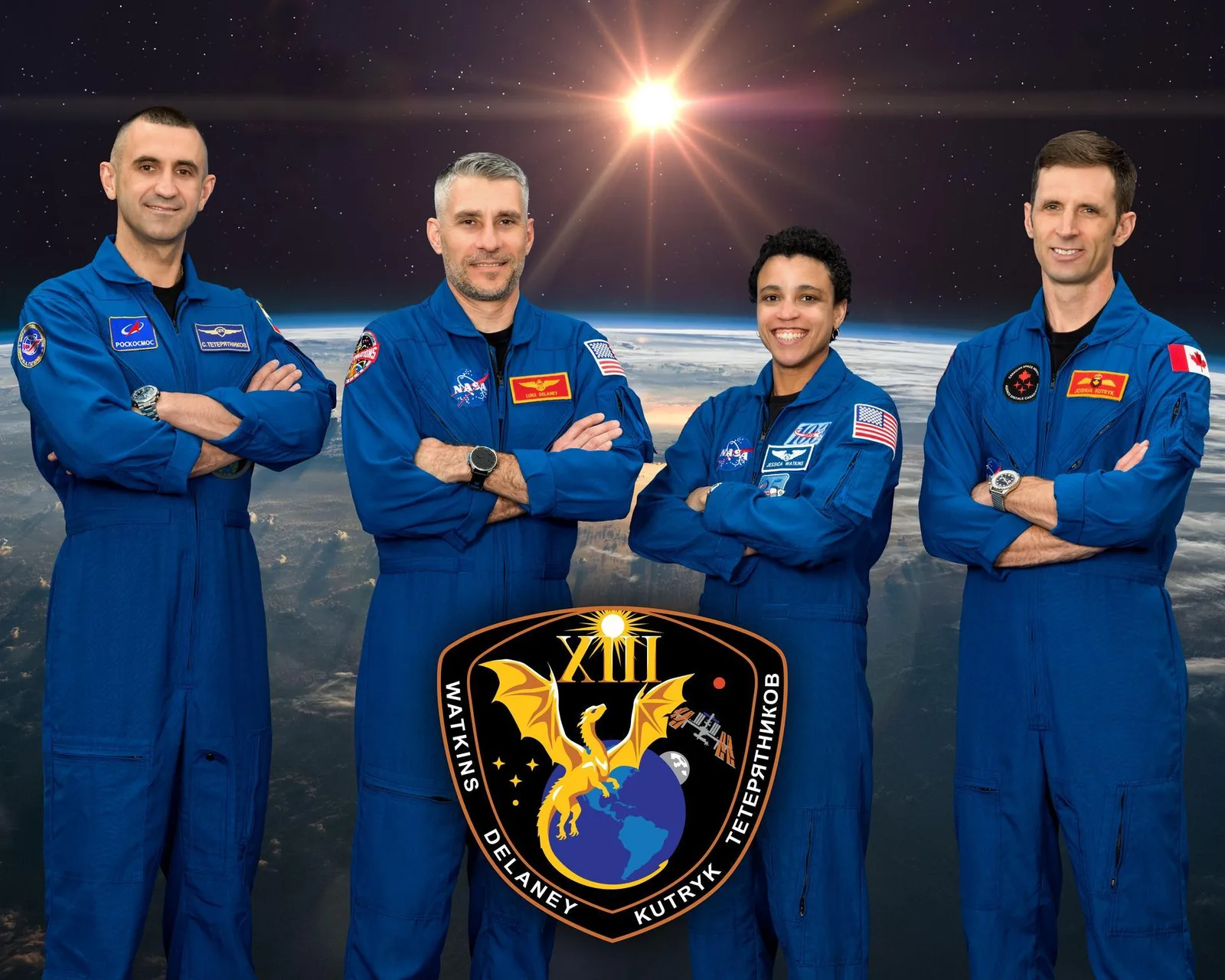
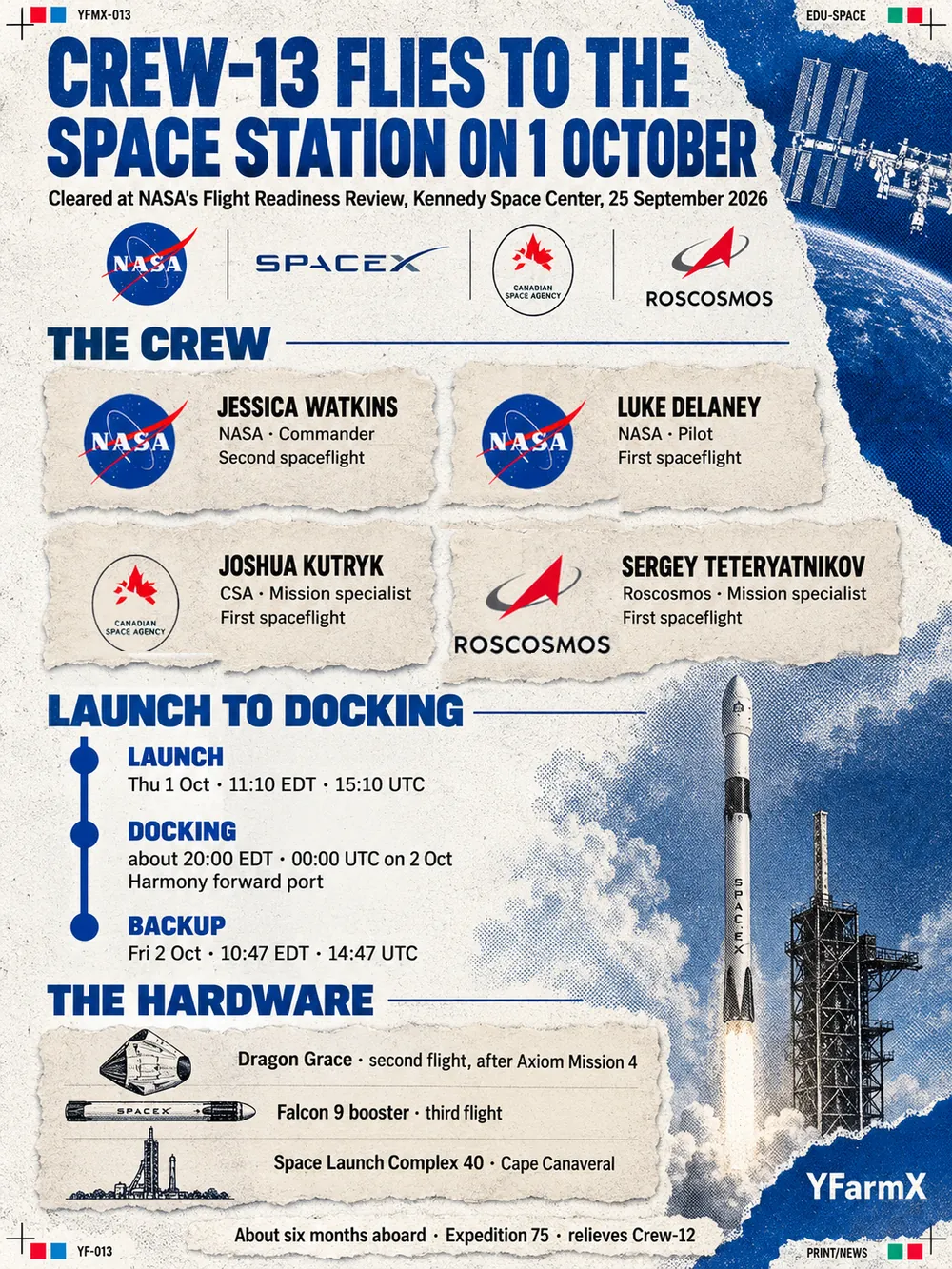
Crew-13 carries four people from three space agencies: NASA astronaut Jessica Watkins as commander, NASA astronaut Luke Delaney as pilot, and Canadian Space Agency astronaut Joshua Kutryk and Roscosmos cosmonaut Sergey Teteryatnikov as mission specialists. Watkins is the only one of the four who has flown before: NASA introduced the other three as first-time space flyers on 3 August.
| Crew member | Agency | Role | Spaceflight record |
|---|---|---|---|
| Jessica Watkins | NASA | Commander | Crew-4, 2022: 170 days in space |
| Luke Delaney | NASA | Pilot | First flight |
| Joshua Kutryk | Canadian Space Agency | Mission specialist | First flight |
| Sergey Teteryatnikov | Roscosmos | Mission specialist | First flight |
Watkins is a geologist who worked on the Curiosity rover science team at NASA’s Jet Propulsion Laboratory, and NASA says she will be the first NASA astronaut to launch aboard a Dragon twice. Delaney is a former naval aviator and test pilot who flew as a research pilot at NASA’s Langley Research Center. Teteryatnikov graduated from the Naval Academy in St Petersburg in 2011 as an engineer in ship power plant operations, and has been a test cosmonaut since 2023.
Kutryk, a Royal Canadian Air Force colonel and former CF-18 fighter pilot, was assigned in 2023 to a long-duration flight on Boeing’s Starliner-1, which later became an uncrewed cargo flight. Crew-13 is the Canadian Space Agency’s first astronaut mission under NASA’s Commercial Crew Program.
When does Crew-13 launch and dock?
Crew-13 is targeted to lift off at 11:10 EDT (15:10 UTC, 16:10 in the UK) on Thursday 1 October 2026 and to dock with the space station less than nine hours later, at about 20:00 EDT. NASA set that timeline on 22 September, with Dragon docking to the forward-facing port of the Harmony module. SpaceX lists a backup opportunity on Friday 2 October.
| Event | Date | EDT | UTC |
|---|---|---|---|
| Flight Readiness Review go announced | Fri 25 Sep | 15:06 | 19:06 |
| Crew arrives at Kennedy | Sat 26 Sep | about 13:00 | about 17:00 |
| Launch | Thu 1 Oct | 11:10 | 15:10 |
| Docking, Harmony forward port | Thu 1 Oct | about 20:00 | about 00:00 on 2 Oct |
| Backup launch opportunity | Fri 2 Oct | 10:47 | 14:47 |
SpaceX’s approximate timeline has the Falcon 9 first stage landing on Landing Zone 40 at Cape Canaveral 7 minutes 41 seconds after liftoff, and Dragon separating from the second stage at 9 minutes 39 seconds.
The Dragon is Grace, on its second flight
The Crew-13 Dragon is Grace, the capsule that carried Axiom Mission 4 to and from the space station in 2025, and this is its second flight. SpaceX gives Ax-4 as the spacecraft’s previous mission, and the Ax-4 crew announced the name Grace right after their launch on 25 June 2025. The Falcon 9 first stage is on its third flight, after launching Crew-12 and one Starlink mission.
Crew-13 is the 13th crew rotation of SpaceX’s human space transportation system, and its 14th flight with astronauts to the station through NASA’s Commercial Crew Program counting the Demo-2 test flight, NASA’s mission page says.
The Crew-13 launch date has already moved in both directions. NASA brought the mission forward from November when it named the crew in April, to increase the frequency of US crew rotations, and by August was targeting no earlier than 12 September. On 29 August NASA moved the launch to deal with an oxidiser leak on Dragon’s propulsion system, found during standard prelaunch processing of the spacecraft. When the crew entered quarantine on 17 September the target was early October, and on 22 September NASA named 1 October.
What will the crew work on in orbit?
Crew-13 joins the station’s Expedition 75 for about six months of research, much of it on how the human body copes with long spaceflight. NASA’s research plan for the mission includes a new blood-clotting study run with the European Space Agency, lunar-landing piloting tests and a vitamin trial against eye changes, and the Canadian Space Agency has its own slate for Kutryk.
| Study | Agency | What it measures |
|---|---|---|
| Venous Haemostasis | NASA with ESA | Blood flow and clotting in weightlessness |
| Manual Piloting | NASA | Lunar-landing skill after months in orbit |
| B-Complex | NASA | Whether daily B vitamins prevent SANS eye changes |
| Zero T2 | NASA | Health of crew who exercise with and without the treadmill |
| Spacecraft Occupant Risk | NASA | Forces on the crew during landing |
| SANSORI-2 | CSA | What causes the vision changes some astronauts get in orbit |
| SPARK | CSA | Why and how astronauts experience anaemia in space |
| C-STARS | CSA | Stress, coping and emotions on long missions |
Venous Haemostasis tracks crew with MRI scans, jugular vein ultrasounds, blood pressure checks and blood draws before, during and after flight. Jason Lytle, one of its principal investigators at NASA’s Johnson Space Center, said: “Irregular and slow blood flow can increase the risk of blood clot formation, a serious health condition.” Zero T2 feeds exercise plans for Artemis and deep-space missions, where a spacecraft may be too small for a treadmill.
Crew-12 heads home after nearly eight months
Crew-13 relieves NASA’s SpaceX Crew-12, four crew due home in October after nearly eight months in space: NASA astronauts Jessica Meir and Jack Hathaway, European Space Agency astronaut Sophie Adenot and Roscosmos cosmonaut Andrey Fedyaev. They launched from the same pad at 05:15 EST (10:15 UTC) on 13 February 2026 and docked to Harmony’s space-facing port at 15:15 EST (20:15 UTC) the next day.
By 25 September the four were packing personal items and cargo into the Dragon that will fly them home, and rehearsed its re-entry procedures with flight controllers. Fedyaev also tested a Roscosmos lower body negative pressure suit, which draws fluids back towards the feet to ease the return to Earth’s gravity. They share the station with NASA astronaut Anil Menon and Roscosmos cosmonauts Pyotr Dubrov and Anna Kikina.
Crew-14 is already named for spring 2027
NASA named Crew-13’s relief on 24 September 2026: Crew-14, with NASA’s Kayla Barron as commander and Chris Birch as pilot, and JAXA astronaut Makoto Suwa and Roscosmos cosmonaut Arutyun Kiviryan as mission specialists, launching no earlier than spring 2027. That matches the Canadian Space Agency’s figure of about six months aboard for Crew-13, and NASA’s mission page lists the Crew-13 landing in 2027.
NASA has committed to operating the station through 2030, with commercial stations lined up to follow it. For Crew-13, the handover is due to begin at about 20:00 EDT on 1 October, when Dragon Grace docks at Harmony’s forward port with Watkins in command.
Questions people ask
- When does Crew-13 launch?
- NASA and SpaceX are targeting 11:10 EDT (15:10 UTC) on Thursday 1 October 2026 for Crew-13, from Space Launch Complex 40 at Cape Canaveral Space Force Station in Florida. The Flight Readiness Review polled go on 25 September 2026, and SpaceX lists a backup opportunity at 10:47 EDT (14:47 UTC) on Friday 2 October.
- Who is flying on Crew-13?
- NASA astronaut Jessica Watkins is the Crew-13 commander and NASA astronaut Luke Delaney is the pilot. Canadian Space Agency astronaut Joshua Kutryk and Roscosmos cosmonaut Sergey Teteryatnikov fly as mission specialists. Watkins spent 170 days in space on Crew-4 in 2022; Crew-13 is the first spaceflight for the other three.
- How long will Crew-13 stay on the space station?
- About six months, according to the Canadian Space Agency, and NASA's mission page lists the landing in 2027. On a 1 October 2026 launch, Crew-13 docks to the Harmony module's forward port at about 20:00 EDT (00:00 UTC on 2 October) and joins Expedition 75. Crew-14, its relief, launches no earlier than spring 2027.
Sources
- NASA: NASA, SpaceX proceed toward Crew-13 launch, 25 September 2026nasa.gov
- NASA: NASA's SpaceX Crew-13 Flight Readiness Review underway, 25 September 2026nasa.gov
- NASA: NASA's SpaceX Crew-13 set for Saturday arrival at NASA Kennedy, 25 September 2026nasa.gov
- NASA: NASA, SpaceX move to final Crew-13 prelaunch prep for 1 October liftoff, 22 September 2026nasa.gov
- NASA: NASA's SpaceX Crew-13 mission pagenasa.gov
- NASA: NASA shares SpaceX Crew-13 assignments for space station mission, 23 April 2026nasa.gov
- NASA: Spacewalk preps, health research on station as NASA introduces SpaceX Crew-13, 3 August 2026nasa.gov
- NASA: NASA, SpaceX adjust Crew-13 launch date, 29 August 2026nasa.gov
- NASA: NASA, SpaceX continue Crew-13 prep as crew enters quarantine, 17 September 2026nasa.gov
- NASA: NASA to study human health, performance during Crew-13 mission, 24 September 2026nasa.gov
- NASA: Station gets ready for SpaceX crew swap during health research, 25 September 2026nasa.gov
- NASA: Crew-12 launches, 13 February 2026nasa.gov
- NASA: SpaceX Crew-12 docks to station beginning long-duration mission, 14 February 2026nasa.gov
- NASA: NASA shares SpaceX Crew-14 assignments for space station mission, 24 September 2026nasa.gov
- NASA: FAQs, the International Space Station transition plannasa.gov
- Canadian Space Agency: Crew-13 missionasc-csa.gc.ca
- Canadian Space Agency: Biography of Joshua Kutrykasc-csa.gc.ca
- Canadian Space Agency: Joshua Kutryk's science activitiesasc-csa.gc.ca
- SpaceX: Crew-13 mission pagespacex.com
- Axiom Space: Ax-4 astronauts name newest member of Dragon fleet, 25 June 2025axiomspace.com