NASA picks a telescope to map where planets are born
NASA selected PRIMA, a far-infrared space telescope with a 1.8-metre mirror, on 23 September 2026 as the first mission in its new Probe Explorers class. If confirmed, its project cost is capped at $1.2 billion, not including launch, with launch targeted for 2033.
Listen to this articleListen
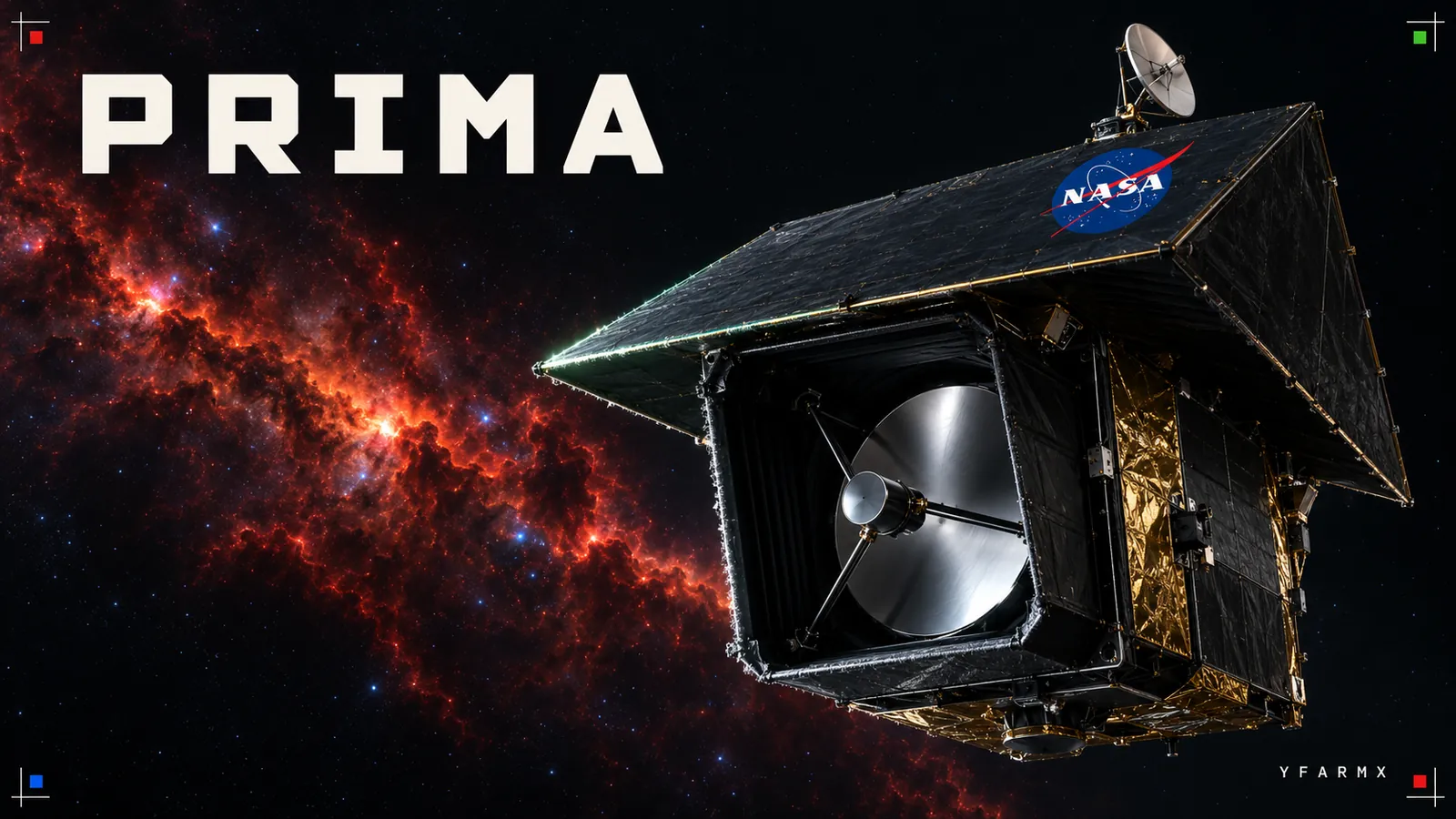
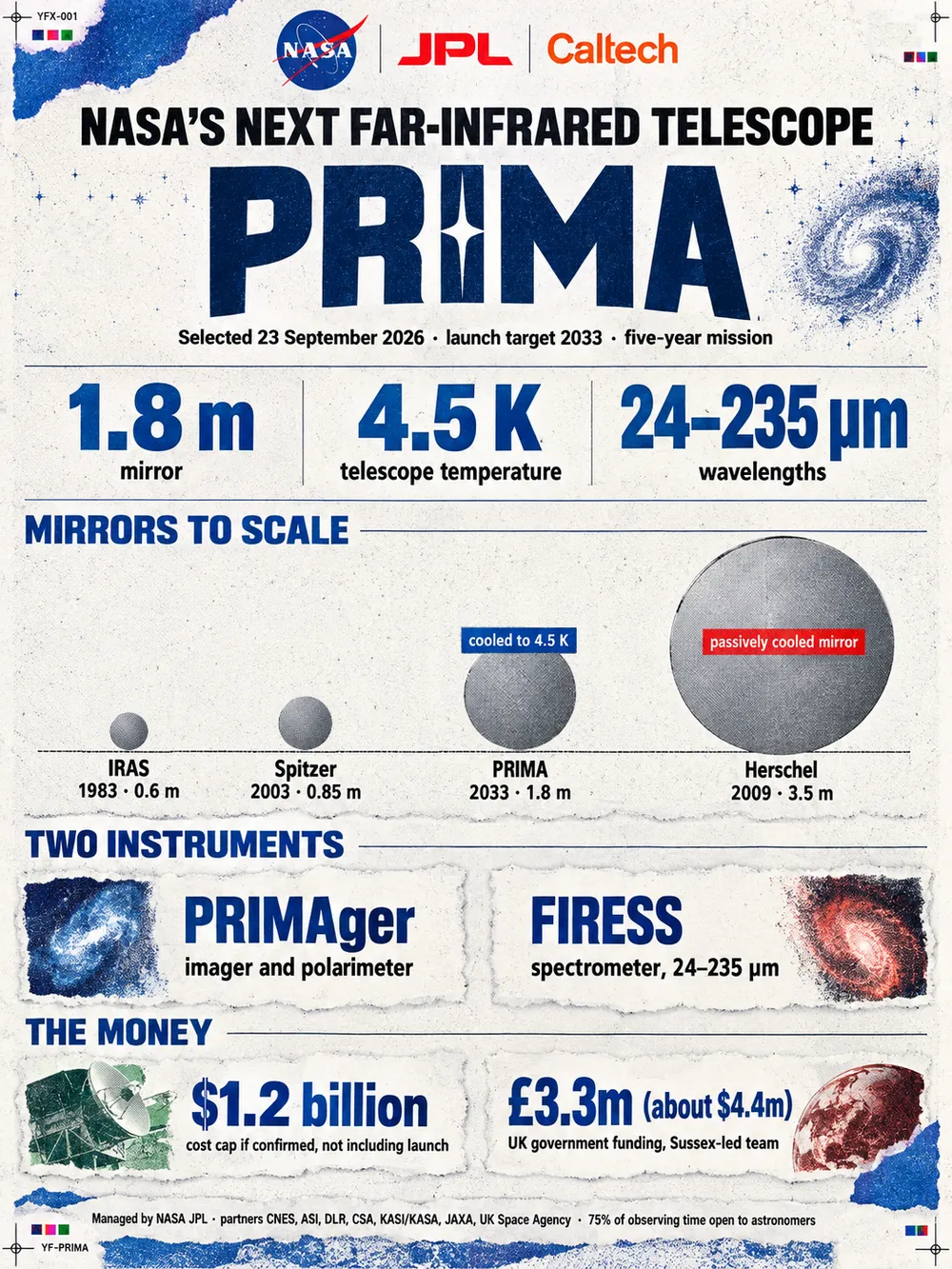
NASA selected PRIMA, the PRobe far-Infrared Mission for Astrophysics, on 23 September 2026 as the first mission in a new class of astrophysics missions called Probe Explorers. The telescope now moves into Phase B, preliminary design, and in its announcement NASA set the budget: “If confirmed, PRIMA’s project cost is capped at $1.2 billion, not including launch and other non-project costs.” Launch is targeted for 2033, for a planned five-year mission.
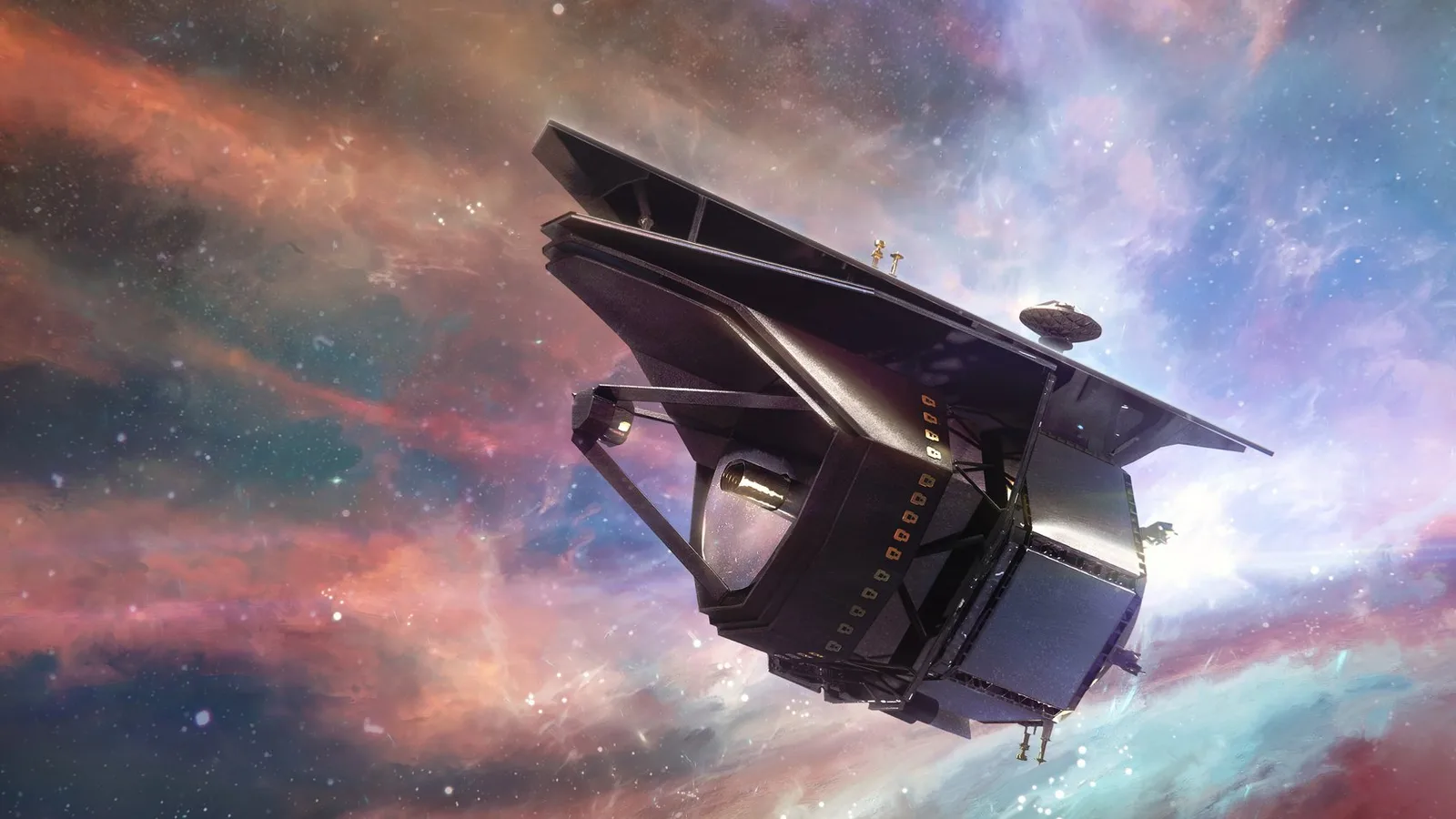
PRIMA is designed around a 1.8-metre aluminium mirror, cooled to 4.5 degrees above absolute zero, feeding two instruments that see light between 24 and 235 micrometres. NASA’s Jet Propulsion Laboratory will manage the mission, with NASA’s Goddard and Marshall centres and partner agencies in seven countries, the UK Space Agency among them. “The PRIMA mission is humanity’s next window into the deep universe,” said Nicky Fox, associate administrator of NASA’s Science Mission Directorate.
What will PRIMA look at?
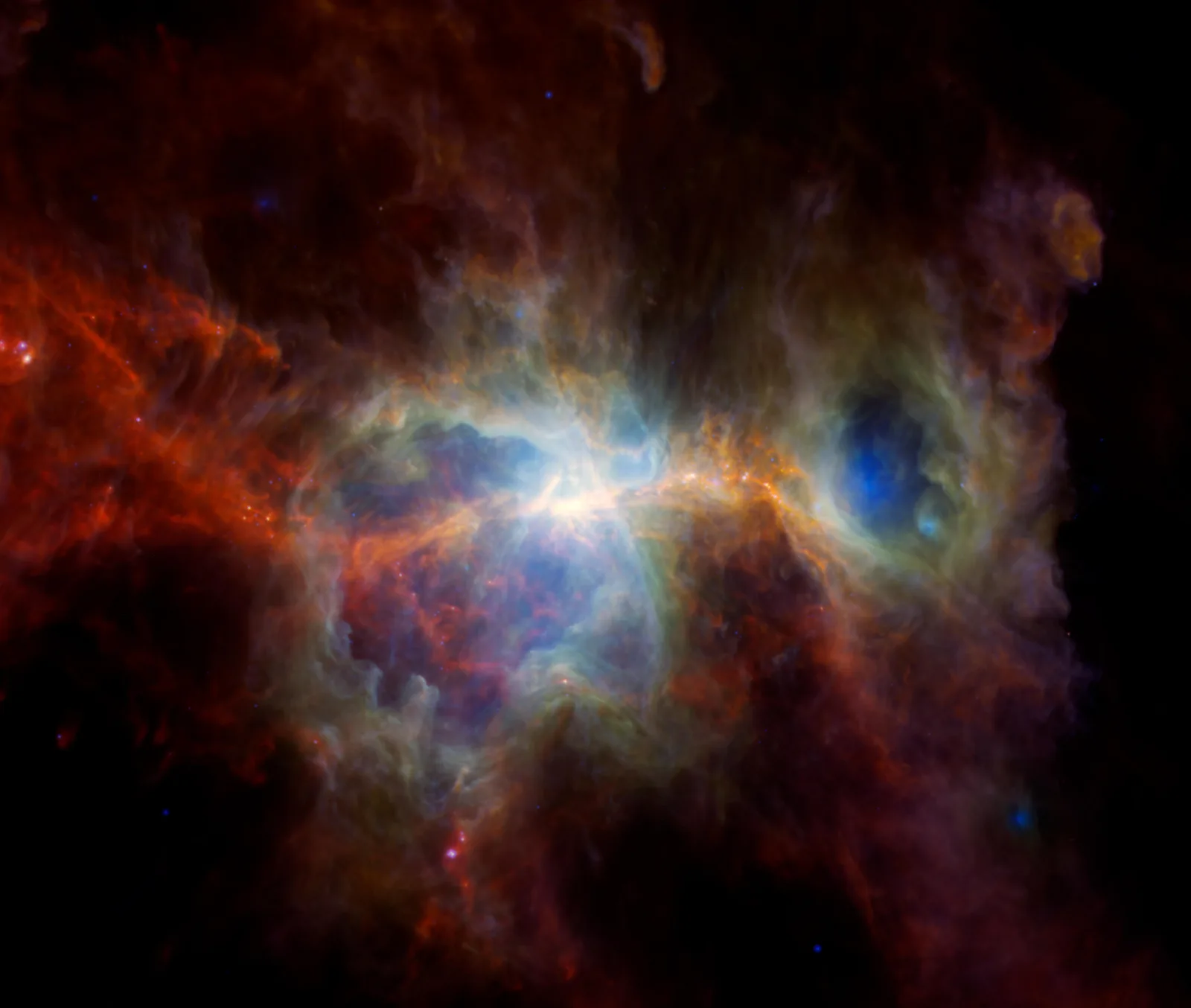
PRIMA will map the cold gas and dust where stars, planets and galaxies form, in far-infrared light between 24 and 235 micrometres. That light has wavelengths a few hundred times longer than visible light, and Earth’s atmosphere absorbs it, so the telescope has to work from space. Dust that hides a newborn star from an optical telescope glows at these wavelengths. The James Webb Space Telescope covers 0.6 to 28.5 micrometres, and NASA describes PRIMA as the bridge between infrared observatories such as Webb and radio telescopes.
PRIMA’s science team has set three core goals:
| Goal | What PRIMA measures |
|---|---|
| How planets form | Water and total gas mass in 200 planet-forming discs, compared with the make-up of exoplanet atmospheres |
| How galaxies and black holes grew | Star formation and black hole growth together, between about 9 billion and 3 billion years ago |
| Where dust and heavy elements came from | How dust and elements such as carbon and oxygen built up in galaxies over cosmic time |
ESA’s Euclid found the most distant quasar yet observed in July 2026, a black hole feeding 670 million years after the Big Bang. PRIMA’s black hole work covers a later era, when galaxies were growing fastest and dust and gas hid much of that growth from optical and X-ray telescopes.
Why does the telescope have to be so cold?
PRIMA’s mirror will be cooled to 4.5 kelvin, and its detectors to 0.1 kelvin, because a warm telescope’s own heat swamps the faint far-infrared glow of cold objects. NASA carried liquid helium on Spitzer for the same reason. Caltech, which manages JPL for NASA, says PRIMA’s cooling makes it “orders of magnitude more sensitive than previous far-infrared space missions”.
Jonas Zmuidzinas, the Caltech physicist who co-invented PRIMA’s detectors, puts the gain at roughly a thousandfold: “In this less-explored wavelength band, the far infrared, we have a chance to leap forward in sensitivity by about a factor of a thousand. That’s very rare.”

The far-infrared telescopes before it traded size against temperature. Spitzer’s telescope was cold and small. Herschel’s mirror was the largest ever flown in space when ESA retired it, and it was passively cooled, with only the instruments sitting in superfluid helium.
| Telescope | Mirror | How it was kept cold | Wavelengths |
|---|---|---|---|
| IRAS, launched 25 January 1983 (NASA, Netherlands, UK) | 60 cm | Cryogen, which ran out after 10 months | 12 to 100 µm |
| Spitzer, launched 25 August 2003 (NASA) | 85 cm | Liquid helium, telescope at about 5 K, until 15 May 2009 | 3 to 180 µm |
| Herschel, launched 14 May 2009 (ESA) | 3.5 m | Mirror passively cooled; instruments at −271 °C until 29 April 2013 | 55 to 670 µm |
| PRIMA, launch target 2033 (NASA) | 1.8 m | Telescope at 4.5 K, detectors at 0.1 K | 24 to 235 µm |
PRIMA carries a camera and a spectrometer
PRIMA has two instruments: PRIMAger, an imager and polarimeter, and FIRESS, the Far-Infrared Enhanced Survey Spectrometer. FIRESS covers the whole 24 to 235 micrometre band at once with four grating spectrometer modules, and a Fourier transform module can switch into the light path for high-resolution spectra. PRIMAger takes hyperspectral images from 25 to 84 micrometres and measures polarised light in four bands from 90 to 235 micrometres, which the team will use to tell dust made by stars from dust grown between them.
Both instruments use kinetic inductance detectors, about 12,000 of them in total, according to the mission site. Zmuidzinas and JPL engineer Rick LeDuc invented the design in 1999, and the detectors were installed and tested in 2007 at the Caltech Submillimeter Observatory on Maunakea in Hawaii. The Max Planck Institute for Astronomy in Heidelberg has proposed two beam-steering mirrors, one for each instrument, to point and steady the field of view, with Germany’s DLR funding its work.
Caltech’s IPAC will run the science centre, receiving, processing and archiving the data and scheduling the telescope, with the data held at its Infrared Science Archive. About 75 per cent of observing time will go to astronomers across the community through peer review, and Caltech says the team has already received nearly 200 ideas for using PRIMA from more than 400 astronomers.
How did PRIMA win the first probe slot?
PRIMA was one of two finalists NASA named on 3 October 2024, and the only one still in the running at the final choice. Each team received $5 million for a 12-month concept study. The other finalist was the Advanced X-ray Imaging Satellite, AXIS, led by Christopher Reynolds of the University of Maryland. The AXIS team submitted its concept study report on 29 January 2026, and NASA disqualified the mission from the competition in March 2026, according to Reynolds’ university page.
PRIMA’s principal investigator is Jason Glenn of NASA’s Goddard Space Flight Center. Between the two announcements NASA raised the cost cap and moved the launch target back a year:
| October 2024 | September 2026 | |
|---|---|---|
| Cost cap | $1 billion per mission, not including the rocket, launch services or contributions | $1.2 billion if confirmed, not including launch and other non-project costs |
| Launch target | 2032 | 2033 |
| Candidates | AXIS and PRIMA | PRIMA |
The National Academies’ 2020 decadal survey, Pathways to Discovery in Astronomy and Astrophysics for the 2020s, recommended the probe class. Caltech places it between Explorer missions such as SPHEREx and flagships such as the Nancy Grace Roman Space Telescope.
Britain puts £3.3 million, about $4.4 million, into PRIMA
The UK government is backing a British PRIMA consortium with £3.3 million, about $4.4 million at the European Central Bank’s reference rates for 25 September 2026 ($1.3252 to the pound). Space Minister Liz Lloyd gave the figure in the University of Sussex’s announcement on 25 September: “It is fantastic that a consortium led by the University of Sussex is developing technology and software critical to the mission, backed by £3.3m in Government funding.”
Seb Oliver, professor of astrophysics at Sussex, leads the UK contribution and is one of PRIMA’s 27 international co-investigators. The consortium also includes Imperial College London and Celtic Terahertz Technologies, and three of its members have set out their parts:
| Institution | Role |
|---|---|
| University of Sussex | Leads the UK team; develops software that sharpens the resolution of PRIMA’s images |
| STFC RAL Space | Leads the UK work on the ground segment that processes and analyses the data, as set out in October 2024 |
| Cardiff University | Optical filters that set the wavelengths reaching both instruments’ detectors, as set out in October 2024 |
The UK Space Agency is one of PRIMA’s partner agencies, alongside France’s CNES, Italy’s ASI, Germany’s DLR, the Canadian Space Agency, South Korea’s KASI and KASA, and Japan’s JAXA. “Sussex has a long history in far-infrared astronomy, and PRIMA builds on a remarkable heritage that includes IRAS, ISO, Spitzer, AKARI and Herschel,” Oliver said. IRAS, the first space telescope to survey the sky in infrared, was itself a joint project of NASA, the Netherlands and the UK.
The next far-infrared telescope is due at L2 in 2033
PRIMA now spends Phase B on preliminary design and technology development, and a confirmation review of its technical, programmatic and cost performance decides whether it is ready to begin Phase C, implementation. It is designed to work from the Sun-Earth L2 point, where Herschel observed, with its telescope able to point at 26 per cent of the sky at any moment.
Herschel’s helium ran out on 29 April 2013. Chris Pearson, astrophysics programme lead at RAL Space, said in 2024 that PRIMA would be “the first mission since Herschel to explore these particular wavelengths”, in a statement published by UKRI, the UK’s research funder. A 2033 launch puts a far-infrared telescope back at L2 twenty years later, with a mirror about half the width of Herschel’s and cooled to 4.5 kelvin. Shawn Domagal-Goldman, director of NASA’s Astrophysics Division, placed it in NASA’s queue of large observatories: “With our Webb and Roman space telescopes, we set a cadence of launching premiere-class missions in both halves of the decade. We’re going to keep that up and kick off the next decade with PRIMA, as part of a pipeline that will consistently have missions of this caliber ready to go.”
Questions people ask
- What is NASA's PRIMA telescope?
- PRIMA, the PRobe far-Infrared Mission for Astrophysics, is a NASA space telescope that will survey the universe in far-infrared light between 24 and 235 micrometres. It carries a 1.8-metre aluminium mirror cooled to 4.5 kelvin and two instruments: PRIMAger, an imager and polarimeter, and FIRESS, a spectrometer. NASA selected it on 23 September 2026 as the first mission in its Probe Explorers class, with launch targeted for 2033.
- How much will PRIMA cost?
- NASA says that if PRIMA passes its confirmation review, its project cost is capped at $1.2 billion, not including launch and other non-project costs. When NASA named PRIMA and the AXIS X-ray telescope as finalists on 3 October 2024, it capped each Probe Explorer at $1 billion, not including the rocket, launch services or contributions.
- What is the UK's role in PRIMA?
- The UK Space Agency is one of PRIMA's international partners, which span seven countries. A UK consortium led by the University of Sussex, with Cardiff University, Imperial College London, STFC RAL Space and Celtic Terahertz Technologies, is developing technology and software for the mission with £3.3 million of government funding, about $4.4 million at the European Central Bank's reference rates of 25 September 2026.
Sources
- NASA: NASA selects far-infrared telescope as first in new mission class, 23 September 2026 (updated 24 September)nasa.gov
- NASA Jet Propulsion Laboratory: NASA selects far-infrared telescope as first in new mission class, 23 September 2026jpl.nasa.gov
- Caltech: NASA selects PRIMA mission; key roles for Caltech, JPL and IPAC, 23 September 2026caltech.edu
- PRIMA mission site (Caltech IPAC): mission overview and instrumentsprima.ipac.caltech.edu
- PRIMA mission site: PRIMA observatory specificationsprima.ipac.caltech.edu
- PRIMA mission site: core science theme 1, planet formationprima.ipac.caltech.edu
- PRIMA mission site: core science theme 2, galaxies and supermassive black holesprima.ipac.caltech.edu
- PRIMA mission site: core science theme 3, dust and heavy elementsprima.ipac.caltech.edu
- PRIMA mission site: community newsletter, Winter 2026 edition, signed by the principal investigatorprima.ipac.caltech.edu
- Max Planck Institute for Astronomy: NASA selects far-infrared telescope PRIMA, with MPIA hardware, 25 September 2026mpia.de
- University of Sussex: Sussex researchers among team selected for landmark NASA mission, 25 September 2026sussex.ac.uk
- UKRI: NASA selects proposal involving UK scientists for further study, October 2024ukri.org
- Cardiff University: Cardiff scientists part of team bidding for $1bn NASA mission, October 2024cardiff.ac.uk
- NASA Science: NASA selects AXIS and PRIMA for Astrophysics Probe Explorers studies, 7 October 2024science.nasa.gov
- Christopher Reynolds, University of Maryland: AXIS principal investigator's page and mission newspages.astro.umd.edu
- ESA: Herschel closes its eyes on the Universe, 29 April 2013esa.int
- Pilbratt et al., Herschel Space Observatory: an ESA facility for far-infrared and submillimetre astronomy, arXiv:1005.5331arxiv.org
- JPL Science: Spitzer Space Telescope project pagescience.jpl.nasa.gov
- NASA Science: Spitzer Space Telescope mission pagescience.nasa.gov
- JPL: Infrared Astronomical Satellite (IRAS) mission pagejpl.nasa.gov
- Caltech IPAC: Celebrating IRAS, NASA's first infrared space telescope, 25 January 2023ipac.caltech.edu
- NASA: James Webb Space Telescope fact sheetwebb.nasa.gov
- NASA JPL: Orion Nebula in infrared (PIA25434), 22 November 2022jpl.nasa.gov
- European Central Bank: euro reference rate for the pound sterlingecb.europa.eu
- European Central Bank: euro reference rate for the US dollarecb.europa.eu