Euclid finds the oldest quasar yet seen, and 30 more behind it
ESA's Euclid telescope has found the most distant quasar yet observed, shining when the Universe was 670 million years old, and 30 more ancient quasars alongside it.
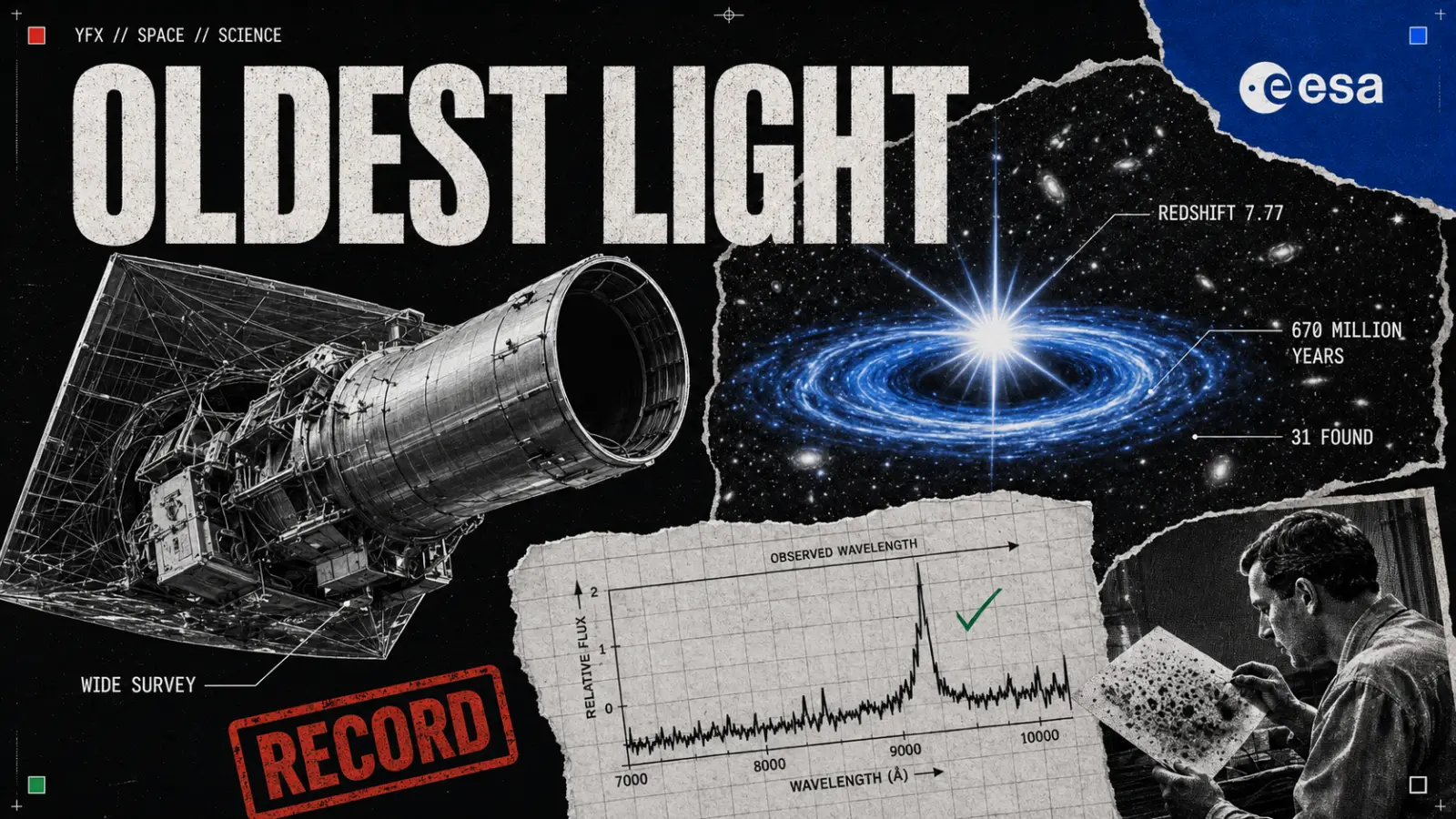
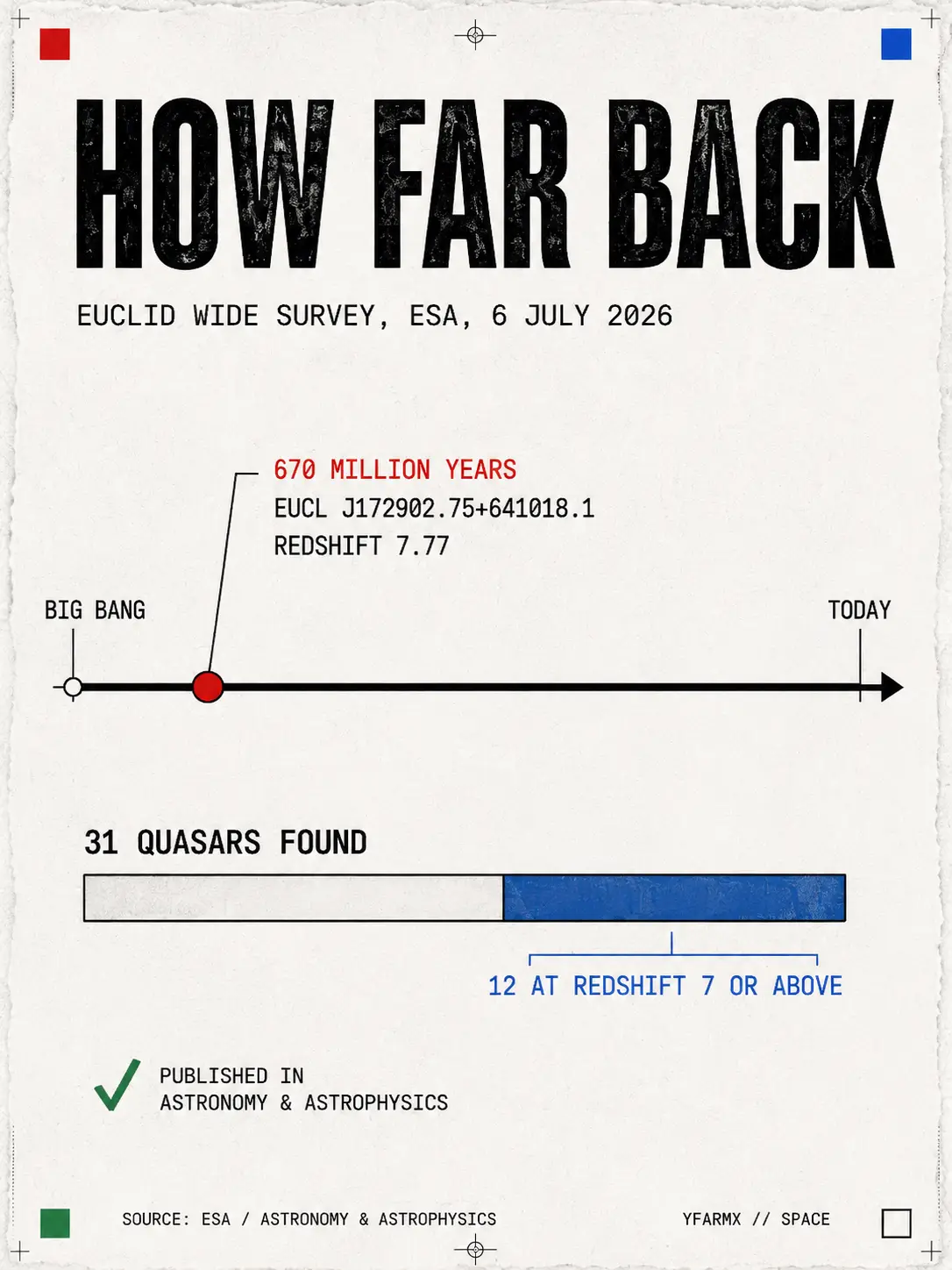
The European Space Agency’s Euclid telescope has found the most distant quasar yet observed. EUCL J172902.75+641018.1 sits at a redshift of 7.77, which places it just over 13 billion light-years away and means the light Euclid caught left it when the Universe was 670 million years old, about 5 per cent of its current age.
A single record-holder is a good headline. The useful number is the other one: Euclid found 31 ancient quasars in the same work, twelve of them at redshift 7 or above. The second oldest, EUCL J125308.55+705432.3, sits at redshift 7.69, close enough to the leader that the two are effectively a pair.
What a quasar is, and why an old one is awkward
A quasar is what a supermassive black hole looks like while it is eating. Gas and dust spiral in, friction and gravity heat the material to millions of degrees, and the result outshines the galaxy around it. ESA describes these two as shining with the light of a trillion Suns.
That is the problem these objects set. A black hole massive enough to power a quasar takes time to assemble, and at 670 million years after the Big Bang there has not been much time. One such object could be an outlier. Thirty-one of them, twelve in the first stretch of cosmic history, is a population, and a population has to be explained rather than excused.
Daming Yang of Leiden University, who led the study, set out the ambition: “By finding and studying them, we can better understand how these enormous systems formed and grew so quickly.”
Why Euclid found them and other telescopes did not
This is a survey result, not a pointing result. Euclid’s job is to image more than a third of the sky, and the objects came out of the Euclid Wide Survey rather than from anyone deciding in advance to look at that patch. A telescope that sees a small field very deeply will miss a rare object unless it happens to be aimed at it. A telescope that sees a wide field with space-based infrared vision will find the rare object because it looked everywhere.
NASA supplied the detectors for Euclid’s Near-Infrared Spectrometer and Photometer, the instrument that does the infrared half of that work.
What is not known
The masses of the black holes powering these quasars are not established by this work, and neither is the mechanism that built them so early. The survey is incomplete: Euclid has covered a fraction of its eventual footprint, so the count of 31 is a floor rather than a total. Whether the two record-holders are genuinely the earliest quasars or simply the earliest Euclid has reached so far is exactly the question the rest of the survey exists to answer.
The findings are published in Astronomy & Astrophysics.