XRP ETF flows: an eight-week streak snaps, then buyers return within days
Watching XRP ETF flows this month has been an education in how quickly a narrative can wobble and re-form.
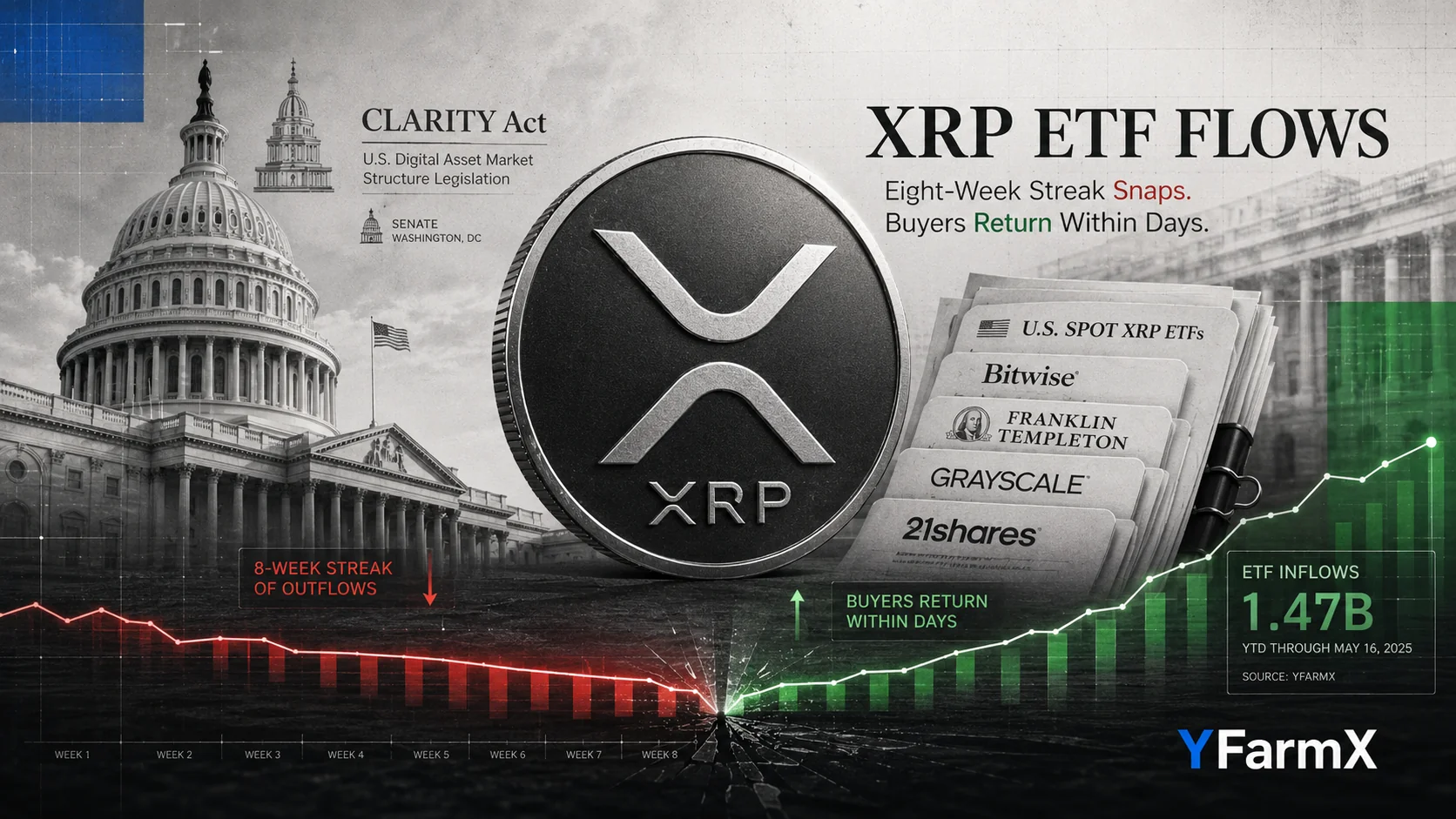
Watching XRP ETF flows this month has been an education in how quickly a narrative can wobble and re-form. US spot XRP funds recorded 7.18 million dollars of net outflows in the week of 6 to 10 July, their first negative week in roughly two months, and did so at precisely the moment bitcoin and ether products ended their own long outflow phases with strong inflows. For five days, XRP was the only major crypto ETF category in the red, an unwanted distinction for an asset whose entire 2026 story has been institutional accumulation through weakness.
The streak that snapped had been genuinely impressive. Spot XRP ETFs had logged eight consecutive positive weeks through late June, lifting cumulative net inflows to about 1.47 billion dollars since the first fund listed in November 2025, with the week of 26 June alone adding around 23 million. Seven products now trade in the US, from Bitwise, Franklin Templeton, Canary Capital, Grayscale and 21Shares among others, and the buying persisted even as the token itself sank toward 1.04 dollars, roughly 70 per cent below its 2025 high of 3.65.
Then, almost as quickly, the picture turned again. On 16 July, XRP ETF flows swung to their strongest day of the month, 6.78 million dollars of net inflows led by Bitwise’s fund at 4.41 million and Franklin’s XRPZ at 2.38 million, according to SoSoValue data, with total assets across the category climbing back toward one billion dollars. One bad week, it turns out, was rotation rather than capitulation.
The push and pull maps neatly onto Washington. XRP has become the market’s purest legislative trade: the CLARITY Act would finally entomb the security-or-commodity question that shadowed the token through nearly five years of litigation between Ripple and the SEC. Each twist in the Senate calendar moves the odds, and the odds move the flows. Polymarket pricing on 2026 passage sliding into the low 40s did XRP no favours in early July; the Federal Hall hearing and talk of a floor vote in the week of 20 July appear to have coaxed buyers back. Assets that trade on cloture maths are a novelty even by crypto’s standards.
The honest caveats belong on the record. Weekly flows in single-digit millions are small against the category’s 1.47 billion cumulative total, and smaller still against bitcoin’s complex, where one fund can move a quarter of a billion in a session. Divergence between trackers is routine at this scale. And the underlying token remains in a downtrend that July’s historically friendly seasonality, an average return near ten per cent for the month, has yet to reverse.
What the episode establishes is that the XRP ETF investor base is real, price-insensitive to a degree that borders on devotional, and highly responsive to legislative headlines. If the Senate delivers before the August recess, the flow data suggests a coiled spring. If it does not, eight-week streaks can be rebuilt, but 2030, the date Senator Lummis warns the next window may open, is a long time to average in. Issuer materials are available from Franklin Templeton, Bitwise and Grayscale; the litigation history is archived at the SEC.
One statistical quirk deserves unpacking, because it confuses even seasoned observers: cumulative net inflows of 1.47 billion dollars sit alongside total assets of only about one billion. The gap is the drawdown. Investors have genuinely wired in 1.47 billion dollars of net new money since November, but the tokens that money bought have fallen far enough that the pile is worth less than what was paid for it. Flows measure conviction; assets measure outcome. That the conviction number keeps growing while the outcome number shrinks is either the most bullish datapoint in the XRP story or a monument to sunk-cost accounting, and the Senate will shortly help decide which.
Sources
- Bitwisebitwiseinvestments.com
- Franklin Templetonfranklintempleton.com
- Grayscalegrayscale.com
- SECsec.gov